Executive summary
Capable leaders often repeat behaviours they know are costly: the short fuse, the postponed conversation, the decision that will not come. Senior roles bring better lives but worse days, and many leaders believe that admitting a struggle would cost them. The consequences reach the organisation: decisions slow, bad news travels less freely and colleagues learn to manage around the leader.
Our research links performance to the behaviours that pressure undermines. In Leadership Alpha, confronting reality and candour over charisma were among the behaviours most associated with outperformance. In Challenging Teams, the ability to surface and address disagreement had the strongest link with financial performance.
Coaching helps leaders decide what to do differently. Therapy helps them understand why the pattern persists. Drawing on five composite cases, this paper argues for making confidential therapy a normal part of senior leadership support, offered through the organisation so that it gives permission, reaches people earlier and stays confidential. The organisation receives the benefit, not the information.
Start by making it standard rather than remedial. Put confidentiality in writing, choose therapists who understand organisations and have senior leaders go first. Measure take-up and results in aggregate, and fix what is fixable in the organisation itself.
In this paper
- Better lives, worse days
- The job has got harder
- Holding it together
- The behaviours that cost the most
- Why coaching is not always enough
- Three leaders who said it themselves
- Five leaders you may recognise
- The indispensable operator
- The first-time chief executive
- The loyal lieutenant
- The marathon runner
- The founder who could not be told
- Why through the organisation, not privately
- What good provision looks like
- Questions for leaders
- Under pressure
- Sources and further reading
The short fuse in the executive meeting. The difficult conversation postponed for a third quarter. The need to check every number personally. The inability to stop working at eleven o’clock at night. Leaders usually know these behaviours are costing them. Many have received the same feedback for years. Knowing has not been enough.
Organisations tend to respond with another development plan often incorporating executive coaching. Sometimes that is exactly what is needed. Sometimes the work needs to go deeper.
Coaching is very good at helping people decide what to do differently on Monday. Therapy is good at a different question: why Monday keeps turning out the same way. Both have a place. Organisations have embraced the first and remain oddly coy about the second.
We have become comfortable investing in almost every part of a leader’s performance except the one doing most of the work: the mind that makes the decisions, absorbs the pressure and sets the emotional temperature for everyone else.
When capable leaders repeat behaviours they know are costly, the task is to understand what keeps the pattern in place. The consequences of not doing so reach beyond the individual: decisions slow, bad news travels less freely and colleagues learn to manage around the person who is supposed to lead them.
This is the case for making confidential therapy a normal option within senior leadership support. Leaders deserve help and the way a leader handles pressure shapes the conditions in which everyone else works.
The offer should be voluntary, clinically independent and available before a crisis.
Coaching changes what leaders do. Therapy changes why they keep doing it.
In this article we set out what the evidence says about the pressures on senior leaders, connect those pressures to the leadership behaviours our own research links to performance, and describe five leaders—composites drawn from our practice—whom many executives will recognise. We then make the case that therapy is most valuable when it is provided by the organisation as a normal part of senior leadership, rather than sought privately once something has already broken.
Better lives, worse days
Senior roles bring autonomy, status, interesting problems and, usually, financial security. None of these confers immunity from distress. It is quite possible to value the job and be damaged by the way one is living it.
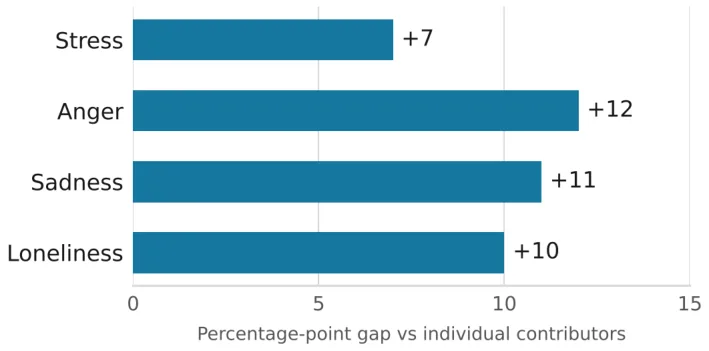
Gallup’s analysis of its 2025 global survey illustrates the tension. Leaders, defined as managers of managers, reported stronger engagement and better overall life evaluations than individual contributors but worse days. They were more likely to experience stress, anger, sadness and loneliness on any given day.[1] Figure 1 shows the gaps.
Figure 1 Senior leaders report harder days
The difficulty is compounded by what leaders believe disclosure will cost them. In Businessolver’s 2024 survey of US workers, HR leaders and chief executives, 55% of CEOs reported experiencing a mental health issue in the previous year, a 24-point increase on 2023. In the same study, 81% of CEOs agreed that companies view someone with mental health issues as “weak or a burden”.[2]
That second number deserves a moment. The people most able to change how organisations treat psychological strain believe that admitting to it would diminish them. It is a reasonable belief in many cultures. It is also a very effective way of ensuring problems are addressed late.
Loneliness compounds the difficulty. In RHR International’s survey of chief executives, half reported feeling lonely in the role, and 61% of those believed it hindered their performance.[3] The more senior the role, the fewer people there are with whom a leader can think aloud about their own doubts. Direct reports have an interest in the answer. The board is, in a sense, the examiner.
The cost is not confined to the individual. Deloitte and Workplace Intelligence found that nearly 70% of C-suite executives were seriously considering leaving for a role that better supported their wellbeing—a higher proportion than the 57% of employees who said the same.[4] Few organisations would tolerate a 70% flight risk in any other critical asset without a plan.
None of this means senior roles should be pressure-free. In Leadership Alpha we noted that senior executives frequently report feeling overwhelmed and highly satisfied at the same time, and that diamonds are formed under pressure.[5] We stand by that. But pressure is not the problem. Unprocessed pressure is.
The job has got harder
Some of this is the ordinary weight of seniority. Some of it is new. The demands on senior leaders over the past decade have not simply multiplied; they have changed character. Economic shocks, geopolitical volatility and a news cycle that never closes have shifted the executive’s task from solving problems to holding uncertainties. And uncertainty, as the neuroscientist Lisa Feldman Barrett has shown, is more unpleasant to the human nervous system than assured bad news, because it cannot be prepared for.[19]
Artificial intelligence is the sharpest current example. Boards expect visible results; the technology moves faster than any individual can master; there is no settled playbook; and the personal exposure is considerable. In Microsoft’s 2024 Work Trend Index, 79% of leaders agreed their company needed to adopt AI to stay competitive, while 60% worried their own leadership lacked a plan to do so and 59% worried about quantifying the gains.[20] A 2025 survey of chief executives by Dataiku reported that nearly three-quarters feared for their jobs within two years if they could not show measurable results from AI.[21] Whether or not that fear is well-founded, it is the kind of pressure that does not respond to working harder—which is precisely the kind that drives the patterns described below.
Holding it together
The most worrying leaders are rarely the ones who are visibly struggling. They are the ones who are performing.
Alyson Meister and colleagues at IMD have studied people who function at a high level while privately unable to sleep or concentrate—“holding it together on the outside” while “screaming inside”. Their 2025 paper describes this state as reaching point break.[6] Anyone who has worked with senior teams will recognise it. The diary is full, the presentation is polished and the leader is running on reserves that are not being replenished.
Meister’s earlier work, with Maude Lavanchy, drew on sports science to explain why expertise offers little protection. Under stress, conscious self-monitoring can override the automatic, well-practised behaviours that made someone excellent in the first place. Experts choke too. Recovery, they argue, matters as much as execution. [7]
In 2019 the World Health Organization recognised burn-out in its International Classification of Diseases as an occupational phenomenon with three dimensions: exhaustion, increased mental distance or cynicism, and reduced professional efficacy.[8] The third dimension is the one boards should worry about. A tired leader still turns up. A leader with reduced efficacy makes worse decisions while appearing to function normally.
Deloitte estimates that poor mental health costs UK employers £51 billion a year. The largest single component, around £24 billion, is presenteeism: people working while unwell and performing below their capability. In its 2024 survey, 63% of respondents reported at least one characteristic of burnout, up from 51% in 2021.[9]
Presenteeism is usually discussed as a workforce issue. We would argue it is most expensive at the top. When a frontline colleague is struggling, their own output falls. When a chief executive is struggling, the effect travels through every decision, meeting and relationship they touch. Gallup attributes 70% of the variance in team engagement to the manager or team leader alone.[10] Leaders’ moods are contagious, whether or not they intend them to be.
Presenteeism is most expensive at the top.
The behaviours that cost the most
Our research on senior teams has focused on performance rather than wellbeing. Yet when we look at the leadership behaviours most closely associated with outperformance, a striking number depend on psychological steadiness.
In Leadership Alpha, we analysed how leaders in 137 companies were rated against 50 leadership traits and related those ratings to economic performance.[5] Several of the ten behaviours that emerged are, at heart, about managing oneself under pressure:
• Confront reality. Seeing the business as it is requires tolerating the anxiety of bad news rather than defending against it.
• Productive paranoia. A little fear sharpens performance; too much degrades it. Where a leader sits on that curve is partly a matter of temperament and history.
• Be as good at exiting people as attracting them. We have never met a leader who did not wish they had acted sooner on an underperformer. We attributed the delay partly to cognitive dissonance and the fear of difficult conversations.
• Candour over charisma. Direct, repeated communication is uncomfortable for leaders whose sense of worth depends on being liked.
• Work hard, don’t be hard work. Leaders who are hard work struggle to accept critical feedback, overestimate their contribution and blame others for failure.
In Challenging Teams, our study of 408 senior teams found that the ability to surface and productively address disagreement had the strongest link with financial performance. We also observed that the real obstacle to repairing ruptures in a team is rarely technique. It is ego. [11]
Similarly, in our strategy+business article on executive hubris, Jonathan Mackey and I argued that excessive CEO confidence is best countered by a culture of critical thinking and humility.[12] Humility is hard to instruct. It is considerably easier for a leader whose self-esteem does not rest on being right.
There is a further complication. Tasha Eurich’s research suggests that while about 95% of people believe they are self-aware, only 10–15% meet the criteria when rigorously assessed. Seniority makes this worse: the more powerful the leader, the less likely they are to receive honest corrective feedback.[13] The people who most need an accurate mirror are surrounded by colleagues with good reasons to polish it.
Figure 2 summarises what we see in practice. The behaviour above the line is visible to everyone. The pattern beneath it is usually visible to no one, including the leader.
Figure 2 Above the line and below it
| What colleagues see | What it often protects against | What it costs the organisation |
|---|---|---|
| Sudden anger when challenged | A sense that status or control is under threat | People stop bringing bad news early |
| Postponing a difficult people decision | Guilt, loyalty or a need to be liked | Underperformance is tolerated and good people notice |
| Checking everything personally | Fear of failure and of being found out | Decisions queue at the top; capable people disengage |
| Working all hours, never switching off | Self-worth tied to output | Exhaustion, narrowed judgement, eventual departure |
| Certainty and impatience with doubt | Fragile confidence that cannot afford to be wrong | Errors go unchallenged until they are expensive |
| Withdrawal and isolation | Shame about struggling | Major decisions made without counsel |
Source: Accelerating Performance Consulting. Illustrative patterns drawn from our coaching and therapy practice; not a diagnostic tool.
Why coaching is not always enough
As both a Master Certified Coach and a psychotherapist I am an enthusiastic advocate of coaching. But coaching has a boundary, and good coaches know where it is.
The boundary usually announces itself through repetition. The same development goal appears on the plan for the third year. The leader agrees the new behaviour sincerely, practises it for a fortnight and then, under pressure, reverts. In Leadership Alpha we suggested leaders ask themselves which feedback keeps surfacing that they keep ignoring.[5] When the same feedback appears in three consecutive 360-degree reviews, it is not a feedback problem.
At that point the useful question is no longer “what will you do differently?” It is “what does the old behaviour do for you?” Most persistent behaviours once served a purpose. Hypervigilance was useful in a chaotic household. Relentless achievement earned approval. Avoiding conflict kept the peace. These strategies are not failures; they are often the reason the person succeeded. They simply stop working at a certain altitude.
Figure 3 Coaching and therapy: complementary, not interchangeable
| Executive coaching | Corporate therapy | |
|---|---|---|
| Central question | What will you do differently? | Why does the pattern persist? |
| Time frame | Present and future | Present, informed by the past |
| Typical focus | Goals, skills, stakeholders, transitions | Anxiety, stress, confidence, reactions, relationships |
| Works best when | The leader can act on insight | Insight alone has not changed behaviour |
| Practitioner | Accredited coach | Registered psychotherapist with organisational experience |
Source: Accelerating Performance Consulting.
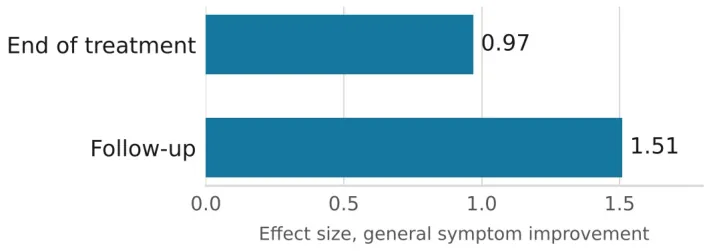
Therapy works on that deeper layer. And there is substantial clinical evidence for it. Jonathan Shedler’s review of the evidence on psychodynamic therapy, published in American Psychologist, reported effect sizes as large as those for other evidence-based treatments. More unusually, the benefits tended to continue growing after therapy ended. In one meta-analysis he cites, the effect size for general symptom improvement rose from 0.97 at the end of short-term psychodynamic treatment to 1.51 at follow-up.[14]
That finding matters for organisations. Most development spending decays: skills taught on a programme fade if they are not used. Change that alters how a person relates to pressure appears to keep paying out.
Figure 4 The benefits kept growing after therapy ended
The evidence also suggests that therapy is most useful when it takes work seriously. A Dutch randomised trial compared standard cognitive-behavioural therapy with a version that integrated work issues from the start, for employees on sick leave with common mental health problems. Both groups improved similarly in symptoms, but the work-focused group returned to work fully 65 days earlier.[15] Therapy that understands the workplace produces benefits the workplace can see.
IN PUBLIC
Three leaders who said it themselves
António Horta-Osório took leave from Lloyds Banking Group in November 2011, weeks into the task of restoring the bank after the financial crisis —“the most high-profile sick leave in the City”, as the Evening Standard put it. He returned the following month and later described the turnaround as having “almost shattered” his mental health. With the psychiatrist Dr Stephen Pereira he developed a resilience programme that some 200 Lloyds executives went on to complete, and he oversaw the training of thousands of mental-health first-aiders across the bank.[22] A leader who got help, and then made the organisation provide it.
Jacinda Ardern resigned as Prime Minister of New Zealand in January 2023 with a sentence most executives will recognise: “I know what this job takes and I know that I no longer have enough in the tank to do it justice.”[23] She named the problem and left. The argument of this article is that organisations should catch it earlier.
Arianna Huffington collapsed from exhaustion in 2007, two years after founding the Huffington Post, and broke her cheekbone in the fall. Her own account of what she learned about sleep, pace and recovery became the book Thrive and, later, the company Thrive Global.[24]
Five leaders you may recognise
The following cases are composites. Each draws on patterns we have encountered repeatedly in our practice; names, sectors and identifying details have been changed, and no individual client is described. We include them because executives rarely recognise themselves in statistics. They often recognise themselves in stories.
CASE 1
The indispensable operator
Daniel ran the Americas for a European services group. He flew between London and New York most weeks, ran at five each morning and answered email in the air. The business valued him enormously. His team was quietly terrified of him.
Under pressure Daniel became controlling and, when he felt his judgement was questioned, explosive. Each outburst was followed by remorse and a resolution not to repeat it. His 360 said the same thing three years running. He was passed over for a group role, and told why.
In therapy he connected his need to be first at everything with a childhood in which love felt conditional on achievement. That insight did not make him less ambitious. It made him less frightened. Over three months the outbursts stopped. He began delegating the work he had always insisted on owning, and his team started bringing problems to him early. Eighteen months later he got the group role.
What changed for the organisation: a high performer retained and promoted, and a team that stopped managing around its leader.
CASE 2
The first-time chief executive
Anna was promoted from CFO to CEO of a private equity–backed business with an ambitious value creation plan. She had never failed at anything. She was now quietly certain that she would.
She over-prepared for every board meeting, rewrote her team’s papers late at night and found it increasingly hard to decide. Nobody noticed except her husband, who noticed that she had stopped sleeping. She would never have sought therapy privately; she regarded it as something for people who were not coping.
The company offered therapy to its new leadership team as part of the transition. Anna treated it, at first, as another workstream. Gradually she began to separate her worth from her results and to tolerate the possibility of being wrong in front of others. Her decisions became quicker, not because she cared less but because each one no longer felt like a verdict on her.
What changed for the organisation: a CEO who could lead rather than audit, and a board that gained a more candid partner.
CASE 3
The loyal lieutenant
Mark led a division and had known one of his direct reports for twenty years. Everyone, including Mark, knew the colleague was no longer right for the role. For eighteen months Mark found reasons to wait: the timing, the market, the risk of disruption.
In therapy he discovered that the issue was not the colleague. Mark had watched his father lose his job abruptly in his teens, and had promised himself he would never do that to anyone. Removing someone felt less like a business decision than a betrayal of that promise.
Understanding the source did not make the conversation easy. It made it possible. Mark acted within six weeks, and did so with considerable care, which he now realised he was capable of. The rest of his team, who had been watching, noticed.
What changed for the organisation: a long-standing performance problem resolved, and a leader more able to make the difficult calls the role demands.
CASE 4
The marathon runner
Claire was general counsel of a listed company that had spent two years in near-permanent crisis: a regulatory investigation, a contested bid and a restructuring. She was outstanding throughout. Her mantra was “I just need to keep going.”
Her chief executive noticed small changes before she did: a shorter temper, a new rigidity, a reluctance to take leave. When he suggested she might use the therapy the company offered its executive committee, she was offended. Then she was relieved.
Therapy gave Claire somewhere to put two years of unprocessed strain. She learned to recognise her early warning signs and to rest before she was exhausted rather than after. She had been privately drafting her resignation. She did not send it.
What changed for the organisation: an irreplaceable leader retained through a critical period, and an executive committee that began to talk more openly about pace.
CASE 5
The founder who could not be told
Tom founded a technology business and took it through a private equity transaction. The new board wanted challenge at the top table. Tom heard challenge as disloyalty. Two senior hires left within a year, each citing the founder.
The operating partner suggested a coach. The coach, to her credit, suggested a therapist. Tom’s early life had taught him that being wrong was dangerous, and his considerable success had rarely required him to revisit that lesson.
Therapy did not make Tom a different person. It gave him a pause between hearing disagreement and reacting to it, and the capacity to repair a relationship after a rupture rather than end it. His team stabilised. The board’s confidence in him, which had been wavering, recovered.
What changed for the organisation: founder energy retained without founder fragility, and a value creation plan back on track.
Two features unite these cases. Each leader was valuable and visibly successful. And in each case the behaviour holding them back had resisted good advice, good feedback and good intentions. What changed it was understanding where it came from.
Why through the organisation, not privately
An obvious objection is that therapy is personal. Why should an employer be involved at all? Surely leaders who want therapy can arrange it themselves.
Some do. But in our experience private arrangement produces three predictable problems. Leaders seek help too late, often in crisis. They choose therapists who may have little understanding of the pressures of senior organisational life. And because the arrangement is secret, it reinforces the very belief—that struggling is shameful—that kept them from seeking help sooner. Provision through the organisation addresses each of these.
It gives permission. When an organisation offers therapy to its senior leaders as routinely as it offers coaching, it changes the meaning of accepting it. It becomes a sign of investment rather than of fragility. Given that four in five CEOs believe companies regard mental health difficulties as weakness, this is not a trivial shift.[2]
It brings people in earlier. Offered routinely, therapy reaches leaders at the pressure point rather than the breaking point. This matters because generic provision often fails senior people. Many organisations already fund an employee assistance programme, yet utilisation is low: in one UK survey, nearly 85% of employers reported EAP use of just 3–5%.[16] Senior leaders in particular rarely see a helpline as designed for them, and worry about who might find out.
It brings organisational understanding. Corporate therapists who have worked at senior levels understand board dynamics, value creation plans, restructurings and the particular loneliness of the top job. They work with the individual while understanding the system around them, and they can connect insight to the decisions the leader faces this week.
It stays confidential. The organisation provides the time and funds the work. It does not receive reports on what is discussed. In our service there is no reporting back to the organisation; the only exceptions are the rare circumstances, common to all therapy, where there is a risk of immediate harm, and even then the client would be consulted first.[17] The organisation receives the benefit, not the information.
The organisation receives the benefit, not the information.
It pays back. Deloitte’s review of published studies found that employers recoup on average around £4.70 for every £1 invested in supporting employee mental health, through higher productivity and lower absence and turnover.[9] Those are workforce-wide figures. We would expect the leverage to be greater where the individual’s decisions affect thousands of people, though we know of no study that measures it directly for executives.
It cascades. Deloitte and Workplace Intelligence found that 72% of employees whose executives are transparent about their own wellbeing report above-average wellbeing themselves, compared with 57% of employees whose executives are not.[4] A leader who looks after their own mind gives everyone else permission to do the same.
There is one caveat we would insist on. Therapy for leaders is not a substitute for fixing an unreasonable organisation. In Silo Logic we warned against asking people to absorb contradictions that the organisation has created.[18] If the workload is impossible, the targets contradictory or the culture punitive, the answer is to change those things. Therapy can help a leader see the problem clearly and act on it. It should never be used to help them tolerate it indefinitely.
What good provision looks like
For chairs, chief executives, HR directors and private equity operating partners considering how to offer therapy to senior leaders, we would suggest the following.
• Make it standard, not remedial. Offer therapy to the top team as part of the senior leadership package, alongside coaching, rather than as a referral for people who are visibly struggling. Referral marks people; availability does not.
• Put confidentiality in writing. State clearly that no clinical information is reported to the organisation and that participation has no bearing on performance management. Then honour it, visibly.
• Choose therapists who know organisations. Look for registered psychotherapists (with UKCP or BACP, for example) who have also worked at senior levels in business.
• Give it a structure. We typically work in weekly one-hour sessions over three months. A consistent rhythm creates the safe space in which deeper work becomes possible.
• Go first. If the chief executive uses the service, or simply speaks positively about it, uptake follows. If the most senior person treats it as something for others, so will everyone else.
• Use workshops to normalise it. Therapist-led sessions on stress, pressure and recovery give whole teams a shared language and lower the threshold for individual work.
• Measure in aggregate. Track uptake, retention of senior leaders, and engagement in their teams. Never ask who attended or what they discussed.
• Fix what is fixable in the organisation. Use the themes that emerge—without identifying anyone—to address the organisational causes of avoidable strain.
Questions for leaders
As in Leadership Alpha, we offer some questions for honest self-appraisal.[5] Answer them privately. That is rather the point.
• Which of my reactions do my team plan their week around?
• Which piece of feedback keeps returning despite my efforts to act on it?
• What decision am I postponing, and what feeling am I avoiding?
• When I stop working, what becomes difficult to sit with?
• Who can hear my uncertainty without needing me to reassure them or without me feeling exposed?
• What did I learn early in life about failure, and is it still serving me?
• If my closest colleague described my mood over the last three months, what would they say?
• What would I do differently if I were less afraid?
Under pressure
In Leadership Alpha we reminded readers that diamonds are formed under pressure. That remains true. So is a great deal of rubble. The difference lies not in the pressure itself but in what happens to it.
Organisations already accept that leaders’ capabilities can be developed. They pay for coaching, programmes and assessment without embarrassment. Therapy belongs in the same category: a disciplined, evidence-based way of helping capable people perform closer to their potential, and enjoy their lives while they do it.
The leaders in our cases did not need fixing. They needed somewhere to understand why their strengths had started working against them. Their organisations were wise enough to provide it.
The question for every board is not whether its leaders are under pressure. They are. It is whether those leaders have anywhere to take it.
Accelerating Performance Consulting provides one-to-one corporate therapy and therapist-led workshops for senior leaders. Our therapists combine psychotherapeutic training with extensive experience of senior organisational life.
Sources and further reading
Numbers identify evidence and prior writings cited in the article. Case studies are composites; names and details are fictional.
[1] Harter, J., and Pendell, R. (2026). Leaders Have Better Lives But Worse Days. Gallup. Based on 2025 World Poll data; leadership analysis of 9,880 employees who lead other managers.
[2] Businessolver (2024). State of Workplace Empathy Study, ninth edition. As reported in Starner, T., Heavy Is The Head That Wears The Crown: The State Of CEO Mental Health, WorldatWork Workspan Daily, 26 June 2024.
[3] Saporito, T. J. (2012). It’s Time To Acknowledge CEO Loneliness. Harvard Business Review, February. Reports RHR International’s CEO Snapshot Survey.
[4] Silverglate, P., and Fisher, J. (2022). The C-suite’s Role In Well-being. Deloitte and Workplace Intelligence. Survey of 2,100 respondents (1,050 C-suite, 1,050 employees) in the US, UK, Canada and Australia.
[5] Price, C., and Toye, S. Leadership Alpha. Accelerating Performance Consulting. Revised September 2026.
[6] Meister, A., Dael, N., and Krings, F. (2025). Reaching Point Break: Understanding The Lived Experience Of Being Overwhelmed. Frontiers in Organizational Psychology. DOI: 10.3389/forgp.2025.1590159.
[7] Meister, A., and Lavanchy, M. (2022). The Science Of Choking Under Pressure. Harvard Business Review, 7 April.
[8] World Health Organization (2019). Burn-out An “Occupational Phenomenon”: International Classification Of Diseases. Press release, 28 May. ICD-11 QD85.
[9] Deloitte (2024). Mental Health And Employers: The Case For Employers To Invest In Supporting Working Parents And A Mentally Healthy Workplace. Press release, 17 May 2024.
[10] Gallup (2026). State Of The Global Workplace: 2026 Report. Harter, J., and Pendell, R.
[11] Price, C., and Toye, S. (2026 revised edition). Challenging Teams. Accelerating Performance Consulting. The 408-team study reports an association, with the limitations described in that article.
[12] Mackey, J., and Toye, S. (2017). How Leaders And Their Teams Can Stop Executive Hubris. strategy+business, Issue 90, Spring 2018.
[13] Eurich, T. (2018). What Self-Awareness Really Is (And How To Cultivate It). Harvard Business Review, 4 January.
[14] Shedler, J. (2010). The Efficacy Of Psychodynamic Psychotherapy. American Psychologist, 65(2), 98–109.
[15] Lagerveld, S. E., Blonk, R. W. B., Brenninkmeijer, V., Wijngaards-de Meij, L., and Schaufeli, W. B. (2012). Work- Focused Treatment Of Common Mental Disorders And Return To Work: A Comparative Outcome Study. Journal of Occupational Health Psychology, 17(2), 220–234.
[16] HCML. Employee Assistance Programme Confusion Is Hurting Businesses Financially. Survey of UK employers.
[17] Accelerating Performance Consulting (2024). Accelerating Performance Corporate Therapy Service.
[18] Price, C., and Toye, S. (2026). Silo Logic: Why Sensible People Protect Their Patch—And How To Change The Pattern. Accelerating Performance Consulting.
[19] Feldman Barrett, L. (2017). How Emotions Are Made: The Secret Life Of The Brain. Houghton Mifflin Harcourt. Discussed in Garvey Berger, J., and Coughlin, C. (2022). Unleash Your Complexity Genius. Stanford University Press.
[20] Microsoft and LinkedIn (2024). Work Trend Index Annual Report: AI At Work Is Here. Now Comes The Hard Part. Survey of 31,000 people in 31 countries.
[21] Dataiku (2025). Global AI Confessions Report: CEO Edition. Survey of 500 chief executives conducted by The Harris Poll.
[22] Horta-Osório, A. Public accounts of his 2011 leave of absence and subsequent mental-health campaigning, including interviews with the Financial Times and The Daily Telegraph; Lloyds Banking Group and Mind, Mental Health at Work gateway (2018).
[23] Ardern, J. (2023). Resignation statement, Labour caucus retreat, Napier, 19 January.
[24] Huffington, A. (2014). Thrive: The Third Metric To Redefining Success And Creating A Life Of Well-Being, Wisdom, And Wonder. Harmony Books.