Executive summary
Excellent leadership accounts for roughly a quarter of a company's value. We call the difference Leadership Alpha: the value potential of a company multiplied by the pace at which its leaders move towards it.
Popular lists of leadership traits emphasise empathy, listening and wellbeing, and say little about performance. Our research across 137 companies, in which leaders, their managers and their reports rated 50 traits, found that the results-oriented traits were most closely linked to outperformance in growth, cash, profit and enterprise value. Leaders in private equity and asset management companies tended to be stronger than those in publicly traded companies.
Ten behaviours stand out: confront reality; know where you are going; productive paranoia; detached but not disconnected; deep financial literacy; be as good at exiting people as attracting them; candour over charisma; operator, not orator; purpose drives profit; and work hard, don't be hard work. The organisational failures of recent years show how often these are missing.
Start with an honest self-appraisal using the ten questions in this paper, then work on the behaviour where the gap between intention and practice is widest.
In this paper
Leadership matters
The field of management research has long sought to quantify the impact of leadership on economic performance. While we have chosen not to join this debate, we’ve yet to meet a leader who believes the quality of the CEO and senior leadership team is insignificant. Research on this topic varies widely, but the consensus is clear: the CEO has a measurable impact on a company’s profits.
In the 1980s, researchers discovered that CEOs could influence changes in a company’s stock price—hardly surprising. By the early 2000s, studies began reporting the effects of CEOs on profitability and return on assets (ROA). Estimates suggested CEOs accounted for 15% of the variance in profitability and up to 29% of the variance in ROA. More recently, Teneo, commenting on Private Equity (PE) portfolio companies, noted, “The calibre of portfolio company leadership is cited as the number one reason for deal success.[1] While it is very difficult to directly quantify the financial value of leadership or isolate its contribution from broader operational improvements, 94% of General Partners (GPs) responding to our survey considered portfolio leadership as ‘very important’ and believed it contributed an average of 53% to investment returns.” (Teneo, November 2022).
When researchers began using Tobin’s Q as a metric to calculate firm value, they found that CEOs were responsible for at least 25% of a company’s market value, after controlling for industry effects. In some cases, this figure reached as high as 38%.
Let’s assume the alpha of excellent leadership is approximately 25%. As a heuristic, this is likely more accurate than not. However, more interesting than calculating the exact impact is understanding what creates this impact. What distinguishes an effective leader from a weak one?
We believe the differentiating factor is acceleration, which underpins our concept of Leadership Alpha. Imagine a company’s natural rate of development, influenced by competitive dynamics, customer preferences, regulatory intensity, and other factors. Leadership Alpha is the difference a leader makes in accelerating value creation. Mathematically, it can be expressed as:
Leadership Alpha (X) = VP (value potential of the company) × A (acceleration pace towards that value).
For example, consider a large bank we know well. One of its divisions has a transformation plan spanning from 2025 to 2032. This timeline suggests a lack of urgency and therefore an absence of Leadership Alpha.
Throughout our careers, we’ve approached the topic of leadership from various angles and observed different leadership styles with varying results.
As a senior partner at McKinsey for 15 years—seven of those as the worldwide leader of the Organisational Practice—I (Colin) have worked extensively with senior leaders. I am also a Visiting Associate at Oxford and a Visiting Professor at Imperial College. My perspective on leadership was shaped by these environments. However, McKinsey, Oxford, and Imperial are not typical organisations; they are filled with subject-matter experts who take real ownership of their work. That said, they are not without issues, including some challenging personalities and the occasional ‘dark triad’ types.
Over the last few years, I have stepped away from consulting to work in two PE-backed enterprises: a bank and an AI insurance start-up. These experiences exposed me to entirely different leadership styles. I’ve hired around 50 senior leaders in these roles. While many delivered exceptional results, others did not. This has prompted me to reflect deeply on what separates leaders who deliver from those who don’t.
Since returning to consulting, I’ve found myself working with quite a few PE houses. These offer the perfect laboratory for studying leadership, given their clear value cases and relatively short timescales for achieving results.
Sharon, meanwhile, is a qualified psychotherapist with multiple degrees, including an MBA and a MSc in Organisational Psychology. Through her work, she has encountered many leaders in vulnerable states, often struggling to lead themselves or leverage their strongest capabilities.
What strikes us both is that whether one begins at the business level and moves toward the personal, or vice versa, leadership challenges are universal.
In this article, we will examine some examples of poor leadership practices, share our insights from experience and propose ten key leadership behaviours based on our empirical data.
Commonly viewed leadership characteristics
A quick LinkedIn search on leadership reveals these top six topics:
• The importance of listening
• Empathy
• Personal growth
• Envisioning your leadership journey
• Humility
• Making space for others
Similarly, a list of advice from The Times includes: “make empathy great again,” “stop working to live,” “learn to love to listen,” “learning isn’t optional,” and “you were there once.”
If you think this list is just an idiosyncratic product of social media, consider Harvard Business Review (HBR). Recently, HBR published two excellent articles - “What Defines a Successful Organisation?” and “What Makes a Great Leader?” - in which they asked their readers (presumably, fairly well-informed readers) to answer those questions.
The responses included the following:
For the leader:
• “A good leader must have inclusiveness in their DNA.”
• “Active listening, a willingness to admit mistakes, and humility.”
• “A good leader listens, displays empathy, and knows when to coach versus when to mentor versus when to simply support the choices an employee makes.”
• “Vulnerability is the most underrated leadership competency. By sharing our mistakes and how we overcame them, our weaknesses and how we seek support, and our privileges in how our identities are seen and received by society, we can develop deeper bonds of trust on our teams.”
For the organisation:
• “An organisation that not only delivers on customers’ expectations today but also caters to their future, undiscovered demands.”
• “An organisation that can satisfy a need in society while also providing satisfaction to employees in terms of purpose, compensation, and challenge.”
• “An organisation that helps employees achieve the right balance between work and family life.”
• “An organisation is successful when people enjoy waking up in the morning to dedicate their skills and time to deliver the organisation’s values… Its purpose and outcomes are human-and planet-centric, desirable and responsible, and innovative and versatile.”
HBR is a respected and renowned journal. Although a little traditional in its outlook, perhaps? Surely a more contemporary source like The Leadership Think Tank, a cutting-edge digital group, would better reflect current leadership imperatives.
Here’s their list:
10 Leadership traits for 2025
1. Prioritising psychological safety 2. AI and leadership 3. Human-centred leadership 4. Future-ready skills 5. Leading hybrid teams 6. Diversity as a superpower 7. Agility and adaptability 8. Fostering innovation 9. Sustainability leadership 10. Leadership wellness
Who could disagree with any of these? Yet, isn’t something missing? Aren’t they just a bit too fluffy?
In our view, something has been almost entirely overlooked. If it doesn’t hit you hard in the face, take another look—and think again.
The absent factor
Where on earth is performance? Have we shifted the business dialogue so far from the fundamentals that we no longer talk about—or even think about— performance? Hardcore financial metrics like EBITDA, cash conversion, ROCE, and PBT seem to have vanished from the conversation.
We recognise that shareholders are not the only stakeholders. Without customers, employees, and partners, an organisation cannot survive. But surely, financial performance remains the ultimate scorekeeper. Imagine you had a dream to open a restaurant and, after two years of excruciatingly hard work, you had delighted customers and happy employees but went bankrupt and lost every penny you invested. Would you call that a success?
We’re not the only ones calling for a return to common sense. Daniel Goleman, the creator of emotional intelligence, recently wrote in HBR: “Ask any group of businesspeople the question, ‘What do effective leaders do?’ and you’ll hear a sweep of answers.[2] Leaders set strategy; they motivate; they create a mission; they build a culture. Then ask, ‘What should leaders do?’ If the group is seasoned, you’ll likely hear one response: The leader’s singular job is to get results.” Note that this is Goleman himself—the father of emotional intelligence— emphasising the importance of a results orientation.
Could this overwhelming focus on non-financial stakeholders partially explain the poor productivity growth faced by most Western nations over the past decade and a half?
Productivity growth in the UK is famously weak. See Colin’s LinkedIn post “UK Productivity is Crap”. But it’s not just a British issue. In France, between the end of 2019 and mid-2023, hourly productivity fell by 1.1% per year, according to figures from the Banque de France.
In Germany, the CEPR state the annual productivity growth rate per hour worked declined from 1.7% during 1995–2005 to only 0.7% between 2005 and 2019. Meanwhile, Roland Berger’s Q4 2024 quarterly report states that global productivity growth has fallen by more than 50% in the last 13 years, dropping from an average of 2.6% per year in the 2010s to just 1.2% in 2023.
And in the UK, it’s not just productivity that’s faltering. According to official figures, only 36% of British businesses were classified as ‘innovation active’ between 2020 and 2022. This is the lowest level of innovation activity in over a decade. While it may be tempting to blame the COVID-19 pandemic for poor investment in innovation, taxpayer-funded incentives for research and development increased during this period.
Our findings
We recently completed empirical research that confirms our belief: the more results-oriented traits on the leadership spectrum are most strongly associated with driving performance.[3] Using the top 50 leadership traits generated by ChatGPT-4 (see right), we analysed which traits were most closely linked to outperformance.
The definition of outperformance was primarily based on organic revenue growth. As our previous research (see Speed Wins paper) demonstrated, organic growth is the single best predictor of future enterprise value.[4] However, recognising that some excellent companies may not be growing, we expanded our criteria to include cash conversion, EBITDA, post-tax profit, and enterprise value. These metrics were analysed over one, three, and five years. A company had to perform strongly in at least two of these three time horizons to be classified as an outperformer.
We were fortunate to identify 137 companies from a diverse range of sectors, geographies and ownership types to serve as the basis for our research. In each company, participants ranked themselves, 3 subordinates, and their managers against the 50 leadership traits, and we calculated the correlation coefficients between these traits and economic performance relative to industry peer groups.
The results varied slightly by industry but showed minimal variation by geography. The most significant factor driving differences was ownership type: PE and asset management companies tended to have consistently stronger leaders compared with publicly traded companies.
It’s important to note that all 50 traits were ‘good things’. The key question was which traits were most valuable in driving performance. The answer was more definitive and compelling than we anticipated. Below, we present the Top 10 Leadership Behaviours that accelerate performance.
50 Key leadership traits:
1. Integrity - Adherence to moral and ethical principles.
2. Vision - Ability to see the big picture and create a clear direction.
3. Communication - Skill in conveying ideas clearly and effectively.
4. Empathy - Understanding and sharing the feelings of others.
5. Confidence - Belief in one’s abilities and decisions.
6. Adaptability - Flexibility in response to change.
7. Decisiveness - Ability to make decisions promptly and effectively.
8. Accountability - Taking responsibility for one’s actions and outcomes.
9. Resilience - Ability to recover from setbacks and challenges.
10. Collaboration - Working effectively with others toward a common goal.
11. Innovativeness - Encouraging creativity and new ideas.
12. Emotional Intelligence - Recognising one’s own emotions + those of others.
13. Inspiration - Motivating and encouraging others to achieve their best.
14. Humility - Being modest and open to feedback.
15. Strategic Thinking - Planning long-term goals and actions.
16. Trustworthiness - Earning the trust of others through honesty and reliability.
17. Dependability - Being reliable and consistent in actions.
18. Courage - Willingness to take risks and face challenges.
19. Passion - Demonstrating enthusiasm and dedication.
20. Delegation - Assigning tasks and responsibilities effectively.
21. Problem-Solving - Ability to identify and resolve issues efficiently.
22. Inclusiveness - Valuing diverse perspectives and promoting equality.
23. Mentorship - Supporting and developing others’ skills and talents.
24. Negotiation Skills - Reaching agreements that satisfy all parties involved.
25. Focus - Staying concentrated on goals and priorities.
26. Self-Discipline - Maintaining control over one’s actions and behaviours.
27. Creativity - Thinking outside the box and fostering innovation.
28. Cultural Awareness - Understanding different cultures and backgrounds.
29. Networking - Building and maintaining professional relationships.
30. Customer Orientation - Prioritising the needs and satisfaction of clients.
31. Results-Driven - Focused on achieving outcomes and success.
32. Authenticity - Being genuine and true to oneself.
33. Patience - Remaining calm and understanding under pressure.
34. Time Management - Effectively managing one’s time and priorities.
35. Technical Proficiency - Understanding the relevant tools of the trade.
36. Conflict Resolution - Addressing and resolving disputes constructively.
37. Follow-Through - Ensuring that commitments are completed.
38. Analytical Thinking - Using logic and reasoning to solve problems.
39. Encouragement - Providing support and affirmation to team members.
40. Self-Awareness - Understanding one’s strengths and weaknesses.
41. Risk Management - Identifying and mitigating potential dangers.
42. Optimism - Maintaining a positive outlook, even in tough situations.
43. Service Orientation - Commitment to serving others and the organisation.
44. Lifelong Learning - Continuously seeking knowledge and improvement.
45. Commitment - Dedication to the mission and goals of the organisation.
46. Balance - Maintaining a healthy work-life equilibrium.
47. Purpose - Ability to connect employees to the purpose of the organisation
48. Diversity Advocacy - Promoting diverse ideas and perspectives.
49. Charisma - Attracting and engaging others through personality.
50. Self-Reflection - Evaluating one’s actions and decisions for growth.
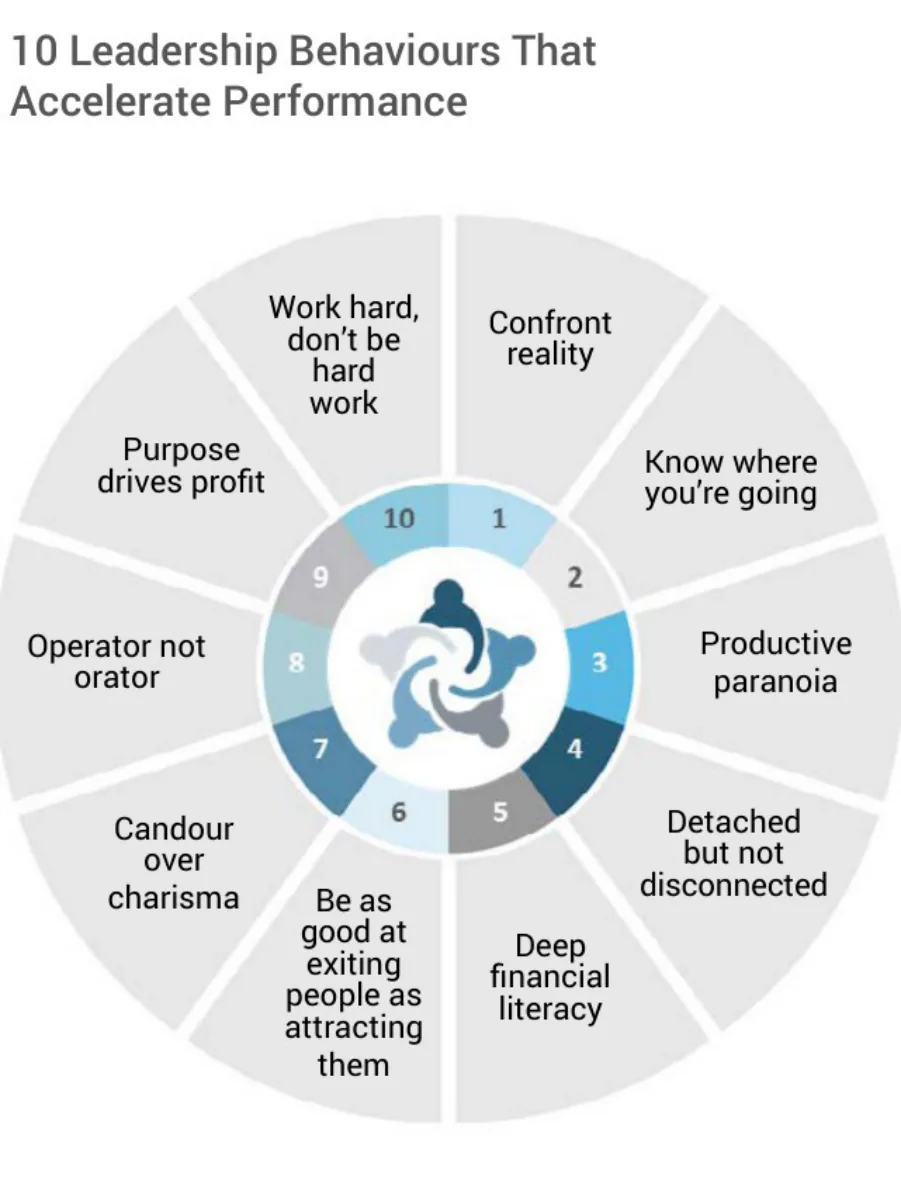
Note that we’ve taken a slight creative liberty with our Top 10. Rather than directly lifting from the 50 traits, we grouped clusters of highly ranked traits into broader, actionable categories.
For example, ‘Follow Through’, ‘Results Driven’ and ‘Focus’ have been combined under the heading of Productive Paranoia.
We made this adjustment to make the findings more practical - optimising a list of 50 items isn’t anyone’s idea of a productive Sunday.
If you read this list and think, “Fair enough, but most organisations are already good at this stuff,” think again. Organisations, much like the rest of the universe, tend toward entropy. They’re far more likely to deteriorate and disassemble than to improve spontaneously. Leaders need to maintain a clear-eyed perspective on this reality.
Consider the following examples of wrongdoings and malpractice that we’ve observed across various sectors.
Litany of organisational malpractice
Let’s start with the 2013 horse meat scandal. A random inspection by the Food Safety Authority of Ireland (and later England) uncovered vast amounts of horse meat in burgers sold in supermarkets. A staggering 85% of the burgers were contaminated. Was this just a bad batch?
No—this malpractice had persisted for years with the complicity of the entire supply chain.
But surely the reliable Germans wouldn’t let us down? In 2015, after much prodding, Volkswagen admitted to cheating on U.S. emissions tests. They installed software in diesel engines that could detect testing conditions and adjust performance to pass. This wasn’t the work of a rogue engineer; hundreds of employees knew about it, actively plotted its implementation and went to great lengths to conceal it. (BBC, 2015).
Even the beloved NHS in England, the guardian of public health, has faced scandals. Only recently did it fully disclose the extent to which it infected thousands of haemophilia patients and blood transfusion recipients with HIV and Hepatitis C through contaminated treatments. Pharmaceutical companies, including Cutter Laboratories, knowingly manufactured and sold contaminated blood products. (The Times, 2018).
And today, the NHS faces new controversies. Despite their professional reputation, some doctors have fostered a toxic work environment due to tensions over employing physician associates (PAs) and anaesthesia associates (AAs). Intended to ease workloads and improve flexibility, this initiative has instead led to defensive and hostile reactions, with ‘protect doctors’ jobs’ being prioritised over ‘work together to help patients’. (BBC, 2024 )
This dysfunction is not exclusive to the UK. The opioid crisis in the U.S. and Canada has claimed over 600,000 lives in the past two decades, worsened by companies like Purdue Pharma deliberately targeting patients most likely to become addicted. (Random House 2018).
Perhaps healthcare involves uniquely high stakes, but the same issues arise in other industries. Take Nike, which notoriously used child labour in Cambodia and Pakistan in the 1990s, forcing children to work up to 16 hours a day, seven days a week. Sadly, such practices persist. Child labour remains rife in the fast fashion industry, with an estimated 160 million children worldwide—roughly 1 in 10—working in slave-like conditions. (International Labour Organisation, 2022).
It’s not just children who suffer. Global mining giant Rio Tinto recently revealed that 50% of its female workforce experienced bullying in the past year, largely as retaliation for the company’s decision to hire more women. Even worse, eight employees reported instances of actual or attempted rape or sexual assault. (Financial Times, 2024).
Let’s turn to the UK Post Office. Over 16 years, 900 sub-postmasters were convicted of theft, fraud, or false accounting due to Horizon, a faulty accounting system developed by Fujitsu. Kemi Badenoch, leader of the Conservative Party in the UK, wrote “The Post Office itself has won awards for diversity and inclusion; it has a modern slavery statement, carbon reduction plan and a statement of corporate social responsibility. And yet despite these manifestations of good governance, it is known to be a highly dysfunctional organisation that has engaged in immoral and unlawful conduct; with the complicity of senior management.” (The Times, 2024)
Sometimes incompetence is the issue. The HS2 rail project in the UK, initially estimated in 2009 to cost £18 billion, ballooned to over £50 billion by 2023 before its northern leg was cancelled.(Gov.uk, 2023). A recent review found that both civil servants and ministers often lack the technical expertise needed for large infrastructure projects. To illustrate, there have been 13 Secretaries of State for Transport in just 18 years.
And what of the financial sector? Despite lessons from the 2008 financial crash, issues persist. In the UK, wealth manager Hargreaves Lansdown faces a High Court claim from 5,000 people for promoting Neil Woodford’s failing equity fund until the bitter end. The fund endorsed as a top pick, ultimately suspended operations, leaving nearly 300,000 clients badly out of pocket. (Financial Times, 2020).
Surely regulators can restore trust? Unfortunately, not. The Financial Conduct Authority (FCA) has faced numerous scandals, including mishandling the London Capital Ponzi scheme, which cost 11,600 investors over £237 million. Despite a £320 million transformation program, the FCA remains plagued by poor planning and a culture described as “profoundly defective.” (Reuters, 2021)
And what of the auditing industry? Britain’s audit firms failed to flag problems in more than three-quarters of major corporate collapses over the past decade. Emails from the failed engineering giant Carillion’s auditors even joked that their work resembled “more Mills & Boon than Shakespeare.” (Financial Times, 2024).
Education fares no better. Over the past 40 years in the UK, only 18 teachers have been dismissed for incompetence. Instead, underperforming teachers are quietly moved to other schools—hardly a system prioritising children’s education. (Parliament.uk, 2023).
Even charities are not immune. Captain Tom, a national hero during the COVID-19 pandemic, raised millions for charity through his valiant efforts. Yet, after his death, his family exploited his legacy for personal gain. (The Guardian, 2024). Similarly, supermodel Naomi Campbell’s Fashion for Relief was revealed to have spent only 8.5% of its funds on actual welfare, while she enjoyed lavish perks. (Sky News 2024)
Mismanagement extends to well-known organisations like Barnabas Aid, where the CEO and three senior staff members were suspended over financial mismanagement and fostering a toxic workplace culture. (Premier Christian News, 2024).
Not even the UK’s famed love of animals is safe from scrutiny. The RSPCA faced resignations from two sponsors, who accused the charity of leadership failures after undercover investigations revealed animal cruelty at its approved abattoirs. (BBC, 2024).
Perhaps religion offers solace? Unfortunately, the Vatican itself has faced allegations of fraud, with the Pope’s surgeon accused of claiming to operate while actually miles away on a personal retreat. (The Times, 2024)
The Church of England, meanwhile, has a long, tragic history of covering up child sex abuse cases. Jayne Ozanne, a founding member of the Archbishops’ Council, said ‘We must look afresh at how we empower leaders and allow them to speak out when they disagree rather than muzzling them.” (BBC 2024).
Finally, McKinsey, Colin’s alma mater, has its own scandals. Senior partner Martin Elling admitted to destroying records related to McKinsey’s work for Purdue Pharma, which sought to ‘turbocharge’ OxyContin sales. The firm ultimately settled for $650 million over its role in the opioid crisis. (NY Times, 2021).
Yet, even when individuals step forward to challenge the wrongdoing they witness, appropriate action is not always taken. A decade ago, Dr Hilary Cass—now renowned for her review of child gender medicine— exposed inadequate staffing levels at Great Ormond Street Hospital. Her reward? Demotion and a legal gag order.
Contrast this with the actions of Ed Davey, the Liberal Democrat leader who, as Post Office Minister, received a flood of emails from MPs about constituents falsely accused due to the faulty Horizon software. Davey even met Alan Bates, who presented the case against the system in detail. Why, then, did he remain incurious, accepting vague assurances from officials and responding with a letter stating he had “full confidence” in the system? Perhaps it was because, as a Liberal Democrat, serving in the coalition government was his only opportunity to hold a ministerial position.
These are just a few examples of organisational failings. Widen the lens and we could include Enron— the archetype of corporate scandal—Fannie Mae’s underreporting of profits, Deutsche Bank’s spying scandal, Guinness’s share trading fraud, Lockheed’s bribery convictions, Royal Dutch Shell overstating its reserves not once but twice, Southwest Airlines violating safety regulations, Tyco’s executive theft, and countless others.
Where was the leadership oversight, accountability, and responsibility in any of these cases? It seems self-interest dominated behaviour. Where was leadership?
Response to wrongdoing and incompetence
Even a cursory glance at the litany of organisational malpractice reveals that these issues are widespread and cross-sector. Malpractice seems rampant.
So, what happens when these scandals come to light? Do leaders take action? Are they committed to identifying the root cause and ensuring it never happens again? Unfortunately, leadership often behaves as though it’s engaged in a circular firing squad, shifting blame left and right.
As our examples illustrate, organisations are often guilty of willful blindness. This curious state of knowing without acknowledging is most commonly driven by self-interest. As we saw in the Dr Hilary Cass case, those who expose wrongdoing are rarely rewarded; they are often removed. Furthermore, ‘knowing’ poses risks—not only to career advancement but also to relationships within the organisation. It means challenging the status quo, provoking arguments, unsettling colleagues, losing friends, and facing isolation. It’s a courageous step. Willful blindness, on the other hand, is easier.
An unintended consequence of this widespread wrongdoing is the increase in regulation, which ultimately hampers the economy’s productive capacity. Consider the administrative costs of regulatory compliance. In the UK alone, there are 130 bodies that regulate various industries. Over the past decade, the average increase in headcount across these bodies was 84%. At the FCA, for instance, staff numbers grew by 117% between 2014 and 2024. In many cases, regulators are growing faster than the industries they oversee. The FCA’s headcount grew by 10.7% between 2017 and 2022, compared to a 6.7% increase in the financial services sector.
So, let’s not be naïve - organisations are far from perfect. While most people want to do the right thing most of the time, ‘most’ isn’t good enough. A minority will lie, cheat, steal, and exploit their customers. Leaders have a critical role to play in maintaining oversight and accountability. They must guide their organisations toward productive behaviours. Idealism won’t achieve this. Tough-mindedness is essential.
It’s no surprise, then, that we were left somewhat underwhelmed by the leadership traits highlighted by LinkedIn, HBR, and The Leadership Think Tank. We are not alone in our concerns. Matthew Parris, writing in The Times after watching a sweet video by a UK political leader titled, “Love is Enough”, said, “Love is not enough - in home life, in public life, or in politics. Here in the UK, our biggest national problems cannot be fixed by love, kindness, or any of the other caring qualities. Some of the harsher qualities are needed: a little coldness, a little hardness, a little toughness, a little tight-fistedness, a readiness to discriminate, and a hefty dollop of unsentimentality. We are in a mess, and love alone won’t fix it.”
Our research points in an entirely different direction to the current zeitgeist.
Leadership alpha
Let’s look in more depth at the Top 10 Leadership Behaviours that accelerate performance.
1. Confront reality 2. Know where you’re going 3. Productive paranoia 4. Detached but not disconnected 5. Deep financial literacy 6. Be as good at exiting people as attracting them 7. Candour over charisma 8. Operator not orator 9. Purpose drives profit 10. Work hard, don’t be hard work
1. Confront reality
Leaders must have the courage to see their business as it truly is, not as they wish it to be.
Some economic realities are inescapable. For example, Volkswagen takes twice as many person-hours to produce each car compared with its Japanese competitors. Its share price has fallen from 250 Euros in 2016 to 86 Euros in December 2024. In an increasingly price-sensitive market, no amount of branding or feel-good campaigns will bridge this cost and value gap. Volkswagen has recognised this and introduced a restructuring plan, which includes closing several plants and increasing automation. However, their works council has threatened strike action to preserve jobs. It remains to be seen who will win this battle, and which side is more in touch with reality. Perhaps the upcoming merger between Nissan and Honda, expected to be completed in 2026, with its associated synergies, will play a role in determining the outcome.
Intel offers another interesting example. In the 1970s, they were on the brink of collapse, having become uncompetitive in the microchip market. They responded pragmatically by exiting the memory business and focusing on their microprocessor product line, which was only a small portion of their total revenue at the time. It was a wise decision, which created enormous shareholder value. Now, they face formidable competition from Nvidia. Only time will tell how they fare.
We work with many PE firms. While they make mistakes, they are generally excellent at confronting reality. There are no sacred cows or pet projects—just an intense focus on creating value.
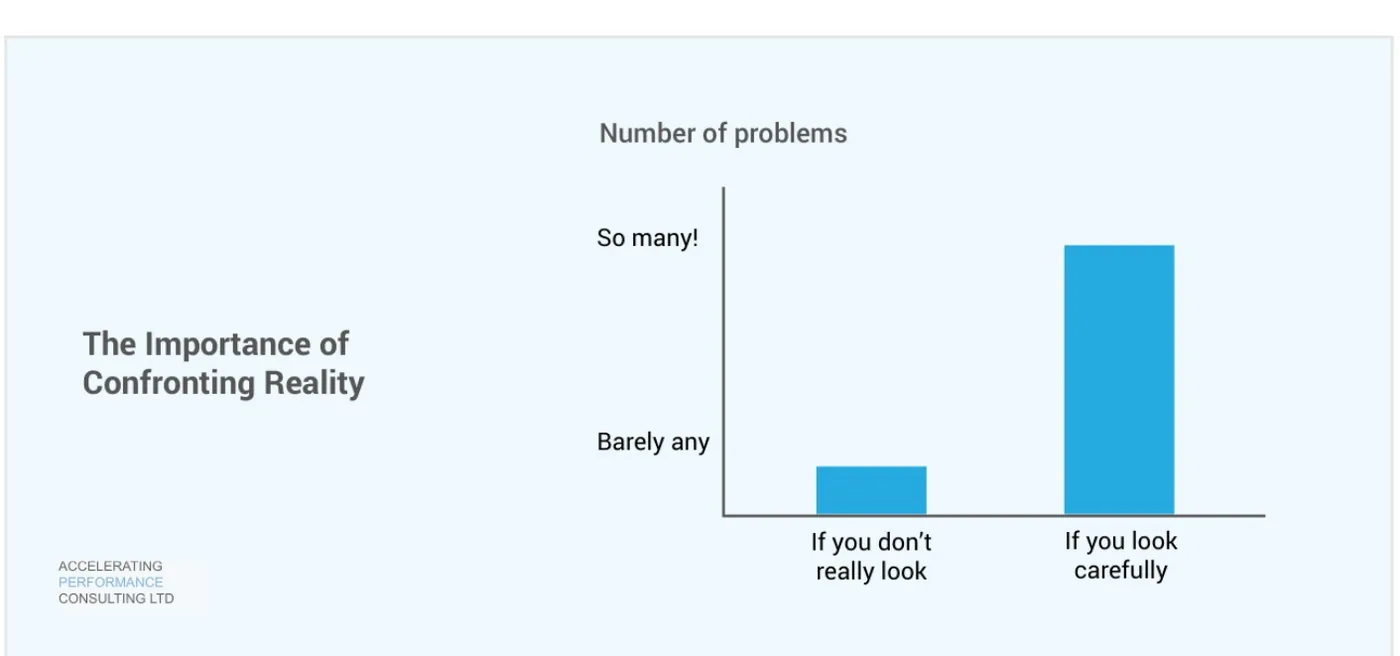
We love the chart below, which we’ve borrowed from the researcher, Jason Shen. The more you look, the more problems you’ll uncover. A CEO’s role is to ‘mine for conflict’. You must ask the tough questions you don’t want to hear the answers to. The gaps between different perspectives present opportunities for problem-solving and value creation.
So, if you truly want to improve your organisation, smile when you uncover a problem—you’ve just discovered another opportunity to improve.
2. Know where you’re going
Colin is privileged to be the Chair of Itim, a UK-listed software house that brings its reengineering expertise to the retail industry. Itim’s founder and CEO, Ali Althar, often says, “Retail is Detail.” The retail sector, which generally operates with tight margins, must compete against the behemoth that is Amazon, leaving little room for error. Ali knows most of the retail CEOs in the UK and observes that the winners are those who “know what good looks like.” These leaders have a clear sense of their company’s value proposition and swiftly eliminate any initiatives that deviate from that differentiated proposition. This clarity of purpose—a topic we will explore later—is crucial for speeding up execution, reducing noise, and creating value.
A leader’s first responsibility is to know where they’re going. Sir Tony Blair has said, “Clarity of direction is the most important quality for a leader in any organisation to have.”
A great example of clarity of direction is Pascal Soriot at AstraZeneca. When he took the helm, the company faced numerous challenges: a declining pipeline and the looming threat of a takeover by Pfizer. Soriot conducted a thorough review and identified oncology as the new direction. With some inspired acquisitions and the success of their Covid vaccine, the company’s value tripled.
The benefit of a clear sense of direction is not just that it provides a North Star, but that it also channels effort and reduces waste. Many businesses have been seduced by the so-called ‘theory of the long tail’. The idea is that, in our digital age, the cost of adding another product to a range has fallen dramatically— after all, it’s just a matter of adding a few more pixels to the website. While there is some truth to this, it has led many companies into sprawling product proliferation. The theory often overlooks the back-office complexity it generates. Multiple products frequently require multiple back-office systems, a huge number of suppliers, and even multiple regulators.
So, instead of focusing on launching new products, initiatives, and ventures, consider focusing on finishing what you’ve already started. Start less and finish more.
Clarity of purpose is essential for speeding up execution, reducing noise, and creating value.
3. Productive paranoia
Make no mistake: your competition wants to see you fail. It’s not your imagination—they would love it if you went bust. Hubris, comfort, and relaxation are preludes to failure.
PE firms excel at this understanding. Any senior manager in a PE portfolio company will tell you there is always an underlying sense of unease. This is a good thing, not a bad thing. As Jim Collins once said, “The only mistakes you can learn from are the ones you survive.” Leaders who avoid decline are constantly asking, “What if?” By preparing for any eventuality, they can build reserves, consider alternative scenarios, and account for risk.
Excellent leaders integrate doubt into their approach. Voltaire once said, “Doubt is not a pleasant condition, but certainty is an absurd one.” Productive paranoia sharpens your awareness of your environment and protects you from hubris. We’ve previously mentioned the U.K. Post Office scandal. As an example of complacency, it stands out. Fujitsu, the supplier of the faulty system that led to unfair imprisonment, misery, and suicides, was at the heart of it. The head of Fujitsu’s UK operation testified during the public inquiry that he “saw no flashing lights” indicating the need for investigation. His monumental lack of curiosity was highlighted when it emerged that he had not bothered to watch a BBC documentary that comprehensively covered the issue. Reflecting on this, he admitted, “I wish I had looked at this, as it might have given me a different perspective.” Indeed it might.
So, embrace productive paranoia. Be alert, be sharp, be tough. If you don’t, the start-ups eyeing your juicy market share certainly will.
However, we’re not advocating a high-fear environment. Our data suggests that fear in an organisation follows the Yerkes-Dodson Law: a little bit of fear can improve performance, but once fear surpasses a certain threshold, it drastically reduces performance.[5]
4. Detached but not disconnected
Treat your business units as guests, not family. In any portfolio of activities, there will inevitably be a performance distribution curve. Not all products will be exceptional, not all geographies will yield the best returns, and not all business units will be keepers.
The CEO must take charge here. It’s unrealistic to expect a business unit leader or product manager to propose reducing investment or exiting their area—that’s the CEO’s responsibility. Vodafone’s CEO, Margherita Della Valle, exemplifies this approach with her clear vision and lack of sentimentality in executing the €8 billion sale of Vodafone’s Italian business to Swisscom. The deal included selling assets from the mobile infrastructure group Vantage Towers, allowing Vodafone to pay down debts, fund a €4 billion share buyback, and invest in the U.K. and Germany. It’s like pruning a tree to promote future growth.
The CEO cannot afford personal attachment to any part of the business. The constant question should be, “Are we the natural owners of this, and can we win?”
That said, this doesn’t mean being distant from the business. In fact, the more time you spend on the shop floor, the better you will understand the operations. Use digital channels, hold skip-level lunch sessions, and encourage input from all levels.
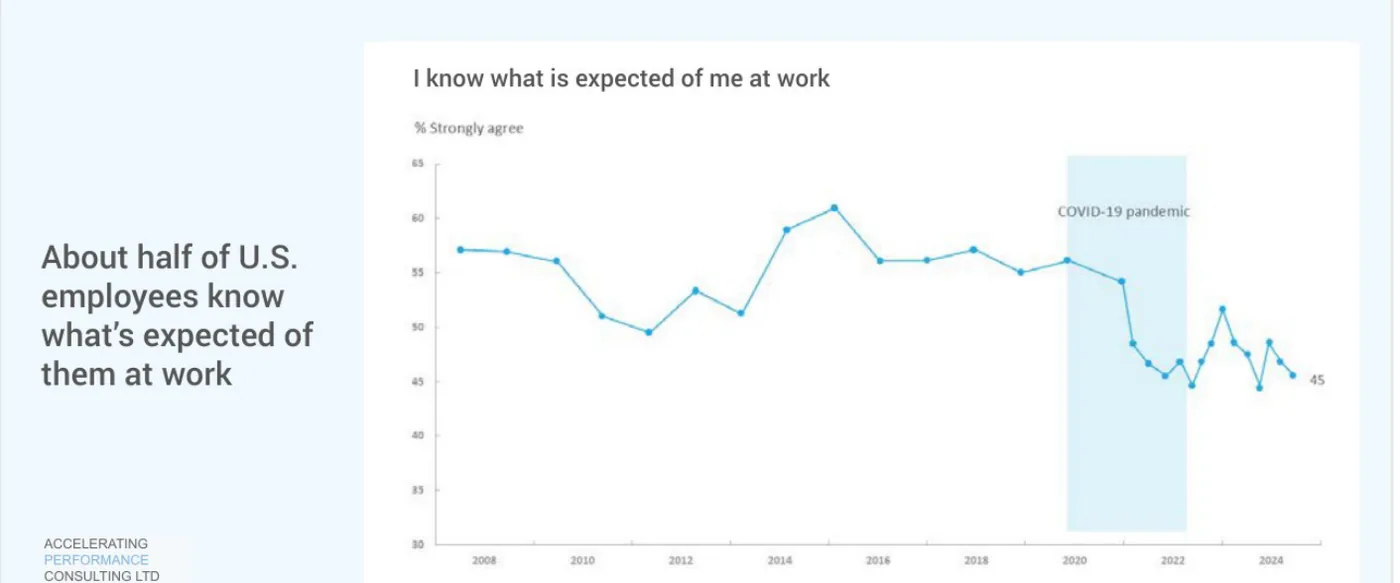
If you think you are already doing enough think again. The chart below, albeit only for US employees, shows that less than half of employees know what is expected from them. That’s a level of disconnection we should be worried about.
5. Deep Financial Literacy
In addition to chairing Itim, as mentioned earlier, Colin also serves as the Chair of two other companies. One thing is abundantly clear in the Chair role: shareholders want performance. And the definition of performance is not vague—it’s financial performance. Shareholders own shares because they believe these will grow in value. Yes, the company must collaborate well with suppliers, engage employees by creating a great place to work, and meet customer needs. But at the end of the day, the benchmark by which a CEO will be judged is financial performance. Our shorthand for cutting through the complexity of GAAP, accruals, free cash flow, and all the financial jargon is this: financial performance boils down to four imperatives: revenue up, cost down, cash in, and risk out.
Sadly, examples of a lack of financial literacy are easy to find. Take Cineworld’s acquisition of Regal, which operated 561 cinemas in the US in 2017. The deal cost Cineworld, or rather its shareholders, $3.6 billion, and in return, they got a pile of debt and ended up in Chapter 11 bankruptcy. Clearly, the CFO had a significant role in this debacle, but the CEO should have been able to smell a bad deal from the outset.
Another example is Cazoo, the second-hand car site. Its stock was first listed in New York in 2021, and by May 2024, its share price had plummeted by 99%. This followed rapid European expansion, huge spending on marketing, and subsequent pre-tax losses of £531.5 million.
If you’ve reached CEO level, you likely already have a strong grasp of the numbers. But what we’re discussing here goes beyond basic understanding. Educate yourself if necessary, surround yourself with team members who complement your skills, and ask the tough questions. Delve deeply into every financial report. You simply cannot afford to get this wrong.
6. Be as good at exiting people as attracting them
Yes, every company needs a compelling employee value proposition that attracts and retains great talent. However, we’ve never met a leader who didn’t wish they had taken quicker action to exit underperformers.
Arguably, one of the most difficult parts of any entrepreneur or leader’s job is firing people when they don’t work out. As a result, we’ve seen countless CEOs holding on to employees months or even years after they know in their gut that the person isn’t right for the role.
Why does this happen? It often comes down to the psychological principle known as ‘cognitive dissonance’. We work hard to hire the right people, and we desperately want to believe we’ve made the right choice. This desire is so powerful that even when employees give us clear signals they’re not the right fit, we don’t want to acknowledge it. Instead, we convince ourselves that if we just move them to a different position, things will improve.
In our consulting work, we coach senior leaders. Typically, these leaders acknowledge that around 25% of their direct reports aren’t truly up to the job, but they hesitate to take action. Stop waiting—start acting.
As the old saying goes, “A fish stinks from the head.” If your leaders aren’t engaged, a large part of the organisation below them will be struggling as well. Recent research in the U.K. revealed that only 1 in 10 employees felt highly engaged with their work, and some estimates suggest that this disengagement costs the U.K. economy around £250 billion annually. Whether or not that figure is accurate, the underlying truth is clear: to be a top-performing company, you need top performers.
Remember, nothing will erode the motivation of a great employee faster than watching you tolerate a bad one.
7. Candour over charisma
Who wouldn’t want to be seen as charismatic? It’s undoubtedly appealing. However, charisma alone won’t solve persistent performance issues, confront underperforming suppliers, or create an efficient systems architecture. What is truly required for a successful CEO is direct and repeated communication.
Part of a CEO’s responsibility is to focus people’s attention productively. A trivial example of this is team meetings. We’ve all attended meetings where people are distracted by their screens, barely listening, and primarily focused on clearing their inboxes. Don’t allow this. You’re paying for their brainpower—ensure they are fully engaged.
On a deeper level, the CEO must be the one who says no. “No” to the new initiative that might improve customer retention but will certainly distract the sales force. “No” to the poorly thought-out training program. “No” to the shiny new acquisition that promises a lot but adds unnecessary complexity.
Here’s a tip: use BBB—Benefits Baked into Budgets. Whenever someone proposes a new initiative promising a specific benefit (e.g., £X), insist that they incorporate £X into their budget, on which they’re incentivised. This approach works wonders in preventing initiative sprawl.
Another useful tip is to shorten meetings. Research from St. Gallen University recorded 1,000 meetings across 100 companies, asking MBA students to rate each meeting section for positive impact. They found that 84% of the productive outcomes occurred in the first half of the meeting.
One outcome of radical candour is ending debates and starting execution. A key responsibility of senior leaders is resource allocation, and the ability to say no is more important than saying yes. In some organisations, people are accustomed to pushing decisions until they get a “No,” which serves as a safe escape from personal risk.
In others, what appears to be a decision is merely the starting gun for further debates outside the room. These delay tactics need to be eliminated. Debates should occur before decisions, not after, so that the organisation avoids the complications of leaders being at odds with each other post-decision.
8. Operator not orator
We love orators - they can be entertaining. But we’d rather employ operators. Get your hands dirty and do real work.
In recent years, there’s been a heavy emphasis on influence, communication, and engagement. Sometimes it feels like CEOs are expected to have a stint at RADA. While influence skills are certainly important, clarity about performance expectations is non-negotiable. Let’s take HR as an example, one area where we work with some exceptionally talented leaders.
Traditional thinking about HR suggests their role is simply to ensure we have the right people in the right place at the right time. But that’s wrong. The true role of HR is to reduce the cost of talent relative to the company’s enterprise value. That’s what HR is responsible for: driving enterprise value through productivity, not just ‘looking after the people stuff’.
How do you spot an operator? Easy. They’re impatient. They’re eager to move. They connect ideas to implementation quickly. They experiment. They obsess over the numbers. They do as little as possible to achieve the greatest impact.
Here’s a great example: one of our clients, the CEO of a PE portfolio company, has what she calls “Sue’s magic ten” on her screensaver. These are the ten imperatives she constantly refers to:
1. Run lean operations (no bloat) 2. Manage cash like it’s your own (because some of it is) 3. Partner with customers to deeply understand their business (and continually renew that understanding) 4. Build differentiation versus competitors (don’t be a ‘me too’) 5. Invest in technology that reduces customer pain and increases loyalty (it costs far more to win a customer than to keep one) 6. Fire unprofitable customers and kill pet projects to free up resources (and reduce noise) 7. Get on the shop floor and maintain constant dialogue with staff (listen more than speak) 8. Put big people in big jobs (every extra head creates complexity, so limit the number of roles) 9. Invest in developing people (exit those who don’t want to be here) 10.Continuous improvement is our goal (it takes resilience)
9. Purpose drives profit
While we dislike the ‘let’s carve our purpose into the stonework in our reception’ approach, the data we’ve gathered clearly indicates that a strong sense of purpose can drive real value.
However, it can be overdone. We’re all familiar with the story of the activist investor in Unilever, who criticised managers for spending too much time articulating the purpose of mayonnaise. He had a valid point—when any good thing is focused on excessively, it can start to seem ridiculous.
That said, a sense of purpose that runs through the entire organisation can be a powerful force. Strangely, the purpose of a company can often get lost in the rush of day-to-day operations. For example, the purpose of an insurance company is to help people (and organisations) when they face tough times, and the purpose of a soap manufacturer is to prevent the spread of disease. The clearer these purposes are communicated and consistently discussed within the organisation, the more effective they become. Think of an organisation as a beach, with a few big boulders representing major value opportunities and thousands of pebbles beneath them. Top management can see the big boulders, but to unlock the potential of all the pebbles, everyone in the organisation needs to be engaged.
It’s interesting that Gareth Southgate has mentioned that his current challenge is to replicate the ‘sense of purpose’ he had while managing the England football team. After eight years in such a high-profile role, deciding what comes next must be difficult. While we may not believe in putting purpose on display in the reception, we do believe a purpose-driven strategy should be woven throughout the organisation. If you want your teams to work with confidence and autonomy, they need to understand why they’re doing their jobs. In his article on Purpose-Driven Strategy, Tommy Read explains that “one of the most powerful ways to bridge the gap between strategy and execution is by infusing every level of the organisation with a sense of purpose.” Purpose isn’t just some lofty aspiration. As a team leader, you have to make it clear on a practical level how the strategy is connected to each person’s role.
Managers often respond to disengagement with increased oversight and control, assuming that employees are self-interested and seek to minimise effort. But when they treat workers this way, that’s what they get in return. To truly motivate your team, help them connect with their higher purpose by encouraging them to bring their ‘smarts and energy to work’.
Operators do as little as possible to achieve the greatest impact.
10. Work hard, don’t be hard work
Too many people say things like:
• “I want to start a business, but I won’t risk my salary.”
• “I want to study and work, but I won’t give up my weekends.”
• “I want to get fit, but I love my slow mornings.”
Here’s the truth: if you’re a CEO, work-life balance is unlikely. Senior roles come with stress—there’s a lot at stake. We wish it weren’t so, but the reality is that it’s part of the job.
However, there’s an upside. A recent study found that while 55% of senior executives felt overwhelmed, 81% reported very high job satisfaction.
Senior roles are stressful—that’s a given. But with it comes immense satisfaction. Remember, diamonds are formed under pressure.
A great example of this is Rami Baitiéh, former CEO of Carrefour France and now CEO of Morrisons. Within a couple of years, he reduced Morrisons’ debt by 50%. Known for his demanding and detail-oriented leadership style, he implemented new processes such as customer service training, monthly shopper roundtables, and ensured that no significant meeting occurred without a customer panel present. He also holds daily virtual meetings with his top 150 senior leaders, sharing customer complaints and discussing areas for improvement. His leadership emphasises alignment with his vision, frequently asking employees to recite the company’s three main principles to ensure focus and consistency.
Contrast this with a recent example from the UK, where a critical air traffic control system failed due to an engineer working from home, delaying repairs and stranding 700,000 passengers. Another UK network collapse occurred on a busy August bank holiday because the on-call expert couldn’t log on to the system.
We don’t often use sports analogies, but Roger Federer’s career exemplifies the importance of hard work, grit, and determination. He explains, “It wasn’t effortless. I got that reputation because my warm-ups looked casual, but I had been working hard behind the scenes. I didn’t get where I am on talent alone. I got there by outworking my opponents. I believed in myself, but that belief had to be earned.”
This white paper is a call for clear-sightedness not for dictatorial leadership. We believe the focus on performance is critical not only for the organisation but also for the leaders themselves. Leaders need to apply rigorous standards to their own behaviour. What do we mean by ‘don’t be hard work’? Leaders who are ‘hard work’ often don’t listen to or accept critical feedback, struggle with empathy, overestimate their contributions, are unintentionally hurtful, and take credit for successes while blaming others for failures.
Lastly, let’s remember the words of Ringo Starr, “Of course, I’m ambitious. What’s wrong with that? Otherwise, you sleep all day.”
10 Questions leaders need to ask
Here are ten questions you could ask yourself to take an honest appraisal of whether you’re serious about improving. Answer boldly and frankly.
• If two of my closest colleagues were pushed to identify my top 3 weaknesses, what would they say? You need to be aware of your weak spots to grow.
• Am I serious about changing and improving? You may be secretly happy with the status quo rather than pushing yourself.
• When was the last time I pushed myself to grow? Are you in danger of stagnating?
• Which feedback keeps surfacing that I keep ignoring? If you’re getting the same feedback, it’s probably pointing to your biggest blindspot.
• What assumptions am I holding onto that don’t work? Are they what are limiting your team?
• When does my ego get in my own way? Ask yourself who you’re really doing something for.
• Do I always use my behaviour to positively influence others? Your communication style may not always be building your team up.
• Where are my skills weak? What do I avoid? What tasks do I duck out of and lose the opportunity to improve?
• What truth am I avoiding because it’s uncomfortable? Don’t shy away from difficult conversations - they can have the most impact.
• What standards do I hold my team to but gloss over for myself? People don’t respect those who have double standards - be transparent.
Senior roles are stressful— that’s a given. But with it comes immense satisfaction. Remember, diamonds are formed under pressure.
Some hope for the future
In this piece, we’ve focused on the darker side of organisations and the steps leaders must take to mitigate the universal tendencies to sub-optimise. However, we are genuinely excited about the future. Technology and innovation promise a breathtaking array of breakthroughs in the coming years. To mention just a few:
• Approximately 90% of the world’s data has been created in the last two years alone. The cost per calculation is falling by 99% every four years, making most calculations effectively free, and this power is now in the hands of more people. There are currently 9 billion mobile phones in the world.
• One billion people are already using generative AI. Since 2018, the efficacy of AI has grown by 3,000 times.
• Until recently, a blockbuster medicine would take between 6 and 10 years to develop at a cost of around $6 billion. In 2023, AI discovered a treatment for liver cancer that reached candidate status in just 30 days.
• GNoME, a tool developed by Google DeepMind, discovered 2.2 million new crystals in 2023, of which 380,000 were deemed stable enough for practical applications.
• Microsoft discovered a new material that can reduce lithium use in batteries. Its team used AI to narrow down 32 million potential inorganic materials to 18 promising candidates in just 80 hours—a process that would have taken more than two decades in the past.
• In what may be the biggest discontinuity of them all, IBM has said that they expect quantum computing to be stable and widespread by 2033.
• Plus, a British lab broke the record in 2024 for the amount of energy generated by a controlled nuclear fusion reaction. Although the fuel only weighed as much as a fruit fly, it created enough energy to make 600 cups of tea - that standard British unit.
• And finally, Sharon’s work on the use of psilocybin, in territories where it is legal of course, to turbo-boost self-awareness and leadership capabilities holds enormous promise.
These are just a few of the many exciting developments. There are scores more opportunities in weather forecasting, personalised medicine and nuclear fusion. All of these have massive potential but also carry the potential to fail. We need our leaders to rise to the challenge of seizing the future. We need them to deliver Alpha.
Sources and further reading
1. Callas, P., and Golebiowski, J. (2022). Leadership Alpha In Private Equity. Teneo, 16 November. Private-equity leadership research cited in the article. Source
2. Goleman, D. (2000). Leadership That Gets Results. Harvard Business Review, March–April. Leadership styles discussed in the article. Source
3. Authors’ research. The 137-company leadership study, 50-trait assessment and supporting client experience are described in the article. The underlying proprietary dataset is not published with it. Research credit: Jodie Price.
4. Price, C., and Toye, S. Speed Wins. Accelerating Performance Consulting. Companion article cited in the text.
5. Yerkes, R. M., and Dodson, J. D. (1908). The Relation of Strength of Stimulus to Rapidity of Habit-Formation. Journal of Comparative Neurology and Psychology, 18, 459–482. The Yerkes–Dodson law is discussed in the article. Source
6. Gallup. Employee-engagement research and the chart on employees knowing what is expected of them at work, reproduced and attributed in the article. Source
7. Price, C., and Toye, S. (2017). Accelerating Performance: How Organizations Can Mobilize, Execute, and Transform with Agility. Wiley. Background to the acceleration framework and organisational research. Source
8. Keller, S., and Price, C. (2011). Beyond Performance: How Great Organizations Build Ultimate Competitive Advantage. Wiley. Source
9. McKinsey & Company. Organisational health and performance research discussed in the article. See also Keller and Price, Beyond Performance.
Other sources identified in the text include CEPR, official UK public-service figures, Financial Times, The Times, BBC and Reuters reporting, and corporate accounts from Rio Tinto and AstraZeneca. The supplied article does not give a full bibliographic citation for every example.
The closing technology examples refer to Google DeepMind’s GNoME materials research, Microsoft’s battery-materials research, IBM’s quantum-computing outlook and the 2024 UK fusion-energy record. The article presents these as reported developments and expectations.