Executive summary
An effective board improves the organisation’s consequential choices and what happens after those choices leave the boardroom. Experience, impressive credentials and cordial meetings help, but they do not guarantee effective challenge, clear accountability or purposeful action. The board also needs to fit the business now, rather than the organisation for which its members were originally recruited.
Effectiveness becomes visible in the board’s actual work: what receives attention, which evidence is heard, how disagreement is handled, who has authority to act and whether the original purpose survives implementation. The Chair–CEO relationship, succession, regulatory responsibilities and the capacity to learn all shape that work. AI makes these questions more urgent by increasing the speed and reach of delegated action.
The Chair sets the conditions for candid challenge while respecting management’s responsibility to run the business. Directors need enough independence to question a favoured proposal, enough trust to disagree productively and enough discipline to reach decisions people can implement.
Start with the organisation’s next major choices and examine six months of real board work. Compare directors’ accounts with papers, decisions and what happens in meetings. Identify the gaps that matter, put a few changes into the next three meetings and check whether they improve outcomes. A formal review can help; effectiveness is the continuing responsibility of the board itself.
In this paper
- Even accomplished boards can work better
- A board has a different job
- Attention reveals the working strategy
- Assurance needs a route to reality
- Regulators are part of the board’s responsibilities
- An investigation must be able to change the conclusion
- The Chair must make challenge possible
- The Chair and the CEO set the weather
- Disagreement needs a way back
- Renewal starts before the crisis
- AI makes judgement more valuable
- Ownership, rules and purpose shape the choices
- Keep the board fit for the work ahead
- Examine six months of real work
- Follow a priority from attention to action
- Preserve intent while the business adapts
- Change the next three meetings
- Use the evidence to choose what changes
- What becomes better because the board is there
- Sources and further reading
Even accomplished boards can work better
Wellcome’s board brought together an impressive collection of people doing exceptionally worthwhile work. When we examined its effectiveness, the question was how those individual strengths translated into the board’s collective contribution. Wellcome is the charitable foundation established in 1936 to support scientific discovery and better health. Its contribution is immense, and its purpose is easy to care about.[1]
The governors included Eliza Manningham-Buller, a former head of MI5, Britain’s domestic security service; Damon Buffini, a founding partner of the private-equity firm Permira; Sir William Castell, formerly chief executive of Amersham; and distinguished scientists. It was not a room short of intelligence, experience or people accustomed to being listened to.[2]
The review found an effective, collegial board, with strong relationships and constructive challenge. It also identified opportunities to give more attention to strategic choices, clarify the boundary between governors and executives, and strengthen succession and the capacity to deliver ambitious plans.[3] An accomplished board can still become a better one.
The questions were familiar. How do you challenge management robustly while helping it succeed? How do you invite dissent and still reach a decision people will act on? And how does the Chair build alignment without leaving colleagues feeling that they have merely been brought into line? This stuff is difficult, even in a room full of people who have made a considerable success of difficult things. Distinguished CVs do not, by themselves, settle how the next ten minutes should be used.
The task is to make these questions discussable, test them against actual work and change what happens next. Even a very good board has habits it can no longer see. Familiarity is comforting, but it is not an independent witness.
We know something of that difficulty from both sides of the table. Colin is Chair of a UK-listed software company and has served on many boards. Sharon’s work includes board reviews and coaching Chairs and CEOs through the relationship itself. Directors make consequential choices with incomplete information, challenge executives without taking over their jobs and judge risks whose significance may emerge only later. Hindsight has the considerable advantage of arriving after the event. Examining failures is a way to improve those judgements, not to pretend they were easy.
A board’s contribution can nevertheless fall short of its members’ collective experience. Decisions arrive late, lose their purpose in execution or leave management to reconcile contradictions the board has never resolved. To see where the board adds value, follow a consequential decision from the agenda into the business and ask what became better because it was involved. That is a more demanding test than whether the meeting went well, and a more useful starting point for improvement.
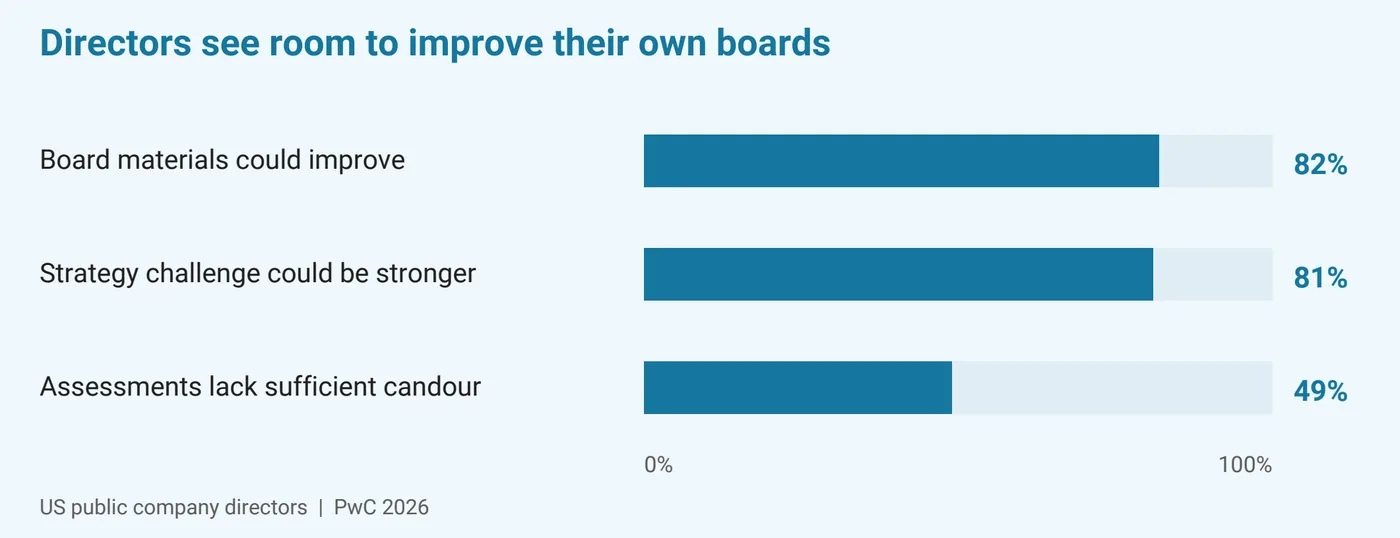
Directors themselves see room for improvement. PwC’s September 2026 survey of 599 US public company directors found that 81% of those answering its strategy question saw scope for stronger challenge to management. Eighty-two per cent wanted better board materials, while 49% identified insufficient candour in assessments.[4] Figure 1 brings these findings together. They are a reminder that able, conscientious people can still become very good at leaving difficult things undisturbed.
Boards have always faced problems of information, authority and human judgement; AI increases their pace and scale. The answer is to keep improving the conditions in which good decisions can be made and carried through, protecting the organisation’s ability to perform tomorrow while judging its performance today. That work belongs in ordinary meetings, not just the calendar entry marked “board review”.
Our work uses five arenas: mandate, the purpose and choices entrusted to the board; governance, how authority and assurance operate; behaviours, how directors work together; connections, their relationships with management, owners and others; and renewal, readiness for what comes next.[5] Following a real decision through these arenas shows how they affect one another. A sound mandate, for example, achieves little if the information arrives late or nobody feels able to question the Chair’s preferred answer.
Timothy Rowley and Stanislav Shekshnia make a useful argument in their November–December 2026 Harvard Business Review article, Building a Board That Fits: boards can reinforce the preferences of those already in control, and fail to adapt as the organisation changes. They connect ownership context with the board’s purpose, people, processes and Chair. Their argument sharpens our five arenas: what does this board need to counterbalance, and can its actual working arrangements do so? [6]
The practical test is to name a pressure that might distort the next important decision. A founder’s conviction may crowd out evidence; an investment timetable may narrow the horizon; a family disagreement may enter disguised as strategy. Directors need to establish which pressure is present, whose voice is missing and what would help them judge more freely. Otherwise the board risks becoming the founder’s favourite opinions, now with a quorum.
A board has a different job
Management develops proposals, runs the business and delivers the agreed strategy. The board helps shape and approves the strategic direction, judges major commitments, oversees risk and performance, and holds executive leadership accountable. Among its most consequential responsibilities is selecting, supporting and, when necessary, replacing the chief executive. The distinction sounds straightforward until people with long experience of running businesses are asked to oversee one without running it themselves.
A non-executive who once ran a successful sales organisation may have valuable questions about customer retention. But if that director starts issuing instructions to the sales director, advice quietly becomes command and the company acquires another management line without anyone having designed one. The CEO remains accountable for a business that other people are helping to run.
Good oversight combines enough understanding to test management’s judgement with respect for executive authority. Directors need to enter important choices while alternatives remain open, then make clear what is approved, what is delegated and what requires a return to the board. The Financial Reporting Council’s guidance connects the Chair’s agenda, information and constructive challenge with this division of responsibility.[7]
Circumstances will change the balance. A refinancing deadline or serious control failure warrants closer attention, but the board and management should agree why that involvement is increasing, what management still owns and when the additional involvement ends. Without that understanding, an exceptional intervention can become a permanent habit long after the exception has passed.
The board shapes the business through the CEO it appoints, the incentives it approves, the authority it delegates and the evidence it requests. Management designs the detailed work, while directors test whether those arrangements still support the strategy. Sometimes the board itself is part of the problem: reserving decisions it has no time to consider is an efficient way to design delay.
What became better because this board was involved?
Attention reveals the working strategy
Imagine a board that has declared growth its overriding priority. The meeting opens with last month’s results and a missed forecast that needs explaining. One director has a question about the regional breakdown; another would like the same numbers at constant currency. By the time the board reaches the investment that might change next year’s results, several directors have trains to catch and the discussion has to be brisk.
The minutes will record that strategy was discussed, while the organisation continues doing much as it did before. Growth has the board’s endorsement; the past has its undivided attention. Most of us find it easier to question a variance we understand than to ask an elementary question about a business model we do not. Familiarity quietly wins the argument about what deserves our time.
The Chair can interrupt that habit by starting with the choices likely to matter most over the next year, whether a market exit, technology investment, refinancing or CEO succession. Work backwards from each choice to the evidence and discussion it requires, giving early exploration enough time to establish real alternatives. Later meetings can then resolve the choice and test readiness to act, rather than discovering that the only practical option is the one management has already prepared.
Scrutiny should also fit the decision. A reversible trial within agreed limits need not wait for the machinery used to approve an acquisition, while safety, vulnerable customers and irreversible commitments may warrant slower examination. Treating every decision as equally important reliably delays the important ones and teaches management to avoid asking.
Put difficult choices where the board still has the energy to think, and use papers to prepare directors for discussion. A presentation that faithfully repeats a document everyone has received is a surprisingly expensive form of audiobook. The useful part begins when directors can examine what they doubt, what is missing and what the business will have to do differently.
Assurance deserves the same discipline. Twenty minutes on a recurring safety defect or customer complaint may expose a business model that no longer works, whereas ninety minutes under an item called strategy may contain remarkably little choice. The subject heading tells us less than the quality of the conversation beneath it.
Assurance needs a route to reality
The board sees the business through information prepared largely by the people it oversees. That is an unavoidable feature of governance, but it becomes dangerous when everyone begins to trust the account more than the business it describes. The numbers need a route back to the work that produces them.
WHSmith provides a recent example. Its November 2025 summary of an independent Deloitte review found that North American supplier income had been recognised inconsistently with policy and accounting standards, substantially as a matter of timing. It connected the problem with demanding targets, decentralised operations, limited group finance oversight and weaknesses in capability and controls. The CEO resigned; the response included stronger oversight and additional retail expertise on the board.[8]
The question for directors is whether the conditions producing the numbers are as sound as the numbers appear. A growth business can meet the plan while accumulating weak controls, stretched capability and incentives to bring tomorrow’s income into today. Greater ambition therefore needs a corresponding ability to see what achieving it requires, including the strains that do not yet appear in the reported result.
A good paper makes the judgement visible by setting out the choice, alternatives, material assumptions and evidence that would undermine the recommendation. It distinguishes results from forecasts and identifies disagreement, tracing claimed improvements to customers, cash or operational evidence. Directors can then ask whose experience is absent, which information arrives too late and where a reassuring average conceals a serious exception.
Internal audit, customer evidence, workforce engagement and properly organised site visits help reveal differences that consolidated reporting smooths away. These routes work best when their purpose and reporting arrangements are clear, so directors can understand the business without creating a private management network. A site visit should improve the next board conversation, rather than leave a local manager wondering whose instructions now take precedence.
Committees provide essential depth, but the whole board must connect their findings. An audit committee may see aggressive income recognition, a remuneration committee may see stretching targets, and the full board may celebrate rapid expansion. Those observations belong in the same conversation because the company experiences their combined effect, even when its governance machinery considers them separately.
The company experiences risks together, even when its committees consider them separately.
Regulators are part of the board’s responsibilities
A board also needs to understand the obligations of the organisation it governs and its relationship with the bodies that supervise it. Requirements differ by sector, jurisdiction and legal form. Management and compliance specialists do much of the detailed work, but directors still have to ask whether the business has the resources, controls and reporting needed to meet its obligations. Relationships with regulators therefore belong in a board review alongside relationships with owners, management and the people the organisation serves.[5]
For companies within the UK Corporate Governance Code’s scope, the 2024 Code strengthens the board’s reporting on material internal controls. Provision 29 applies to accounting periods beginning on or after 1 January 2026, on a comply-or-explain basis. It calls for a declaration of their effectiveness at the balance-sheet date, with disclosure of material controls that did not operate effectively and the action taken or proposed. The provision covers material financial, operational, reporting and compliance controls.[7] The practical question is what evidence gives the board grounds for its conclusion.
Financial services adds specific obligations. The Financial Conduct Authority’s (FCA) Principle 11 requires regulated firms to deal openly and cooperatively with their regulators and disclose matters of which the regulator would reasonably expect notice. The FCA also sets out notification requirements for matters such as significant rule breaches, fraud and serious operational problems.[9] The board should ensure that management understands the applicable requirements, escalation routes and deadlines; a communication strategy cannot be allowed to hold a required notification hostage.
In practice, directors need direct access to the heads of risk, compliance and internal audit, with a clear route for concerns to reach the appropriate committee or the full board. Significant supervisory findings and commitments should have accountable owners, adequate resources and evidence of effective closure. The next board pack should show whether the problem was fixed, rather than merely whether someone wrote a reassuring reply.
A constructive relationship with a regulator leaves room to challenge an interpretation respectfully and explain the business’s position. It also requires candour about what is known, what remains uncertain and what is being done. Silence from a regulator is not approval of every practice, any more than a completed inspection makes further judgement unnecessary. The board’s responsibility is to keep examining the business after the visitor has gone.
An investigation must be able to change the conclusion
At Nestlé in 2025, employees raised concerns about CEO Laurent Freixe’s relationship with a subordinate and alleged favouritism. CFO Anna Manz’s account, reported by Reuters, described an initial investigation that found no evidence and a denial from Freixe. Complaints continued. A broader inquiry, supported by external lawyers, brought information that led the board to act.[10]
Nestlé dismissed Freixe on 1 September 2025 for an undisclosed relationship that breached its code of conduct. Later that month, Chair Paul Bulcke announced an earlier departure, with Pablo Isla succeeding him on 1 October.[10]
An inconclusive inquiry cannot turn an unresolved concern into an established absence of a problem. Directors need to understand its scope, independence and access to evidence, as well as what would justify reopening it. They should also know what happens to people who persist: a speak-up policy offers limited comfort if speaking up becomes the most hazardous part of someone’s job.
The Chair must make challenge possible
A board can have independent directors and still think dependently. Expertise, tenure, reputation and confidence affect who speaks and whose objections survive. A powerful CEO may discourage disagreement without ever expressly forbidding it. An experienced Chair may reach a conclusion so early that the rest of the discussion becomes an exercise in catching up.
The Chair makes disagreement possible by inviting alternatives before announcing a preference, bringing quieter expertise into the discussion and asking what would make a rejected option better. Saying “I don’t understand” or “I have changed my mind” makes it less expensive for everyone else to think. The skill is to distinguish evidence the decision genuinely needs from the search for a certainty that it cannot offer. On a consequential choice, ask directors to set out their initial judgement and principal uncertainty before the strongest voice establishes the weather. Invite someone to make the best case for the alternative. The aim is to give a neglected argument a fair hearing, not to appoint a permanent court jester whose objections everyone learns to ignore.
Robust challenge depends on trust and care. Directors should be able to question a proposal without putting a colleague’s standing on trial, which means giving the colleague time to answer and acknowledging when the explanation improves their own view. A reputation for asking devastating questions is not much use if nobody tells you anything interesting afterwards.
The Chair is answerable too, and the senior independent or lead director needs the standing to hear concerns and act on them. The Chair’s review belongs with someone else; it cannot be credible if the person whose judgement is in question can close down the discussion. Authority includes being willing to hear an account of its effects that we might not have written ourselves.
Once challenge has improved a decision, record how the objections were resolved and support the agreed course, while remaining alert to new evidence. Otherwise executives can find themselves working for a committee whose members each remember a different decision. Endless re-litigation uses the language of rigour while quietly removing the possibility of action.
The Chair and the CEO set the weather
Every board has a formal constitution and an informal one. The first records who may do what; the second lives in relationships, including who controls information, commands shareholder loyalty, sets the agenda or can make a colleague’s position uncomfortable. The Chair–CEO relationship sits near its centre, and separating the roles does not, by itself, balance their power.
The CEO lives in the business and usually controls much of what reaches the board, while the Chair shapes its attention and can mobilise its confidence, including when the CEO’s future is in question. Appointment and removal belong to the board, not the Chair alone, and owners, founders and other directors hold power too. A competent constitution has to work in this less tidy world, as Gildan discovered.
On 23 May 2024, five days before its annual shareholder meeting, Gildan announced that its entire board had resigned. The chief executive it had appointed was leaving too, and an attempt to sell the Canadian clothing manufacturer was abandoned. The outgoing directors handed their seats to nominees of the investor campaigning against them. This was a board refresh with unusually little continuity.[11]
The confrontation began when the board, then led by Chair Donald Berg, removed co-founder Glenn Chamandy in December 2023. Directors said he lacked a credible long-term strategy and had lost their confidence. Major shareholders disagreed. Formal authority sat with the board; the founder retained powerful support outside it. Chamandy returned as CEO in May 2024.[11]
The cost was considerable. Gildan’s 2024 accounts recorded US$82.7 million in expenses relating to the proxy contest, leadership changes and associated matters, including US$36.7 million in advisory fees on shareholder matters.[12] A disagreement about leadership had become a sizeable expense of running the business.
The relationship can give a difficult transformation both pace and staying power. At Rolls-Royce, a board chaired by Anita Frew appointed Tufan Erginbilgic, who became CEO in January 2023. Her 2025 annual-report statement backs the transformation and describes the board monitoring its strategic initiatives. The company reported £3.46 billion in underlying operating profit for 2025.[13] The visible lesson is the combination: clear expectations, room for management to act and a board that stays engaged.
Closeness has its dangers. A Chair may become so invested in an appointment that criticism of the CEO feels like criticism of the Chair, or select someone comfortable to control and then wonder why the business lacks independent leadership. At the other extreme, a powerful CEO can treat the board as an audience and the Chair as a particularly persistent member of it. Agreement can conceal dependency just as easily as disagreement can reveal strength.
BP supplied a sharp illustration in May 2026. Albert Manifold, formerly CEO of building materials group CRH, became Chair on 1 October 2025. Less than eight months later, on 26 May, the board removed him unanimously, citing serious concerns about governance, oversight and conduct. He had helped recruit Meg O’Neill, who arrived as CEO in April. The Financial Times reported allegations that he had crossed into day-to-day management. Manifold denied seeking an executive role and rejected the portrayal of his conduct, saying he had pushed hard for necessary change.[14]
BP’s announcement credited his focus and pace even as it dismissed him. Dame Amanda Blanc, the senior independent director who had led his appointment, explained the board’s decision.[14] A Chair is not a chief executive on a shorter working week. Equally, making colleagues uncomfortable is not by itself misconduct. Boards need enough clarity about roles, evidence and behaviour to tell the difference before disagreement becomes a contest over who gets to define it.
Imagine a Chair who wants faster change and a CEO who thinks the business is already at breaking point. After each meeting, the Chair calls executives directly; the CEO responds by filtering more information. Each now has evidence that the other is the problem. The organisation acquires two weather forecasts and spends its time deciding which umbrella to carry.
A facilitated conversation can help both people see the pattern they are creating. Begin separately with what each is trying to protect, what they fear losing and what they might be contributing to the impasse. Together, examine one disputed decision and the actual words and actions around it. An intervention intended to help may have left the CEO feeling undermined; an attempt to reassure may have sounded evasive to the Chair. Neither has to agree with the other’s judgement to take that experience seriously.
That recognition becomes useful when it changes how the pair work: who decides, how difficult news travels, where disagreement is tested and what comes to the full board. Private conversations should make room for both the business and the relationship, followed by an honest check on whether behaviour changed. “No surprises” means timely candour, not permission for either principal to veto what colleagues hear. A senior independent director with access to both provides a third point of support and challenge.
The published 2016 review of Singapore Post, the postal and logistics group, gives this discipline substance. Trust, openness and transparency in the board–management partnership scored lowest in its section of the directors’ survey. Respect for the boundary between stewardship and management was the only item across the survey on which management rated the board lower than directors rated themselves.[15] A conversation about partnership becomes more revealing when the people living with it get a vote.
Can the Chair and CEO disagree without making it a test of loyalty?
A strong partnership gives the whole board better information and more room to challenge. When the Chair and CEO settle everything privately and present colleagues with a completed decision, the rest of the board is left to provide a rather elaborate endorsement. Disagreement is survivable; retaliation and rival camps make it dangerous. The aim is enough trust to speak plainly and enough independence to act when trust is no longer justified.
Disagreement needs a way back
A board dispute becomes harder to resolve when people stop testing propositions and start testing loyalties. Information is shared selectively, a request for evidence sounds like an accusation, and decisions migrate to private calls between allies even as the formal meeting continues. The participants may still agree about the organisation’s purpose while losing the ability to pursue it together.
Sentebale, founded by Prince Harry and Prince Seeiso of Lesotho to support young people in southern Africa, suffered a public rupture in 2025. Disagreements involving Chair Sophie Chandauka, trustees and Prince Harry were followed by trustee resignations and both princes’ departure as patrons.[16]
The Charity Commission identified unclear roles, confused delegations and inadequate complaints procedures. It found no evidence of widespread or systemic bullying or harassment, or of overreach by the Chair or Prince Harry. It nevertheless found mismanagement in delegation and complaints handling, and criticised all parties for damaging the charity through their public dispute.[16]
Shared purpose does not settle who has authority to pursue it. When boundaries are vague, a practical disagreement can become a constitutional one: who directs the executive, for example, or who investigates a complaint about the Chair? Good intentions do not answer those questions, however strongly everyone professes them.
Repair begins by returning to the disputed choice, the evidence and who has authority to decide. Where the Chair is involved, another director or an independent facilitator should lead. The conversation may require us to listen to a colleague describe the effect of something we thought entirely reasonable at the time. An apology can reopen it, but changed behaviour makes it worth continuing. Mediation is often more useful before everyone has acquired a spokesperson.
Some situations will require a departure, whether because of serious misconduct, persistent obstruction or an irretrievable loss of trust. The board needs a fair process that protects the organisation’s work as it reaches that conclusion. Winning a factional contest is a poor substitute for restoring the capacity to govern.
Renewal starts before the crisis
The decisions ahead should determine the capabilities a board needs, alongside the experience already around the table. Start with the next two or three consequential choices and work backwards: what knowledge, judgement, relationships and time will the board need? Then test those requirements against what members actually contribute together. Every box in a skills matrix can be filled while the most important proposal still leaves the room uncertain what to ask. A board can collect distinguished biographies as enthusiastically as a Victorian collected butterflies, and still lack the person who will ask the awkward question. Recruitment should fill that gap; development and better use of existing expertise may fill it sooner.
It also helps to look at the roles people actually play: who integrates different views, checks the detail, brings new ideas, understands operations, builds support, connects externally and thinks strategically? A board crowded with operators and checkers may examine every variance while nobody questions the business model. If Chair and CEO both claim sole authorship of strategy, clarify their respective contributions before the next strategic review becomes an audition.
Novo Nordisk’s 2025 upheaval exposed the tension. Its Chair and six other independent directors declined re-election after disagreement with the controlling foundation over renewal. Directors favoured selected additions with continuity; the foundation wanted more extensive change. Its Chair, former Novo CEO Lars Rebien Sørensen, became company Chair in November, prompting investor concerns about concentrated power.[17]
Owners may reasonably press for urgency and different capabilities, while independent directors may reasonably worry about what will be lost. Replacing directors does not settle the boundaries between owner, board and management, so those boundaries need discussion while a considered agreement remains possible. CEO succession demands similar foresight: observe possible successors in demanding work and discuss timing while the incumbent is performing well. Development and support belong alongside replacement, rather than arriving as an emergency alternative to it.
AI makes judgement more valuable
In PwC’s 2026 survey, 71% of the 594 directors answering the skills question said their boards needed stronger AI skills for effective oversight.[4] One technically fluent director helps, but the rest still need enough understanding to judge consequential proposals. Seeing a real task being done is a good place to begin, especially when the demonstration includes what happens when the technology gets it wrong and someone has to put it right.
Start with the business choice and follow the whole journey from customer need to result. Hours released become value when they improve service, enable growth or reduce actual expenditure, after allowing for checking, exceptions, technology and transition costs. A task completed in seconds can still leave the customer waiting three weeks if the rest of the process has not changed.
When AI can act, management needs to specify its authority, limits and monitoring, including who can stop it. The board tests those arrangements for material uses and holds an executive accountable for outcomes. That includes asking where authority is moving as systems learn, connect or acquire new permissions; it cannot be allowed to accumulate in software merely because nobody noticed it moving.
AI can help directors too, by comparing papers, finding changed assumptions and retrieving earlier commitments. With appropriate access controls, checked sources and the originals available, it can release time for considering alternatives and omissions. A shorter pack is useful only if directors understand the business better when they have read it.
As analysis becomes easier to obtain, wisdom matters more: judgement about worthwhile ends, difficult trade-offs and the limits of what we know. Doubt can open questions that confident answers close, provided directors are willing to expose their own uncertainty. “What would change our minds?” is especially worth asking when the answer might threaten a decision bearing our signatures.
Ownership, rules and purpose shape the choices
Concentrated ownership can give a board more bite. On a private-equity board, the owner is close, the investment thesis explicit and the consequences of missing it present in the room. McKinsey’s 2025 analysis of its 2024 survey of 913 directors and executives found that 47% of respondents from PE-backed boards rated their impact on value creation very highly, against 11% from public-company boards. Those are self-assessments, but a striking difference.[18]
A public-board model can reward professional respectability more reliably than commercial contribution. A director may become admirably independent of the business’s results while remaining rather dependent on the next invitation. Many public directors are courageous and substantial shareholders, and US director pay commonly includes stock.[19] A dominant private-equity sponsor, meanwhile, can silence inconvenient evidence. Skin in the game sharpens attention, but it does not automatically broaden judgement. Our review question is what the ownership arrangement makes easy to see and what it makes tempting to overlook. Then examine a real decision for that imbalance, rather than awarding good-governance marks to a particular ownership label.
Legal duties also shape the choices. For an ordinary UK shareholder-owned company, section 172 of the Companies Act 2006 requires directors to act in the way they consider, in good faith, most likely to promote the company’s success for members as a whole, while considering long-term consequences, employees, business relationships and wider effects.[20] That gives directors a more substantial task than maximising this quarter’s return, without making every stakeholder’s claim equal. A charitable foundation or NHS body has a different mandate, so copying a sponsor’s return target into either would miss the point.
Independence also constrains how directors are rewarded. The UK Code discourages performance-related non-executive pay; FRC guidance supports personal shareholdings and fees in shares, and allows consideration of non-performance-related options that preserve independence. Companies within scope apply the Code’s Principles and comply with its Provisions or explain departures.[7] Economic commitment can be valuable, provided it does not make oversight dependent on the results it is meant to question.
The Purposeful Company’s work, co-chaired by our very good friend Clare Chapman and Will Hutton, connects purpose with ownership, investment and incentives. Clare’s contribution to Advancing Purpose argues for better information about human and natural assets, investment in skills and attention to workforce transitions.[21][22] The private-equity report adds that control can enable sustained action, but its effects depend on the investor’s objectives and the surrounding rules.[23]
These arguments become concrete in a technology investment where the savings are precise but the loss of experience is barely discussed. Which capabilities disappear, how will people learn if entry-level tasks vanish, and who helps customers when automation fails? The investment case needs to contain those choices and costs. If purpose never changes a difficult decision, it is probably doing public relations rather than governance.
Some conflicts also need changes in regulation, representation or enforcement. Voluntary virtue cannot reliably solve a competitive problem in which benefits are private and costs fall on others. Boards can still make progress by connecting authority, evidence, incentives and consequences in their own decisions, while being honest about whose interests a choice serves and which problems require a wider response.
Keep the board fit for the work ahead
Start by agreeing what the organisation will require of its board over the next two or three years. A change in ownership, a new CEO, a major technology investment or a difficult strategic turn creates different demands. Directors should test whether the board can meet them, including the capabilities it needs to develop and the relationships it needs to repair.[5] Ask what has changed since the present board was assembled. Which capabilities have become less useful, which decisions now require different experience, and which established habits have outlived their purpose? Revisit these questions after a major acquisition, ownership change or strategic turn, rather than waiting for the next scheduled review. A board should not remain beautifully equipped for a company that has moved on.
A periodic review can make this examination more searching, especially where habits or relationships have become hard to discuss. Its scope should include the board, committees, the Chair and individual contributions where relevant. Agree who will see personal feedback, how findings will be tested and how concerns about the Chair will be handled. The senior independent director, or another appropriate independent director, should lead that part. A review loses credibility quickly if the person being assessed can quietly choose which conclusions survive.
Where an independent reviewer is used, independence needs to be more than a line in the appointment letter. The reviewer must be able to distinguish a strong board with a difficult problem from a comfortable board avoiding one, and deliver an unwelcome conclusion without making the relationship itself the priority. Directors should bring the same discipline to their own examination between formal reviews.
The useful result is a clear account of strengths to preserve, the few weaknesses that matter most, and actions with owners, dates and evidence of progress. Management owns operational delivery; the board owns improvements to its own work. A report cannot exercise that responsibility on its behalf.
Examine six months of real work
Examine six months of agendas alongside interviews, feedback, papers and observation, including committees and the contributions of the Chair, CEO and individual members.[5] The five arenas help avoid omissions, while following actual decisions reveals how the board works across them. Figure 2 sets out a practical way to examine that work.
Strategy is a pattern in a set of decisions. The published plan describes an intention; successive choices about capital, people, customers and risk reveal the strategy being pursued. A board review should put those two accounts beside each other. If they differ, directors need to decide whether the organisation has learned something useful or simply drifted.
Begin with the agreed priorities and material risks, tracing when they reached the agenda, what evidence arrived, which alternatives were considered and what followed the decision. Include committee work and decisions between meetings, because the main calendar is only part of governance. Compare scheduled time with actual attention, noticing whether presentations displaced discussion, contrary views were tested and the Chair closed with a shared understanding.
Use questionnaires to locate questions worth pursuing. A low rating may signal a weakness, a disagreement about the board’s role or limited exposure to its work. A neutral answer may mean “I do not know”. Compare the views of executives, non-executives and other relevant participants, then test differences through confidential interviews, papers and observation. Small groups and different questionnaire versions require care; an attractive average can conceal the one weakness the board cannot afford.[5]
Observation is especially useful when it follows the work rather than a performance staged for the reviewer. Who frames the options before the paper reaches the board? Which committee has already settled the issue? Who changes their view after hearing contrary evidence? A contribution can be courteous and still make a decision materially better. Counting interventions will not tell you which ones did.
Then ask executives what they took from the meeting and compare their account with what directors thought they had agreed. That gap can reveal more than either account alone. It is easy for a board to believe it has given clear direction when management has actually received an assortment of preferences and an instruction to make them compatible.
Follow a priority from attention to action
| Examine | Look for | Possible indicators |
|---|---|---|
| Attention | Strategic priorities and material risks receive timely consideration across the board and its committees. | Actual discussion of choices; priorities repeatedly deferred. |
| Judgement | Alternatives, assumptions and contrary evidence are tested before commitments become hard to reverse. | Decisions strengthened by challenge; important evidence arriving late. |
| Decision | Purpose, reasoning, boundaries and delegated authority are understood, with an accountable executive. | Time from a defined request to resolution; explicit assumptions and review triggers. |
| Regulatory assurance | Applicable obligations, supervisory findings and commitments are understood and acted on. | Escalation and notification deadlines met; evidence that remedial action worked. |
| Follow-through | Management acts, outcomes are tested against intent and material departures return to the board. | Intended outcomes achieved; unresolved boundaries; overdue actions weighted by importance. |
| Learning | The board revisits assumptions and improves the conditions for future decisions. | Lessons applied; changes in information, authority or incentives; superseded decisions identified. |
Figure 2. A practical review of the board’s recent work. Examine the decisions and their consequences, using these indicators to guide the enquiry.
For a scientific foundation such as Wellcome, discovery also challenges simplistic accountability. A board needs to clarify an investment’s purpose, the grounds for continuing and when to stop, without pretending that uncertain research is a production schedule. The task is to preserve room to discover something unexpected while maintaining a serious account of the resources committed.
Our work with an NHS hospital trust similarly connected board decisions with leadership capacity, culture and the service patients experienced.[3] A review reaches far enough into delivery to expose the gap without taking delivery away from management.
Assess the Chair–CEO relationship from both sides and through the people who experience it, examining the balance of challenge and support and the Chair’s ability to operate as first among equals.[5] Concrete examples matter more than agreeable descriptions of the relationship. Protect confidential contributions and keep the Chair’s assessment independent, so neither principal can edit away an inconvenient finding.
For the decisions themselves, choose a capital commitment that succeeded, one that disappointed, a risk escalated and a decision repeatedly deferred. Reconstruct what directors knew at the time, remembering that luck can rescue poor judgement and sound judgement can meet bad luck. Examining successes as carefully as failures helps identify the conditions worth preserving, as well as those that need to change. Before approving the next major commitment, record what evidence would make the board reconsider it. Return to that record alongside the outcome. This turns the FRC’s advice to examine decision-making after implementation into a practical learning habit. [7]
The indicators in Figure 2 are starting points for investigation. Reopening a decision may show learning, and more time on strategy may mean nothing more than longer presentations. The interpretation comes from examining what happened, including the cost of waiting as well as the risk of acting.
Preserve intent while the business adapts
Consider a board that approves a service expansion to retain customers through more reliable support. Management secures the technology, recruits staff and launches on time, so the project appears to have succeeded. Yet none of those milestones establishes whether customers now receive the service the board intended.
Fabio Momola’s work in progress on Intent Structuring examines how a decision’s purpose and reasoning survive execution, including the boundaries that matter and the discretion available to implementers.[24] For a board, this is a practical question: will the original intent survive translation into budgets, incentives and operating choices?
Suppose specialist training is shortened to meet the launch budget, while sales incentives reward subscriptions and managers report enrolment and cost per interaction. Customers most at risk of leaving still struggle to get knowledgeable help. Every local choice has a plausible explanation, but together they have changed what the investment is for. The project is green; its purpose has quietly left the room.
The original decision needs to record the outcome sought, the reasoning behind it and the assumptions and trade-offs the board accepted. It should also establish what management can adapt, who owns delivery and what would trigger reconsideration. The company secretary preserves that record, while the Chair makes sure the choices were actually resolved. The word “agreed” cannot do all the work the conversation left unfinished.
The project is green; its purpose has quietly left the room.
The board’s decisions need complementarity: each should make the others more effective. A service promise, cost target, pay scheme and risk limit can each look sensible while making the combined task impossible. Resolving those conflicts across committees is part of governing, because people cannot reasonably deliver a strategy whose governing instructions contradict one another.
New directors and executives also need a usable memory of why boundaries exist and what would justify changing them. Keeping sources, dates and amendments together helps, and AI can make that history easier to retrieve. Superseded decisions must remain identifiable and errors correctable, or the company acquires a very articulate custodian of rules nobody still believes in.
In the service example, reviewing retention and access to competent help alongside costs and launch dates would expose departures from the original promise. A delayed launch and an on-time launch that weakens the service are different problems. Directors need to notice the distinction before a series of reasonable local adjustments has become a different strategy.
Some departures will make good sense, which is why management needs room to adapt within clear authority. Material changes reserved to the board require evidence, alternatives and a timely decision, followed by an updated mandate. Preserving intent must not become preserving a mistake.
People need agency if this is to work: understanding of the purpose, means and authority to act, a voice for concerns and improvement ideas, and enough confidence and safety to take a responsible risk. Ask how a warning or useful idea changed a decision. When every challenge is treated as resistance, even a beautifully maintained record will preserve the error beautifully. Do not wait for a formal escalation. Repeated exceptions, customer complaints, manual overrides and unresolved ideas may show that a governing assumption needs attention. Ask management to bring those patterns into view, with proposed action and a clear account of what it can change itself. The absence of an escalated problem may mean the system is coping; it may mean people have stopped trying.
Closure therefore depends on what changed in the business: whether the exposure reduced, the capability developed or the customer received a better result. Management owns delivery, while the board tests the evidence and asks what was learned. People should leave the review knowing what needs to change and who will help make it happen, because accountability needs correction as well as consequences.
Change the next three meetings
The Chair, company secretary, CEO and committee Chairs can begin over the next three meetings. Before rearranging the agenda, they should agree how they will work through the changes themselves, including how disagreement reaches the board and where concerns about either principal can go. The relationship through which improvement happens deserves as much attention as the plan. Use the evidence checklist below to connect the earlier sections to these meetings: attention and mandate at the first, challenge and authority at the second, follow-through and learning at the third.
At the first meeting, agree which choices most need board attention over the coming year and rework the calendar around them. Remove reporting that adds little, preserve necessary assurance and identify where committee findings need to meet, including material regulatory issues. Directors should practise the prioritisation they expect of management. Name one predictable bias in the way this board approaches decisions and agree how the next meeting will test it. That may mean hearing customer evidence before the financial model, bringing an operational specialist into the discussion, or examining the longer-term consequences before debating this year’s target.
At the second, examine a live decision closely enough to test its alternatives, assumptions and the consequences of waiting. Draw out contrary views before agreeing the purpose, trade-offs, boundaries, executive authority and evidence needed to proceed. For an AI investment, that means testing the economics of the whole process and responsibility for automated actions, rather than stopping at the demonstration.
At the third, examine what followed: whether executives understood the decision, whether action began and what customers, employees and operating evidence revealed. Review the board’s contribution as candidly as management’s delivery, then give the next improvements owners and dates. Return to the same evidence after ninety days. The point is to establish a habit, not to graduate from a review.
Every director remains responsible for preparation, independent judgement and speaking when it matters. The Chair and CEO make those expectations credible when they admit uncertainty, bring bad news early, repair relationships and change course as the evidence warrants. A lecture about culture is less influential than what happens in the room, especially when the person being challenged has the most power.
Use the evidence to choose what changes
The checklist brings the argument together. Use it alongside the next three meetings, drawing on the decisions, relationships and operating evidence discussed above. For each criterion, identify evidence, a consequential gap and an owner. An unknown is a question to resolve, not an invitation to award a reassuring score. Do not average away a serious weakness.[5]
| Criterion | Evidence to look for |
|---|---|
| Purpose and mandate | Directors can explain whose interests they serve, the choices reserved to the board and the pressures or blind spots their collective judgement must counterbalance. |
| Strategic attention | Recent agendas and decisions show sustained attention to the priorities and risks that will shape the organisation’s future. |
| Connected decisions | Capital, talent, incentives and risk limits support the same strategy; contradictions between committees are resolved. |
| Useful information | Papers arrive in time, distinguish fact from assumption and expose alternatives, uncertainty and the consequence of waiting. |
| Independent challenge | Observation and decision records show contrary evidence being tested, views changing and directors speaking without retaliation. |
| Chair and CEO | Both can describe the boundary between support and oversight; disagreement reaches resolution without excluding the rest of the board. |
| Capabilities and renewal | Capabilities and working habits fit the decisions ahead and current ownership context; changes in the business trigger a fresh assessment before a vacancy or crisis. |
| Assurance and escalation | Directors can trace material risks and obligations to accountable owners, reliable evidence and timely escalation or notification. |
| Contact with reality | Customer, workforce and operating evidence can challenge management’s account; directors hear bad news before it becomes a surprise. |
| Technology and delegated authority | Material AI and technology uses have a credible business case, clear authority, monitoring and a way to stop harmful action; recurring exceptions can prompt revision. |
| Decision and follow-through | Consequential decisions preserve intent, assumptions and authority; explicit review triggers and outcomes show when the mandate needs to change. |
| Learning and improvement | The board revisits earlier assumptions, tests the changes it has made and uses the findings to improve its next decisions. |
Choose the three gaps most likely to affect the board’s next important choices. Agree an owner, a first action and a review date for each. After ninety days, revisit the evidence: which decision, behaviour or outcome is different?
What becomes better because the board is there
A better board improves consequential choices and protects tomorrow’s capability. Its relationships help directors think together; its working arrangements carry decisions into the business and bring experience back into the room.
Wellcome shows that even an accomplished board can make better use of the intelligence and goodwill already around the table. Directors must hear what unsettles them, resolve the choices only they can make and leave management with authority to act.
Which choices became better, which risks clearer and which commitments turned into action? Put six months of board work beside its stated priorities and let the answers change the next meeting. The test is what becomes possible because the board is there.
Sources and further reading
1. Wellcome. History of Wellcome. Foundation established in 1936; scientific research and health. History
2. Biographical sources for Eliza Manningham-Buller, Damon Buffini and Sir William Castell. Board membership is recorded in the engagement report below. MI5 biography · Wellcome biography · GE announcement
3. Our board effectiveness client work. Wellcome board effectiveness review; NHS trust reviews and development materials. Internal engagement records.
4. PwC 2026 Annual Corporate Directors Survey. September 2026. Survey of 599 US public company directors. Strategy challenge: 81%, question base 566; board materials: 82%, base 589; assessment candour: 49%, base 575; AI skills: 71%, base 594. See pages 8, 15, 18, 20, 30 and 38. Survey report
5. Board review methods and tools. The supplied collection includes the Board Effectiveness Model, Board Review Process, Delivery Toolkit, diagnostics, structured interview guides and review templates. These inform the practical review approach and integrated evidence checklist.
6. Timothy J. Rowley and Stanislav Shekshnia (2026). Building a Board That Fits. Harvard Business Review, November–December. Ownership context and the design of board purpose, people, process and leadership. Article
7. Financial Reporting Council. UK Corporate Governance Code 2024, including Provision 29 on material internal controls, and Corporate Governance Code Guidance, updated November 2026. The role of the Chair, executive and non-executive directors, and board performance reviews. FRC guidance · UK Code
8. WHSmith Findings following the independent Deloitte Review. 19 November 2025. Company summary of the review covering FY2023–FY2025; findings on supplier income, control weaknesses and planned remediation. The accompanying announcement records the CEO’s resignation. Review findings · Board changes
9. Financial Conduct Authority (23 June 2025; updated 7 July 2025). Notification to the FCA and/or PRA. Principle 11 and notification requirements for regulated firms. FCA guidance
10. Nestlé Investigations and leadership changes. Reuters, 3 September 2025, reports the CFO’s account of successive inquiries. Company announcements of 1 and 16 September record the CEO dismissal and accelerated Chair transition. Reuters report · CEO announcement · Chair transition
11. Gildan. Board and CEO succession contest. Company announcements, 22 April and 23 May 2024; The Canadian Press, 23 May 2024. Board refresh · Board resignations · Press account
12. Gildan 2024 Report to Shareholders. Management’s discussion and analysis, sections 5.6.6 and 16.0. US$82.7 million in recorded costs relating to the proxy contest, leadership changes and related matters. Amounts are in US dollars. Financial report
13. Rolls-Royce, CEO appointment and transformation. Appointment announcement, 26 July 2022; Annual Report 2025, Chair’s statement, pp 4–5; 2025 full-year results, 26 February 2026. Underlying operating profit: £3,462 million. Appointment · Annual report · Results
14. BP, Chair appointment and removal. Company announcements, 21 July 2025 and 26 May 2026; Financial Times, Inside BP’s boardroom ‘bullying’ scandal, 26 May 2026; Albert Manifold’s public response, May 2026. Appointment · Board announcement · Reporting · Response
15. Singapore Post, Corporate Governance Review: Executive Summary. Heidrick & Struggles with Lee & Lee, released 4 July 2016, sections 5.1–5.2, pp 27–28. SGX announcement SG160704OTHRAXWD.
16. Sentebale Dispute and regulatory findings. Associated Press and Charity Commission, 6 August 2025. Findings on delegation, complaints handling and the public dispute, including the limits of the findings on bullying and overreach. Press report · Regulator’s findings
17. Novo Nordisk Board renewal and shareholder disagreement. Company announcement, 21 October 2025, and Reuters, 14 November 2025. The competing approaches to board composition and subsequent appointment of Lars Rebien Sørensen. Company announcement · Reuters report
18. McKinsey, Public-company boards and private-equity practices. 29 July 2025; survey fieldwork April 2024, 913 directors and executives. Reported impact is respondents’ assessment. Research
19. Spencer Stuart, 2025 US Board Index. Public-company director remuneration and board composition. Board index
20. Companies Act 2006, section 172. Current statutory duty to promote the success of the company; subsection (2) addresses companies with other purposes. Legislation
21. The Purposeful Company, Policy Report. February 2017. Collective policy proposals concerning corporate purpose, investment, ownership and incentives. Report
22. The Purposeful Company, Advancing Purpose. February 2023. Clare Chapman’s contributions on human and natural assets and long-term reward, pp 79–83; Andy Haldane on constitutional purpose, pp 77–78. Report
23. The Purposeful Company, Private Equity and Purpose. February 2023. Ownership, incentives, stakeholder outcomes and the importance of sector and regulatory conditions. Report
24. Fabio Momola, Intent Structuring: Designing Meaning for an Intent-Driven Organization. Work in progress shared with the authors, October 2026; purpose, rationale, boundaries, discretion and authorised adaptation.