Executive summary
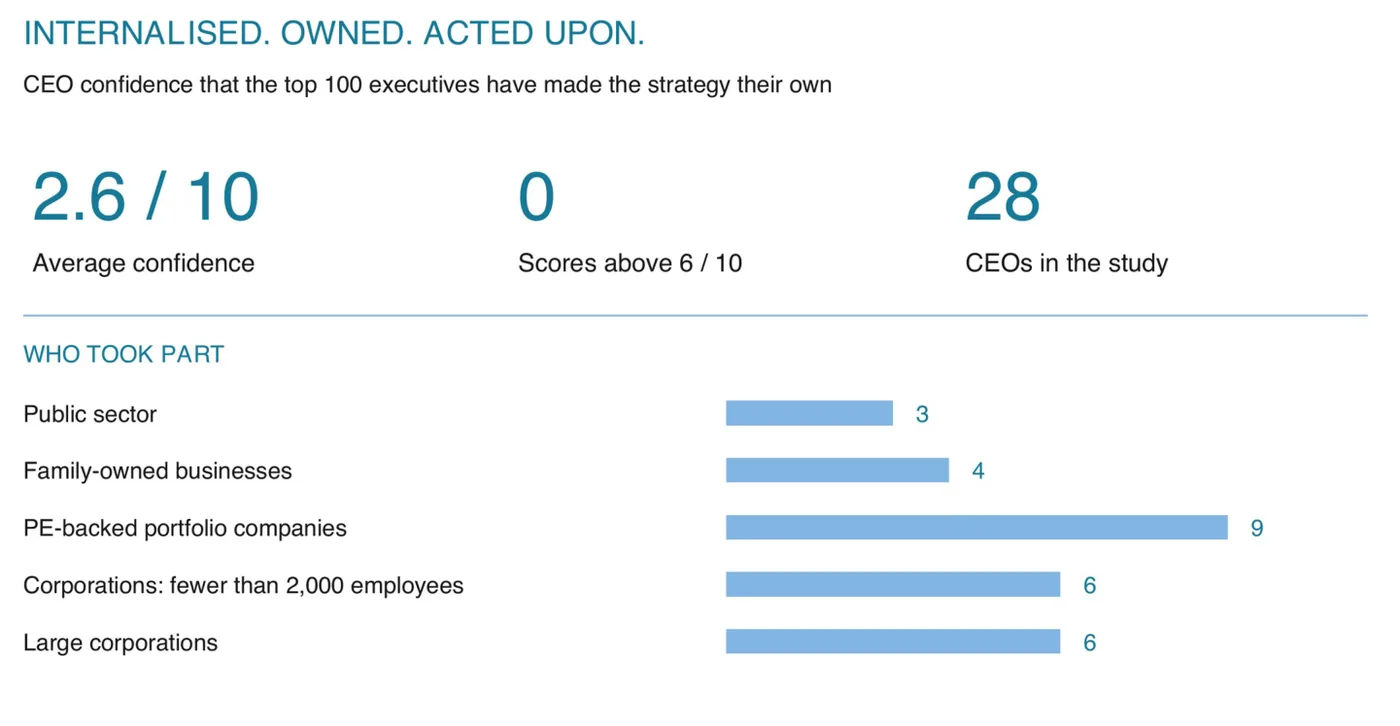
A strategy can look settled in the boardroom while the business continues to work as before. In our research with 28 chief executives in Europe and North America in early 2026, average confidence that the strategy was internalised, owned and acted upon by the top 100 executives was 2.6 out of 10. None scored above 6.
Five blockages emerged: competing priorities within the top team; undercommunication; too many projects with too little funding and staffing; slow implementation, particularly in technology and AI; and clashes of national culture, departmental rivalry and personality. They reinforce one another, and longer private equity holding periods make delay more expensive.
The responses follow the same five themes. Settle the collisions in the executive team first. Communicate until the leaders below it can explain the choices and act on them. Resource a manageable portfolio, finding capacity before adding work. Accelerate implementation by tracking whether a capability works, is used, improves the workflow and delivers value. Deal directly with the clashes between people and units.
Start with one material priority whose progress is slower than expected. Trace the work in the first month, put the decisions into effect in the second and review the results in the third. Before the next round of strategy communication, find one decision in next week's work that should be different because the strategy exists.
In this paper
- Twenty-eight CEOs. An average confidence score of 2.6.
- Where the strategy gets lost
- Competing priorities within the top team
- Straightforward undercommunication
- Too many projects with too little funding and staffing
- Slow implementation, particularly in technology and AI
- National culture, departmental rivalry and personality clashes
- Put the five themes to work
- Sources and further reading
A strategy can look settled in the boardroom while the business continues to work as before. Leaders agree the direction, approve a plan and communicate the ambition. Yet budgets, diaries and everyday decisions still reflect yesterday’s priorities. The cost is time: customers wait for improvements, capital remains tied up and the organisation has less room to respond.
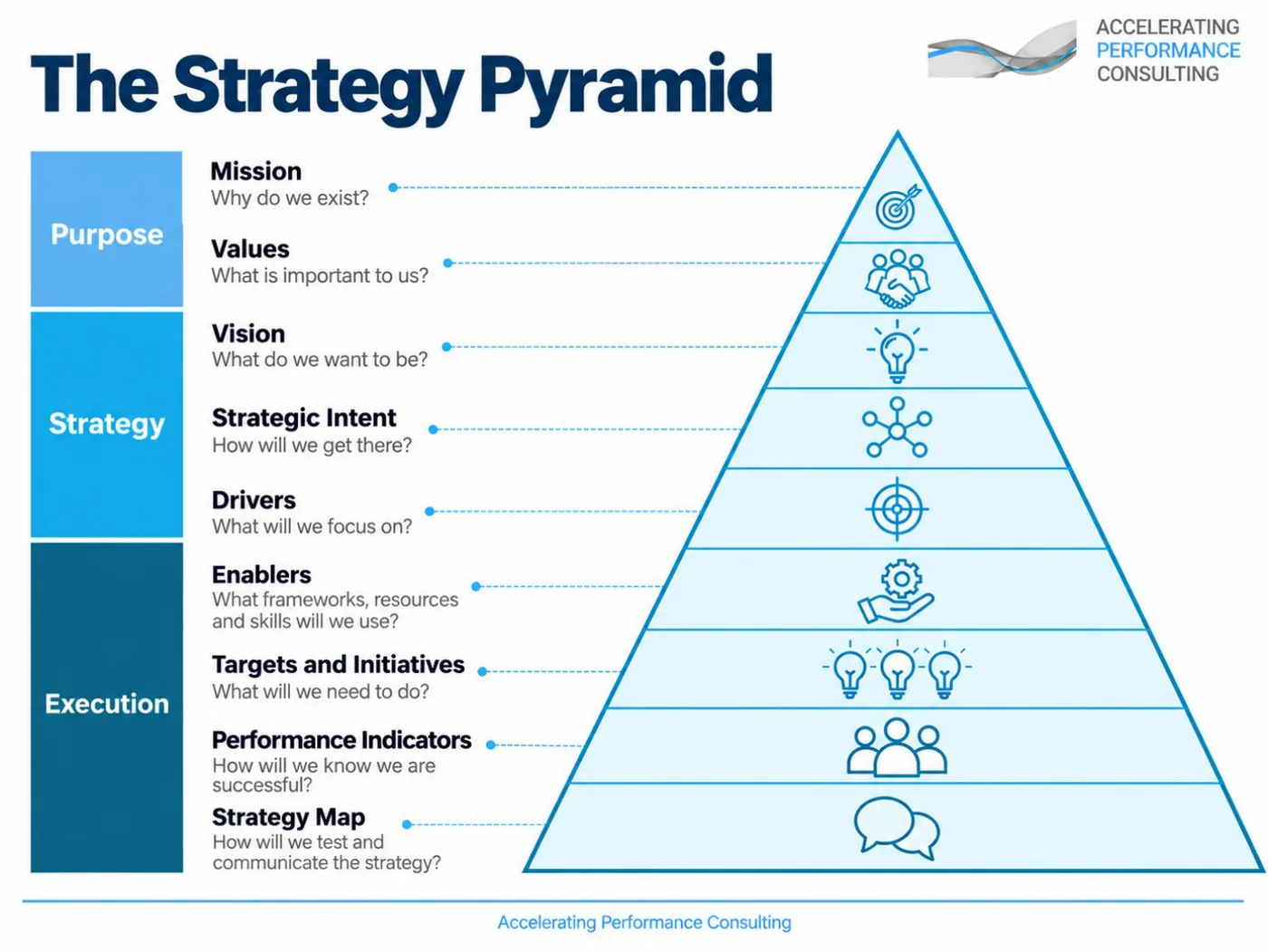
There are many different definitions of mission, vision, values and the other terms used in strategy. Arguing over them adds little value. What matters is clarity about how they connect to action. The strategy pyramid below sets out how we think about them.
Private equity faces a related pressure: capital is taking longer to come home. Bain's Global Private Equity Report 2026 places average buyout holding periods at exit at around seven years, compared with five to six years during 2010–2021.[1] Almost 40% of companies were held for more than five years, against 29% in 2019. Entry prices, financing conditions, operating performance and exit markets all matter. Geopolitics is part of the context, not a complete explanation.
For leaders, the practical implication is to shorten the journey from a sound decision to a valuable result. Improve the customer experience. Remove avoidable cost. Turn earnings into cash. Reduce a material risk. For public-service leaders, the equivalent is earlier, more reliable delivery of public value within the resources available.
Time to value has always mattered. Uncertainty makes delay more expensive: money stays committed, assumptions age and the room to respond narrows. Execution is king, provided leaders remain willing to change a strategy that the evidence no longer supports.
Which makes the results of our recent CEO research particularly uncomfortable.
Twenty-eight CEOs. An average confidence score of 2.6.
In the first quarter of 2026, we conducted research with 28 CEOs in Europe and North America, using interviews and a simple questionnaire.[2] Two central questions guided the work: what gets in the way of translating strategy into action, and what have you done to tackle these blockages?
The questionnaire also asked CEOs to rate their confidence that their business strategy was “internalised, owned and acted upon” by their top 100 executives. On a scale from 0, low confidence, to 10, high confidence, the average was 2.6. No CEO gave a rating higher than 6. All expressed concern about translating strategy into action. “Top 100” was the questionnaire’s shorthand for the senior executive population. The published account does not specify how that wording was adapted in smaller organisations, which limits comparison across company sizes.
This is a small study, and we must treat its results with caution. It gives us the perceptions of these CEOs, not a representative estimate for business as a whole or an independent assessment of their executives. The number is still arresting. Leaders who had set a direction were far from confident that their organisations had made it their own.
Figure 1 CEO confidence in strategy becoming action
A strategy that people can repeat is only the beginning. It must change what they do.
Where the strategy gets lost
Five themes emerged from the interviews: competing priorities within the top team; straightforward undercommunication; too many projects with too little funding and staffing; slow implementation, particularly in technology and AI; and clashes arising from national culture, rivalry between departments and personalities. We discuss them in that order. The sequence is a way of organising the argument, not a ranking of their frequency in the study.
These blockages reinforce one another. An unresolved argument at the top becomes a confusing message below. Confusion permits more projects to survive than the business can resource. Under-resourced projects move slowly. Differences between countries, departmental loyalties and difficult personal relationships can then make collective action harder. Everyone is busy. The strategy waits.
The responses developed in this article follow the same five themes: settle competing priorities, communicate until people can act, resource a manageable portfolio, accelerate implementation and address the clashes that obstruct delivery. They draw on our research and work on strategy, accountability and value-creation leadership. They are practical recommendations, not interventions whose effects this small study has established.
Competing priorities within the top team
Before asking middle managers to align, examine the executive team's unresolved decisions. A strategy can contain several attractive objectives which become incompatible when they compete for the same people, investment or customer. Describing them all as priorities does not make the conflict disappear. It moves the conflict down the organisation.
Take a hypothetical services business pursuing faster growth, improved margin and a new digital proposition. All three may be sensible. But the senior architect needed to build the proposition is also the person who rescues difficult client projects and helps win major bids. Each executive can produce a persuasive argument for using that architect. The company needs one decision about the architect's time.
If the executive team leaves that choice open, the person with the most immediate deadline or strongest relationship will tend to win. The strategy is then being allocated through escalation and personal influence. The formal plan may be unchanged, but its delivery assumptions are being rewritten every week.
A useful top-team discussion therefore begins with a real collision. Put the alternatives, customer consequences and resource requirement on one page. Decide what will proceed, what will wait and what risk the company is accepting. Record who is authorised to revisit the decision and what new evidence would justify doing so.
The chief executive has a particular responsibility here. If an executive releases a valuable colleague to an enterprise priority, the consequences must be reflected in the expectations placed on that executive's own business. Rewarding the original local target unchanged teaches everyone to retain their people next time. A decision that is reversed quietly in the performance review was never secure.
Leaders must also distinguish choices from aspirations. Becoming more innovative is an aspiration. Concentrating development capacity on a defined customer problem, while discontinuing a less promising product extension, is a choice. The aspiration provides direction; the choice begins to organise work.
There will be legitimate disagreement. Different functions see different risks and operate on different horizons. The aim is to make that disagreement useful before it becomes an impossible set of instructions for someone else. The executive team should leave the room knowing what it has traded away, not merely what it hopes to gain.
Make the operating choices match the stated priorities
Every business has a strategy you can read and a set of choices you can observe. The second is visible in its budget, its appointments, its product decisions and the subjects that receive the chief executive's attention. When the two diverge, employees have to decide which to believe.
The answer is not to label everyone resistant. A manager who protects a target on which their job depends may be responding rationally to the organisation around them. Someone who keeps an old project alive may have been given no authority to stop it. A team that continues collecting redundant information may still receive a call from an executive whenever that information is missing.
In our APC work on activating the leaders below the executive team, we call the practical discipline On The Hook: connecting the strategy, stakeholder expectations and what people actually do.[3] That connection must be examined at the level of meaningful deliverables. A department can align its mission statement with almost anything. Its next fortnight of work is considerably harder to disguise.
We would begin by asking the leadership team to trace one important promise all the way to the people expected to fulfil it. Where does the promise become a decision? Who changes their work? What resource moves? Which existing obligation is reduced? Where will the customer or the economics of the business show the difference?
If the answers become vague as the questions become concrete, more communication will have limited value. There is unfinished management work.
Make the measures reinforce the choice
Microsoft's April 2025 Secure Future Initiative report described a Security Core Priority linked to every employee's performance review.[4] It also reported a risk inventory and prioritisation across fourteen deputy chief information security officers. A corporate priority had been translated into individual expectations and a shared governance mechanism.
The July 2026 update reported continued accountability through that deputy structure and a central risk register, alongside concrete engineering changes.[5] Among these, Microsoft said it had decommissioned 1.4 million unused applications. The reports describe the company's programme and its own progress measures; they do not establish that the changes eliminated security risk or isolate the effect of performance reviews.
For our argument, the connection is important. A strategic priority needs to reach the questions used to allocate attention and assess contribution. Training and announcements have limited force if the performance discussion continues to reward an incompatible set of choices.
Use a small combination of measures. One should describe the customer or economic result. Another should show whether the operating change is taking place. Include a relevant measure of quality, risk or workload so that apparent progress cannot be manufactured by exporting the cost. Where outcomes take time, state what early evidence would make the team more or less confident.
Do not let a neat dashboard hide a missing mechanism. If activity is rising but the customer outcome is unchanged, investigate whether the activity is the right one. If the customer outcome improves, check whether demand, mix, staffing or some other factor changed too. A useful performance conversation is willing to revise the explanation.
Straightforward undercommunication
Undercommunication was one of the blockages raised in our interviews. It is tempting to look past it in search of something more sophisticated. Yet a strategy discussed for months by the executive team may reach everyone else through one presentation, an email and a cascade of varying quality. Familiarity at the top is mistaken for understanding throughout the business.
Explain the choices in language that managers can use: which customers matter, what the business will do better for them, why that creates value and what will receive less attention as a result. Repeat the reasoning when decisions are made. A resource allocation is an opportunity to show the strategy at work; a leadership appointment is another.
Then ask managers to explain the implications for their own teams. What will they start, stop or change? Where do they need a colleague's help? Which current target appears to contradict the direction? Their answers are a test of the communication and of the strategy's practicality. Treat an unexpected answer as useful information before treating it as resistance.
This requires conversation. A leader may have understood the words perfectly and still be unsure whether the company will back the consequences. Will a sales director really be supported in walking away from the wrong customer? Will a function be allowed to stop an established report? People watch what happens to the first person who acts on the new priorities.
Keep communicating through those decisions. The aim is shared understanding strong enough to guide action when the chief executive is absent. Counting how many people attended the launch tells you very little about that.
Activate The next 100
We use the phrase ‘The next 100’ for the leaders below the executive team who translate broad direction into operating decisions. The number is shorthand. In a smaller organisation it may be twenty people; in a larger one it may be several hundred. Include people because of the work and decisions they influence, rather than their place in a succession chart.
These managers occupy an unusually demanding position. They are close enough to the strategy to understand its importance and close enough to daily operations to encounter everything that makes it difficult. They receive the new ambition alongside yesterday's unresolved customer problem, a vacancy, an audit request and several initiatives launched by different functions.
Treating them as a communications channel wastes much of their value. Ask them to test the strategy against the operating conditions they know. Which assumptions hold? Which dependencies are missing? What could start quickly? What would have to stop? Where is the organisation asking two teams to optimise contradictory results?
Their answers may be uncomfortable. A programme that appears adequately staffed from the top may depend on the same four specialists as several other programmes. A country manager may have enough total headcount but none of the required expertise. A revenue opportunity may be real, while the timetable assumes customer approvals the business cannot control.
This is where leaders should distinguish constructive challenge from avoidance. Someone who identifies a constraint and proposes a workable alternative is contributing to execution. Someone who repeatedly refuses an agreed commitment requires a different conversation. Calling both resistance makes it harder to learn and easier to hide.
Capability matters too. Managers may need practice in negotiating dependencies, evaluating trade-offs, using commercial evidence and holding a colleague to a commitment. Give them a live problem on which to develop those skills. A training session can help; it cannot supply authority that the operating model withholds.
Participation becomes credible when it changes something. If managers raise a conflict, show the resulting decision. If their evidence overturns an assumption, amend the plan. If the answer is that the company accepts the risk, explain who has accepted it and why. Silence leaves each manager to invent their own interpretation.
The people closest to the work should help make the commitment credible.
Too many projects with too little funding and staffing
A portfolio can contain sensible projects and still be impossible to deliver. Each initiative looks worthwhile in isolation; together they compete for the same money, specialists and management attention. The response is to reduce the number of simultaneous commitments and give the surviving priorities enough capacity to succeed.
Strategy accumulates work easily. Subtraction has fewer enthusiasts. An old initiative usually has a sponsor, a history and someone who remembers why it was once important. Stopping it can feel like criticising the people who supported it, even when the underlying circumstances have changed.
Make continuation a decision that requires evidence. Ask whether the original opportunity still exists, whether the next increment of investment is justified and whether the same capability has a better use elsewhere. Money already spent explains how the company arrived here. It does not, by itself, justify the next commitment.
For every material addition to the plan, specify the capacity it requires and where that capacity comes from. The answer may be additional investment, reduced scope, a later start or stopping other work. What matters is that the answer exists before the organisation is held to the new promise.
Watch the scarce skill rather than aggregate headcount. A programme with fifty allocated people may still wait for one specialist who is spread across six priorities. Portfolio reviews should make those collisions visible. It is entirely possible to have adequate total resources and an impossible delivery plan.
The strongest evidence of prioritisation is observable. A meeting disappears from the diary. A project stops drawing on an engineer. A budget moves. A local target changes. The business has made room for its decision.
Follow the time and money
The most useful starting evidence may already exist. Diaries, project allocations, budgets, workflow records and customer complaints show different parts of the operating reality. Add short conversations with the people doing the work. The aim is to understand resource choices, not to build a surveillance system or a league table of individual busyness.
Choose a bounded population relevant to the strategic priority. Agree the categories before collecting data. Separate work that advances the chosen outcome, work required to run and protect the business, investment in future options, and work whose contribution needs examination. These are questions for judgement, not automatic labels of good and bad.
Then compare intended and observed resource use. The difference is the beginning of a conversation. A team may be devoting substantial time to service recovery because a product defect makes that work unavoidable. Removing the recovery effort before fixing the defect would harm customers. The strategic intervention is to eliminate the cause and then redeploy the capacity.
Once the team understands the work, make a small number of actual changes. Stop a report with no decision attached. Consolidate two forums that make the same decision. End a project whose original rationale no longer holds. Move a capable person to the priority that needs them, with an agreed handover and a revised expectation for the team they leave.
Record the destination of released capacity. Removing ten hours of recurring work does not automatically create ten hours of strategic progress. The time can refill with incoming requests unless the manager has a clear commitment for its use. Nor does released time automatically become a cash saving. That requires an actual change in expenditure or a credible avoidance of expenditure that would otherwise have occurred.
For material investments, trace the benefit through to cash as well as operating performance. When will revenue be invoiced and collected? Which expenditure will actually fall? What transition cost, working capital or continuing support will the change require? A presentation can show a saving while the bank account continues to fund the old process and the new one together.
Resource the customer promise
Recent Starbucks developments illustrate what it means to translate an ambition into operating choices.[7] In its August 2026 account of Green Apron Service, the company described $500 million of additional staffing investment and revised scheduling to put more baristas on the floor at busy times.[6] Its customer-service ambition was being expressed through the availability of people when customers needed them.
In July 2026, Starbucks reported a fourth consecutive quarter of positive global comparable sales growth and a second consecutive quarter of margin expansion. Its account also described changes to queue management, the menu, marketing, rewards and coffeehouses. These are company-reported developments involving several simultaneous interventions. They do not isolate the effect of staffing or establish that every location improved equally.
The managerial point is narrower and useful: a promise about customer experience needs decisions about the work that produces that experience. Staffing and scheduling belong inside the strategy conversation. They cannot safely be treated as implementation detail to be resolved after the promise has been made.
For a different business, the equivalent may be implementation engineers, service appointments, underwriting capacity or the ability to provide an accurate delivery date. The exercise is the same. Identify the moment when the customer should feel the strategic difference, then work backwards through the people, decisions and processes needed to make it happen.
Do this with the people who run the work. A front-line supervisor may know that the proposed change is impossible during the busiest hour but entirely feasible with a different shift pattern. A customer manager may know which promise matters to retention and which is merely attractive in a presentation. Their contribution should be able to alter the design.
That does not transfer the strategic decision to a workshop. Leaders remain responsible for the ambition and the economics. It makes the decision better informed and the commitment more credible. The people who will deliver it can see the reasoning and the conditions under which they are expected to succeed.
Make the commitment explicit
The familiar cascade asks each level to translate the level above it. That can help create clarity, but it can also multiply the number of objectives while leaving dependencies unresolved. Each function produces a coherent plan within its own boundary. Nobody tests whether the plans can all happen together.
For a priority involving several teams, create one working agreement. State the outcome, the contributions, the critical dependencies and the person authorised to settle a conflict. Ask each contributor to confirm the commitment against their actual capacity. A copied name in a project plan is not the same as an accepted obligation.
Keep the agreement short enough to use. It should tell people what they need from one another and what happens when reality changes. A new template with twenty mandatory fields can become another explanation for why nobody has time to execute the strategy.
Figure 2 A priority needs six concrete commitments
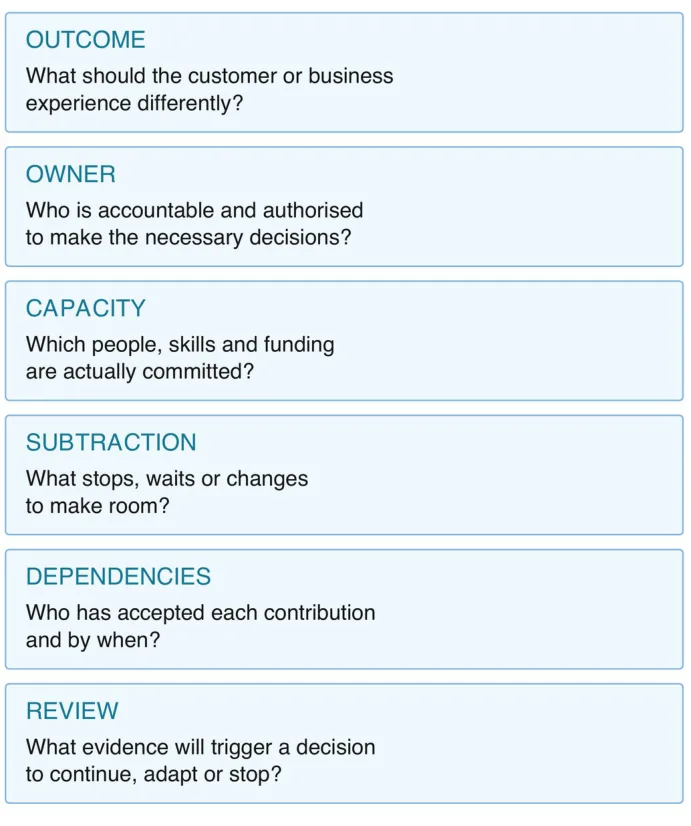
Authors' practical design, informed by APC's On The Hook and accountability approaches.[8] Each item requires an explicit answer; this is not a validated scoring model.
The agreement should also distinguish a commitment from an assumption. A colleague can commit to producing a design by an agreed date. Customer demand, a supplier's capacity or an external approval may remain uncertain. Make these assumptions visible, name who monitors them and agree when a change will trigger a new decision.
This is a more demanding form of accountability than asking whether a milestone is green. It requires people to surface difficulty while there is still room to respond. Leaders should be able to ask what was promised, what is now true, what has been learnt and what needs to happen next. Those questions follow our commitment, reality, insight and action approach.
Accountability includes consequences for repeated failure to honour a realistic commitment. It also includes consequences for executives who impose incompatible demands, withhold an agreed resource or punish an early warning. The agreement must bind both sides.
A priority is credible when someone can show what will change and what will give way.
Slow implementation, particularly in technology and AI
Slow implementation, particularly in technology and AI, was another theme in the interviews. The response needs more precision than an instruction to accelerate. A delayed project may be waiting for data, an integration, a business decision, a scarce specialist or a team willing and able to change its work. Each calls for a different intervention.
Begin with a bounded business outcome. For example, an AI-assisted service process might aim to resolve a defined class of customer requests more quickly while preserving accuracy. This is an illustration, not a finding from the survey. Name the operating leader who owns the outcome alongside the technology leader who enables it. Give them the people and decision authority to take the change through to regular use.
Work backwards from that use. Who will use the system? What changes in their day? What information does it need? Who handles exceptions? How will quality be checked and colleagues trained? What happens to the old process? These questions belong in the investment decision. Leaving them until after the technology is built creates an expensive queue at the end of the project.
Track four things separately: whether the capability works, whether people use it repeatedly, whether the workflow improves and whether the business receives the expected value. A successful demonstration establishes very little about the last three. Faster processing may release capacity, but a financial benefit requires that capacity to serve more demand, avoid expenditure or reduce actual cost.
Use short delivery cycles to resolve specific uncertainties and establish useful operating changes. Some infrastructure investments take longer; the discipline is to make their dependencies and evidence of progress explicit. Do not reward a growing collection of pilots while the business continues to operate exactly as before.
Put authority where the commitment sits
Amazon's 2024 shareholder letter, published in April 2025, described an effort to give the people doing the work greater ownership of reversible decisions. Andy Jassy also reported receiving almost 1,000 employee examples of bureaucracy and making more than 375 changes in response.[9] These are Amazon's reported actions, not a measured estimate of the financial return from removing bureaucracy.
The useful question for other leaders is what happens after a problem becomes visible. A channel for reporting friction matters when someone has the authority and willingness to remove it. Asking for feedback while leaving the approval process untouched can simply add another task to the people experiencing the delay.
Examine a recurring decision that holds up the strategic priority. Identify who currently decides, who supplies necessary expertise and who is being consulted from habit. Specify the limits within which the owner can act. Name the circumstances requiring escalation and the person who will resolve them. Preserve independent scrutiny where the stakes require it.
This does not mean pushing every decision down. Some trade-offs belong at enterprise level because their consequences cross several businesses. The practical aim is to put each decision at a level with enough information, authority and perspective to make it well. Delegating responsibility while retaining every meaningful choice at the top creates dependency under a different name.
Use evidence to keep delivery on course
There is a danger in an article about execution: implying that the strategy is always right and the organisation's task is simply to comply. Strategy includes hypotheses about customers, competitors, capabilities and economics. Some will be wrong. Disciplined execution should make the business quicker to discover which ones.
At the start of an initiative, write down the expected mechanism. If the business believes faster quotations will improve conversion, specify which customers are likely to respond and why. Track quality and margin alongside speed. A faster quotation for an unsuitable proposition will not solve the commercial problem, and an unprofitable win is not strategic progress.
When the evidence contradicts the plan, examine both implementation and the original assumption. Was the agreed change actually used? Did it operate as intended? Did customers respond? These are different questions. A poor outcome may reflect weak execution, a weak proposition or circumstances that have changed since the decision.
The leadership response matters. If every disappointing result is explained as a lack of commitment, people learn to protect the story. If every setback triggers a new strategy, they learn to wait out the current one. Set explicit review points and decision criteria so the company can learn without drifting.
When progress disappoints, examine the context, the plan and the people. Has the market changed enough to invalidate the original ambition? Are the choices and resources still credible? Does the team have the capability and authority to deliver? These questions help leaders avoid replacing a capable manager whose successor would inherit the same impossible conditions.
Match your involvement to the diagnosis. A changed context may require a fundamental rethink before more money is committed. A sound plan delivered at the right pace needs visible backing and protection from unnecessary interference. A capable team with greater potential may need a higher ambition, accompanied by ideas and resources that make it achievable.
When the business is materially off course, change your own allocation of time. Work with the team closely enough to understand the constraint and reach a decision. Waiting for the next scheduled review can turn a recoverable delay into another lost quarter. Once the intervention has worked, return authority to the people who run the business. Permanent rescue by the chief executive is an expensive operating model.
National culture, departmental rivalry and personality clashes
The fifth theme concerns clashes between people whose expectations, loyalties or ways of working differ. National culture, departmental rivalry and personality clashes can all obstruct execution, but they require different responses. Leaders need to identify what is happening in the work before asking everyone to collaborate more effectively.
Adapt implementation to the national context
A programme developed in one country cannot assume that its approach to change will work unchanged in another. A common strategy does not remove differences in how people build trust, respond to authority, challenge a proposal or become committed to a decision.
The example offered in discussing the findings was a tightly controlled programme designed in Germany and taken into Latin America. The issue is the assumption that its management routines will travel as readily as its objectives. Detailed central plans, formal reporting and prescribed sequences can create the appearance of control while leaving local leaders insufficiently involved in making the change work.
This is not a rule about German managers or Latin American employees. Both settings contain substantial differences between countries, companies and individuals. The useful question is what this particular programme assumes about the people expected to deliver it. Does formal approval establish commitment? Will concerns surface in a large meeting? Who needs to be involved before a decision can be acted upon? How much local discretion is necessary to solve problems quickly?
Ask local leaders to help design the implementation before announcing it. Establish the outcomes, essential controls and economic commitments that must hold across the business. Then agree where local teams can adapt the sequence, conversations, involvement and working routines. Test those choices with the people whose behaviour needs to change. Local knowledge should improve the plan, rather than enter as an explanation after it has failed.
The centre remains accountable for coherence. Local adaptation should have a clear reason and an observable effect, not become a general exemption from performance. Review whether the change is being used, whether concerns arrive early and whether customers and the business are seeing the intended result. A uniform reporting pack is weak evidence that a programme has taken root.
Resolve the incentives behind departmental rivalry
Departments can agree with the strategy while defending incompatible versions of success. Sales may promise flexibility that operations cannot support. A product team may want speed while a control function is accountable for avoiding failures. These are illustrative situations, but they show why an appeal to teamwork can leave the real conflict unresolved.
Take a consequential decision or handover and bring the relevant leaders together. Establish the customer outcome, the competing demands and the cost of delay. Agree the contribution each department must make, who can decide and which trade-offs require executive resolution. Where local targets contradict the shared outcome, change the targets. Leaving them intact rewards the rivalry you are asking people to overcome.
The top team must apply this discipline to itself. If an executive continues to protect a departmental result after agreeing a collective priority, colleagues learn that the agreement is optional. Review progress across the whole process, including the points where work crosses boundaries. Make the shared result visible enough that a local success cannot conceal a failure for the customer.
Address personality clashes through behaviour and accountability
Some blockages persist even when the objectives and responsibilities are clear. Two leaders may distrust one another, interpret challenge as a personal attack or repeatedly reopen decisions because they dislike who made them. The consequence is borne by the teams below: information arrives late, meetings become defensive and decisions wait for the chief executive to intervene.
Deal with the behaviour specifically. Identify what was agreed, what happened and what it cost the work. Give each person an opportunity to explain their perspective, then establish the behaviour required from both: sharing information on time, challenging an idea directly, honouring a settled decision and raising a disagreement through the agreed route. A facilitated conversation can help when trust has deteriorated. Vague instructions to improve chemistry rarely do.
Leaders need not become friends to work well together. They do need a professional agreement they can keep. Review it against actual decisions and handovers. If someone repeatedly breaches that agreement, address it through performance management. If the operating conditions keep recreating the conflict, change those conditions too. Personality should not become a convenient explanation for a problem the leadership team has designed into the organisation.
Put the five themes to work
Begin with one material priority whose progress is slower than expected. Examine it through the five themes, in the same order. Has the top team settled the choices? Can the people delivering it explain what changes? Are the funding and people genuinely committed? What is holding up implementation? Which national, departmental or personal differences are obstructing the work?
In the first month, establish the baseline and trace the work. Bring together the executive sponsor, the managers who deliver it and the colleagues controlling the key resources. Examine the promise, the assumptions, the actual allocation of effort and the decisions waiting to be made. Use existing evidence before commissioning another survey. The first output should be a small set of decisions, not an encyclopaedia of obstacles.
During the second month, put those decisions into effect. Move the agreed capacity, stop or defer the competing work, clarify decision rights and amend conflicting measures. Test the working agreement on actual cases. The executive sponsor should remove obstacles that only the executive team can resolve, while leaving operating decisions with their agreed owners.
In the third month, review what changed. Compare the relevant operating and customer measures with the baseline, recognising changes in workload and other conditions. Where practical, use a comparable unchanged team or process to strengthen the interpretation. Record implementation costs as well as benefits. Some outcomes will take longer than ninety days; be explicit about what can and cannot yet be judged.
At the review, decide what to keep, adapt, extend or stop. Put the surviving commitments into normal budgets and management routines. A transformation office can support the work, maintain evidence and expose dependencies. The line leaders who control people, expenditure and customer delivery must continue to own the result.
The purpose of the ninety days is to establish a repeatable management discipline and shorten time to value. One priority, followed through properly, can reveal more about the organisation's capacity to execute than another company-wide declaration of urgency.
The point is to make a few consequential decisions and follow them through. ‘The next 100’ need a direction they can explain, commitments they can fulfil and enough authority to deal with the circumstances they encounter. They also need leaders willing to hear that an assumption is wrong.
Before launching another round of strategy communication, look at next week's work. Identify one decision that should be different because the strategy exists. Make it. Identify the capacity it requires and the work that must give way. Then follow the result through to the customer and the economics of the business.
You cannot settle the geopolitical outlook in that meeting. You can settle who will do what, with which resources, by when.
That is where the strategy will be found.
Sources and further reading
The survey findings are supplied by the authors. Public company examples concern 2025–2026 developments and are company-reported accounts, not controlled evaluations. Practical recommendations and illustrative situations should not be read as measured survey outcomes.
1. Bain & Company (2026). Private Equity Outlook 2026: Gaining Traction, Figure 17; PitchBook and Preqin data. Average holding periods at exit exclude assets still held. The report compares around seven years with five to six years in 2010–2021; it does not establish a universal four-to-six-year shift or attribute the change solely to geopolitics. Read source
2. Authors' CEO study, Q1 2026. Twenty-eight CEOs: 3 public sector, 4 family-owned businesses, 9 PE-backed portfolio companies, among the remaining businesses, 6 corporations employing fewer than 2,000 people and 6 large corporations; 19 male and 9 female, all Europe or North America. Interviews and a simple questionnaire organised around two central questions. Confidence item: “Rate your level of confidence that your business strategy is internalised, owned and acted upon by your top 100 executives.” Scale 0–10; mean 2.6; no score above 6. The categories are the study’s assigned groups, not overlapping totals. Small sample; no claim to representativeness. Findings are CEOs' perceptions. Theme frequencies, subgroup comparisons and causal effects are not reported.
3. Price, C., and Toye, S. (2017). Accelerating Performance. Wiley. The discussion of mobilisation, execution, transformation and agility provides the background to the practical recommendations on leadership commitments and delivery.
4. Bell, C. (2025). Securing Our Future: April 2025 Progress Report On Microsoft's Secure Future Initiative. Microsoft Security Blog, 21 April. Read source
5. Chawro, S. (2026). Securing Our Future: July 2026 Progress Report On Microsoft's Secure Future Initiative. Microsoft Security Blog, 10 July. Read source
6. Warnick, J., and Dahlstrom, L. (2026). The Starbucks Turnaround Is Happening One Customer Connection At A Time. Starbucks, 11 August. Read source
7. Starbucks (2026). Starbucks Reports Q3 Fiscal Year 2026 Results. 29 July; quarter ended 28 June 2026. Read source
8. Authors’ practical synthesis. The recommendations on resourcing, cash discipline, challenge and revising assumptions draw on our consulting and operating experience. They are not independent validation of the CEO survey or quantified estimates of intervention effects.
9. Jassy, A. (2025). Amazon CEO Andy Jassy's 2024 Letter To Shareholders. Amazon, April. Read source