Executive summary
An executive committee sees the large value creation opportunities: the boulders. Managers below it see the pebbles: the unmet customer need, the payment delayed by missing documents, the process that wastes a day. In a private equity holding period, with less help from cheap debt and rising multiples, many of those smaller opportunities are the practical means of delivering the investment thesis.
Too many businesses leave this layer unactivated. In one acquired manufacturer, 110 middle managers analysed their diaries before and after the deal and found their time had barely changed. Activation means equipping managers to recognise an opportunity, make an informed choice, act within clear authority and carry the work through to a measurable result.
Our ABC model connects that ambition to the conditions that change behaviour. Connect managers with the purpose and the economics. Align decision rights, processes, incentives and honest appraisal. Build commercial judgement and execution discipline. Role-model enterprise behaviour at the top. Provide the capacity and psychological safety to test, fail usefully and choose. As AI changes the work, the management roles that remain must add more than the transmission of information.
Start with one consequential outcome in the value creation plan, such as cash collection in a region. Invite the relevant managers to identify the opportunities beneath it, agree an owner, authority and capacity for each, and let finance confirm what has been realised.
In this paper
Stand above a beach and the boulders are easy to see. They dominate the view. From that height, you cannot make out the many small pebbles beneath and between them. Walk down to the beach and a different picture emerges.
Senior management has a similar view of a business. The boulders are the large value creation opportunities: a stronger pricing position, a new market, acquisition synergies, a substantial release of cash. They deserve the attention they receive. But beneath them sit hundreds of smaller opportunities that are difficult to see from the boardroom.
Middle managers are close enough to see the pebbles. An account manager recognises a customer need the standard offer misses. A service leader knows why engineers make repeat visits. A project manager can explain why completed work remains unbilled. Each sees something that an aggregate performance report can conceal.
For a private equity owner, this matters twice. Some of these opportunities are the practical means of delivering the investment thesis. Others can add value that the original plan never identified. A business needs leaders who can discover and pursue both.
That requires the executive committee, or Exco, to give the next layer more than a set of targets. Those managers need commercial understanding, authority and time to act. A change of ownership does not automatically provide any of them.
A manufacturing business we worked with illustrates the problem. It had been a division of a larger company and was sold to a new corporate owner. The acquisition process took about nine months. By the time the transaction completed, people were exhausted but excited. They believed they were escaping the constraints of their former parent and joining a more successful global company with much greater ambition.
The new owner followed a familiar acquisition playbook. It agreed the strategy, replaced weak leaders, sold or closed questionable product lines, formed a new board and put strong incentives in place for the top team. The direction had changed, and the people at the top had powerful reasons to pursue it.
A year later, progress was disappointing. The chief executive had been replaced and the owners were deeply concerned. We were asked to investigate where the business was getting stuck.
We asked 110 middle managers to analyse their diaries, allocating their time across 24 categories of activity and comparing how they spent their time before and after the acquisition.[1] The result was striking: the allocation had barely changed. Despite the transaction, the new strategy and the urgency at the top, managers were still spending their days on much the same work.
The diagnostic made the gap tangible. The owners had changed the business they intended to build, but that ambition had made little difference to the daily work of the people responsible for running it. A strategy can be understood as an announcement without being translated into different priorities, decisions and commitments.
This was a corporate acquisition, not a study of private equity investments. The lesson for PE is nevertheless directly relevant. Changing ownership, governance and incentives at the top does not automatically change how the wider business operates. The diary analysis described one company; it did not establish a universal cause of underperformance. It did reveal a question that every ambitious owner should ask: what are the managers below the executive team actually doing differently?
The leaders immediately below the Exco should therefore be treated as a source of commercial insight and initiative. They help deliver the major opportunities, identify smaller ones and connect the two. Their contribution depends on the quality of their judgement and on whether the organisation allows that judgement to change what happens.
This is where much of the investment thesis becomes real, and where its next improvement may begin.
The view from the boardroom shows the boulders. It cannot reveal every pebble.
The value sits below the boardroom
Private equity makes the issue particularly consequential. An investment thesis combines an expectation about the future with a timetable for reaching it. The price paid, capital available and intended holding period all shape the demands on the business.
Bain’s Global Private Equity Report 2026 argues that the conditions which supported returns through cheap debt and expanding valuation multiples have changed, placing greater demands on earnings growth and operational value creation.[2] The implication we draw is straightforward: owners need greater confidence in the organisation’s ability to deliver the improvements on which the investment depends.
Consider cash generation. The board can identify working capital as a major opportunity. A local manager may discover that one customer rejects every invoice without a particular acceptance document. Securing that document at the right point could remove a recurring delay. A service manager might notice that customers repeatedly request an additional service the company could profitably offer. This is commercial discovery as well as better execution.
An individual opportunity may be too small to reach the Exco agenda. Repeated across accounts, sites or transactions, its cumulative value can become substantial. A small improvement may also make a larger investment work: a new service platform creates little value if avoidable handover failures keep customers from using it.
This calls for judgement about which pebbles to pursue. Assess the likely customer and economic benefit against the effort, cost and risk. Some changes belong with a local manager; others need colleagues to act together. If the same problem recurs across ten sites, a common process or policy may need changing. Senior leaders should resolve that constraint rather than approve ten separate workarounds.
Timing matters too. Suppose, purely illustratively, that a set of improvements would produce an additional £4 million of annual operating earnings, measured as EBITDA. If the same recurring benefit begins three months later, with everything else unchanged, approximately £1 million of earnings falls outside that period. Actual outcomes will depend on implementation costs, the build-up of benefits and other changes in the business. EBITDA is also not cash. The illustration simply makes the cost of delay visible.
By acceleration, we mean reducing the time taken to create value. The middle of the organisation is where that time is often won or lost.
There is relevant external evidence, although it should be interpreted carefully. A McKinsey analysis published in 2023 matched management-practice data with shareholder returns for 50 companies over 2017–2022.[3] Stronger managerial practices were associated with better returns. The researchers explicitly caution that the analysis demonstrates correlation, not causation. It is not a study of a PE “top 100” intervention, but it provides a reason to take management quality seriously as an economic issue.
The practical task is to connect the major priorities to local knowledge, give managers the means to act, and establish which improvements create value for the whole business.
Choose the leaders around the value
We use “the top 100” as shorthand for the leaders below the Exco who materially influence the company’s performance. In a smaller portfolio company there may be 25. In a larger group there may be 200. The number should follow the work.
These leaders might run countries, sites, product lines, customer relationships, technology teams or important specialist functions. Some will hold substantial budgets. Others will influence disproportionate value through their expertise or their ability to connect different parts of the business.
Start with the value creation plan and trace the work required to deliver it. Then look for the people who can reveal what the plan misses. Which managers control important decisions or resources? Who understands customer needs, recurring failures and opportunities across the handovers between functions?
That exercise may identify a regional service leader whose insight matters more to customer retention than a senior headquarters role. It may reveal a specialist whom everyone consults but nobody includes in the leadership discussion. Those selected also need to listen to the people doing the work. Frontline knowledge will not travel upwards merely because another leadership group has been formed.
This is a working group with a clear contribution to make. Membership should not become a reward for seniority or an invitation list assembled to avoid hurt feelings.
Nor should one hundred people attempt to operate as a single decision-making committee. They need a shared understanding of the business and dependable ways of working together. Specific decisions belong with individuals or smaller teams with clear authority.
Their contribution has four directions. They translate enterprise priorities into local choices. They connect work across functions and businesses. They bring customer knowledge, operating evidence and new opportunities back into the strategy. And they lead people: carrying the culture through their daily conduct and earning the discretionary effort that no job description can command.
Managers’ discoveries should help improve the plan. Figure 1 connects major priorities to opportunities they are close enough to recognise and pursue.
Figure 1 Connect the boulders to the pebbles
| The boulder | Pebbles managers can recognise and pursue | Evidence of value |
|---|---|---|
| Profitable growth | Identify an unmet need on an existing account; test an offer with agreed margin and delivery limits. | Additional contribution, repeat purchases and customer response |
| Margin improvement | Correct recurring discount exceptions; remove a repeat fault that causes rework or premium freight. | Realised margin, repeat failures, total delivery cost and service quality |
| Cash generation | Secure the missing acceptance document; correct billing errors; resolve a recurring cause of disputes. | Time from completion to cash, dispute age and cash actually collected |
| Acquisition integration | Share a useful site practice; remove a duplicate handover; clarify ownership of shared customers. | Time saved and redeployed, customer continuity and verified integration benefits |
| Scalable performance | Coach routine decisions; remove approvals that add delay without protecting value. | Decision time, avoidable escalations, quality and control |
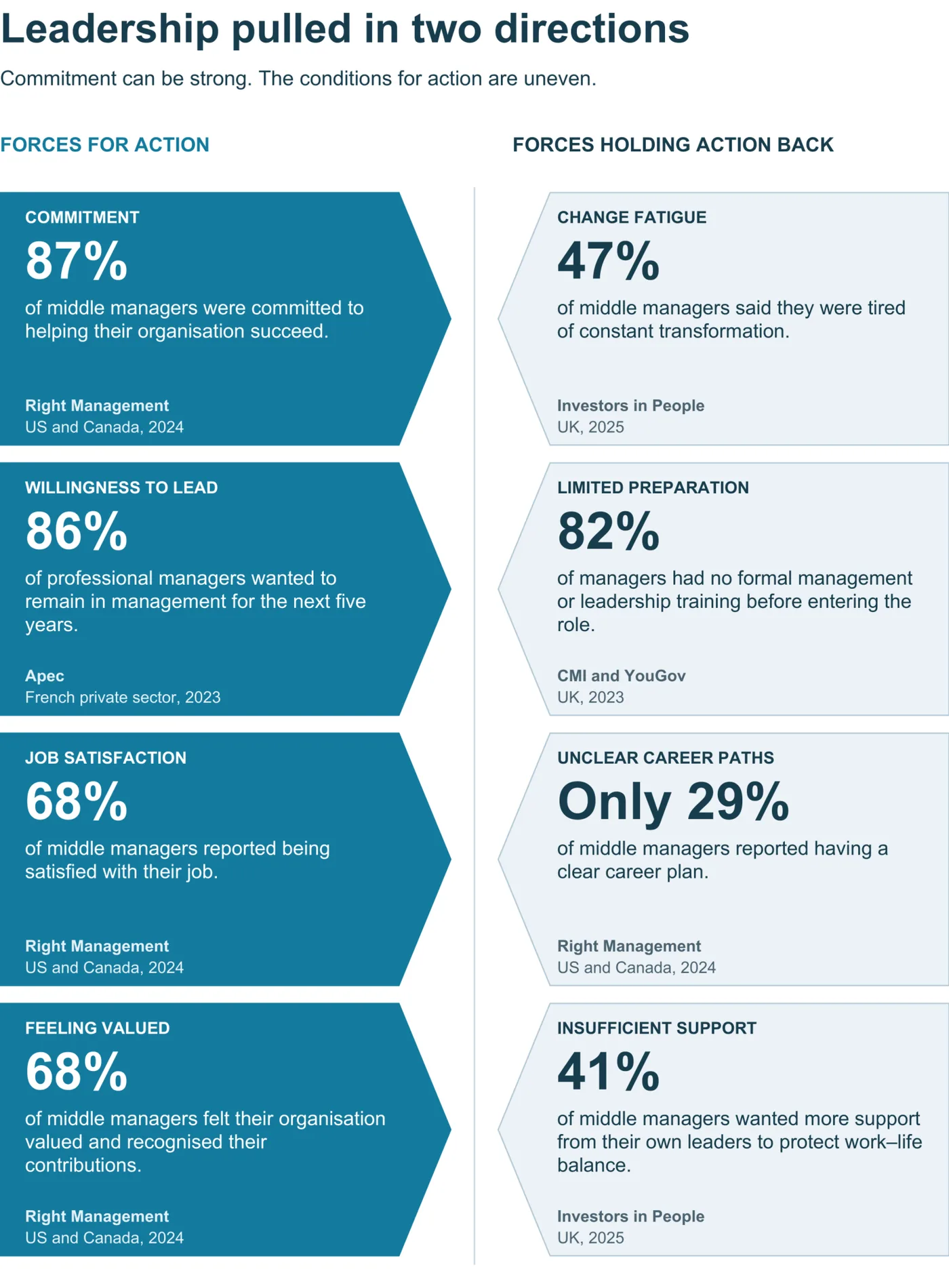
A view from the middle
Before asking how to activate the leaders below the Exco, consider what it is like to be one of them.
Barry Oshry’s work on organisational systems offers a useful explanation.[4] In Seeing Systems, first developed long before today’s debate about management layers, he asks us to look at the conditions a position creates. Those at the top can feel burdened by responsibility; those below can feel that decisions are done to them. People in the middle are pulled between competing demands. These are ways of experiencing a system, not fixed personality types. An executive can be at the top of a function and in the middle between its people and the board.
For a portfolio-company manager, the pull is tangible. Owners and the Exco want delivery, alignment and no surprises. Teams want resources, protection and an honest account of what is coming. Peers want cooperation, often while competing for the same people or investment. Each demand may be reasonable in isolation. The manager has to reconcile them in the same working week, sometimes without the authority to resolve the conflict. Being held accountable does not make the missing decision arrive.
Oshry describes how people can lose their independence in that position. They may identify so strongly with those above that they become enforcers and lose the confidence of their teams. Or they may defend their teams so completely that they stop representing the needs of the wider business. Others become message carriers, relaying demands upwards and downwards without helping either side reach a workable decision. What looks like personal indecision can be a response to unresolved conflict around the role.
The leader above can ease or intensify that conflict. A manager asked to explain a decision needs enough involvement to understand it and raise practical objections before it is announced. They also need permission to say what remains uncertain. If the Exco punishes an accurate forecast because it is disappointing, the next forecast may become more optimistic without the business becoming any stronger. Managers are employees too. The leadership they receive shapes the leadership they can give.
A day in the middle
Consider an illustrative Monday for a regional operations director. A sponsor asks for information that largely duplicates last week’s return. A customer escalation fills the time reserved for coaching. On the integration call, an acquired site still awaits the Exco’s decision on which system to use. A direct report then asks whether rumours about removing a management layer are true. The director does not know. That afternoon brings a pricing announcement to explain to the team, although the director was not involved in the decision and can already see two difficulties. Finally, the CFO asks why the forecast has become less optimistic. It has become more accurate. The director pauses before saying so.
The point of the example is the accumulation. Time intended for leadership is consumed by requests, gaps and decisions held elsewhere. The director must still maintain customers’ confidence and the team’s commitment. Add the expectation of using AI to do more with fewer people and there is another uncertainty: what, precisely, is the manager now expected to contribute? A capable person can need help answering that question without being resistant to change.
Oshry’s answer includes staying connected to other managers. When each remains absorbed in their own unit, a shared problem can feel like a private failure. Meeting as peers allows them to compare what they see, diagnose a problem spanning several functions and coordinate a response. This gives the top 100 a purpose beyond receiving the same presentation. A hundred capable people in separate positions do not automatically form a leadership group.
This perspective changes the diagnosis. Waiting for permission, repeated escalation and guarded forecasts can signal conditions the Exco has helped create. They can also reflect a real capability or performance gap; the task is to distinguish the two. ABC provides a way to examine the whole setting and choose a coherent response. Bringing the managers together helps them make that response work across the business.
Turn commitment into action
Our thesis is that too many businesses leave middle managers unactivated. They may be capable, conscientious people who care deeply about their customers and teams. Yet the business has not primed and supported them to take meaningful action. They can see the pebbles without having a practical way to turn those opportunities into value.
By activation, we mean equipping managers to recognise an opportunity, make an informed choice, act within clear authority and carry the work through to a measurable result. It requires purpose, an operating model that supports action, the right skills, an example from the Exco and space to lead. A favourable engagement score does not establish that those conditions exist.
A manager can be loyal to the company and frustrated by its approval process. They can be committed to their team and unconvinced by a new initiative. They may know what should change but lack the time, authority or reward for making it happen. The useful question is what they are ready and able to do, and what stands in their way.
Some managers also lack the capability or willingness the role now requires. Those gaps need an honest response. But asking good people to show more commitment will achieve little when the system prevents them from acting on the commitment they already have.
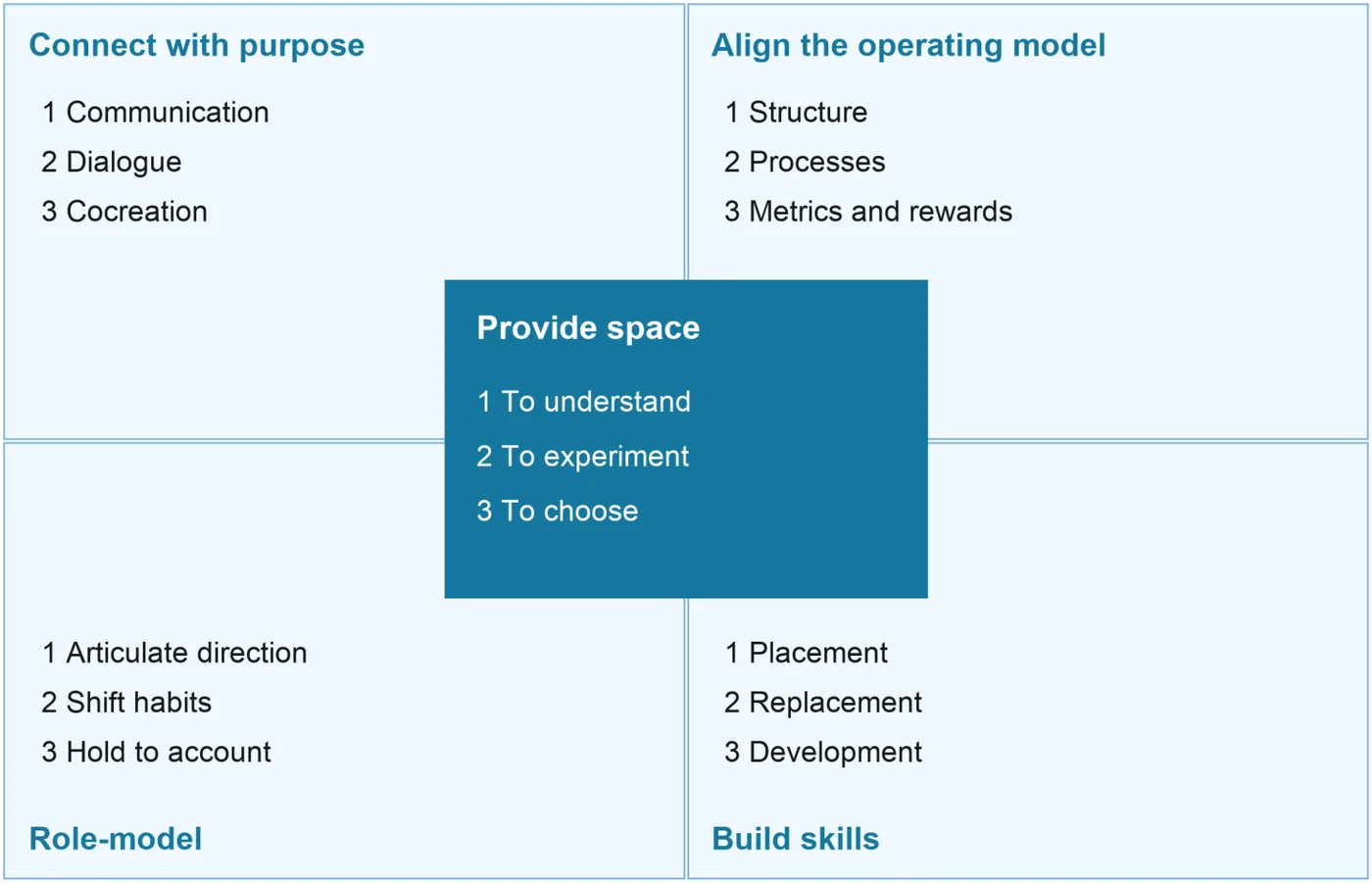
In Accelerating Performance, we developed the Any Behavior Change model, or ABC, to connect an ambition with the specific conditions needed to change what people do.[5] It has five arenas: connect with purpose, align the operating model, build skills, role-model and provide space.
For this task, ABC is an enablement mechanism. Purpose helps managers choose the opportunities that matter. The operating model gives them authority, information and incentives. Skills make competent action possible. Role-modelling shows that the Exco will support the behaviour it asks for. Space gives people time to act, learn and follow through.
The five arenas work together. Skills have little value if every decision must travel upwards. Delegation becomes an empty gesture when executives reverse decisions or leave managers without resources. A bonus cannot release time that reporting has consumed. ABC helps the Exco identify the specific condition blocking action and change it, then judge progress through customer and economic results.
Figure 2 The ABC model
Connect with purpose
Managers need to understand what the owners and the Exco are trying to achieve, why it matters and how the business will win.
“Deliver the value creation plan” is not sufficient. Neither is a financial target presented without an explanation of the choices beneath it.
Take a business seeking better margins. Does that mean improving prices because customers value its distinctive service? Exiting work it cannot deliver profitably? Reducing errors? Changing the product mix? Each possibility requires different decisions. A manager cannot exercise useful judgement if all they receive is the number.
The conversation therefore needs to reach the economics. Which customers are attractive, and why? Where does the business make money? What consumes cash? Owners and executives must also agree the time horizon and funding behind the ambition. Managers cannot sensibly judge a customer investment if one sponsor expects a return this year and another assumes several years of development.
Some information will remain confidential. Leaders should be explicit about that boundary while sharing enough for managers to make the decisions expected of them. A leadership group cannot be held accountable for a commercial logic it has never been allowed to understand.
Purpose also needs to make sense to the people doing the work. The sponsor’s return matters to the owner. Managers may connect more strongly with building a business customers trust, creating better jobs, developing expertise or making an acquired company more competitive. These motivations can reinforce one another when the business explains their relationship honestly.
ABC distinguishes communication, dialogue and cocreation. Each has a place.
Communication establishes the direction. Dialogue reveals what people understand, doubt or believe will get in the way. Cocreation involves managers in designing the changes for which they will carry responsibility.
The Exco still makes strategic choices. Managers help test those choices against customers and actual work, shape their delivery and identify opportunities that were invisible from above. The discussion should be specific enough to change a decision, a resource allocation or the plan itself.
A useful test is to ask several managers, separately, to explain the company’s priorities, one local opportunity worth pursuing and one attractive-looking activity they would decline. Then examine whether their decisions reflect those explanations.
Agreement on the wording of a purpose statement is a modest achievement. Agreement on what to do when priorities collide is much more valuable.
Align the operating model
Once the contribution is clear, the organisation must enable it.
Start with decision rights. Which decisions should this group make? Which require consultation? Which remain with the Exco or board? What financial, customer, safety or regulatory boundaries apply? How will exceptions be resolved?
A manager needs to know which opportunities they can pursue without returning for permission, how much time or money they can commit, and when colleagues must be involved. A modest trial within agreed limits should have a proportionate approval process. Requiring every pebble to travel to the boardroom will soon exhaust the people carrying them.
Authority must then survive its first difficult use. If the chief executive routinely reopens decisions made within agreed boundaries, managers will learn to seek permission in advance. The organisation will have delegated responsibility while retaining the delay.
Cross-functional work needs equally explicit arrangements. Consider reducing the time between installation and payment. Sales, operations, service and finance may each meet their departmental targets while the invoice remains disputed. Give one person responsibility for the complete outcome and secure commitments from those who control its parts. Escalate conflicts they cannot resolve, with a named executive responsible for deciding.
Processes turn that authority into reliable work. Trace a real customer order from promise to payment. At each handover, establish what information must be complete, who accepts the work, how long it should take and what happens when it is wrong. Remove duplicate approvals and checks that add delay without protecting the customer or the business. A box on the organisation chart will not repair a broken handover.
Management processes need the same attention. Planning, budgeting, resource allocation and performance reviews should help managers act on the priorities. A manager asked to improve delivery needs a practical route to change staffing or secure a small investment. Agree decision thresholds, response times and an escalation route for exceptions. Review waiting time, rework and customer outcomes to see whether the process has improved.
Use the operating rhythm to make those decisions, examine results and share useful discoveries. Managers should be able to see whether a problem has already been solved elsewhere. Keep the information proportionate: the opportunity, owner, next action and evidence of value. A new reporting industry would consume the capacity this work needs.
Compensation and incentives are part of the operating model. Set base pay to attract and retain the capability the role requires, then connect variable pay to a small number of outcomes the manager can influence. Combine company performance with local delivery and contribution across boundaries. A manager who releases a strong colleague to a higher-priority project should have their own commitments adjusted, rather than lose out for making the right enterprise choice.
Private equity creates a particular fault line. The management incentive plan, or MIP, may offer the Exco substantial wealth if the investment succeeds, while reaching the next layer only weakly or not at all. Executives with life-changing sums at stake can then wonder why middle managers do not share their intensity. Those managers may be carrying much of the delivery risk for an ordinary salary and a modest annual bonus. The financial proposition is plainly different.
Owners should examine who materially creates the value and whether the reward arrangements recognise that contribution. Meaningful MIP participation may be appropriate for a wider group. Where it is not, a credible longer-term cash incentive or participation in realised results can help connect managers to the value they create. Explain the potential reward, the conditions attached and what each manager can influence. A token allocation or an opaque promise at exit will do little to close the gap.
Executives should also resist assuming that the next layer shares their own ambitions. Some managers want to join the Exco; others want to master their craft, develop their team, enjoy strong working relationships or gain more control over how they deliver. Ask what matters to each person. A promotion that removes someone from work they value may be a poor reward. These motives can coexist with ambition and a wish to earn more. Recognising them does not excuse an inequitable financial proposition.
Make the link between contribution and reward credible. Bonus payments should reflect realised results, with customer, quality and risk conditions that prevent a short-term gain from damaging the business. Assess how results were achieved as well as the numbers. Promotion should recognise people who build capable teams and help colleagues succeed. It should not reward the accumulation of direct reports.
This depends on an appraisal system willing to tell the truth.[6] Too often, ratings crowd the upper end of the scale while delivery falls short. Familiarity, loyalty and the wish to avoid an uncomfortable conversation can inflate the score. Research describes this as leniency bias. When weak and outstanding managers receive similar assessments, pay and promotion cease to distinguish their contributions.
Define what each rating requires before the period begins. Use evidence of outcomes and observable behaviour, distinguish results from circumstances outside the manager’s control, and calibrate assessments across functions. Require an executive who proposes a high rating to explain the evidence. Examine repeated gaps between generous appraisals and poor customer, team or financial outcomes.
The aim is an accurate assessment of each person. A compulsory bell curve can misclassify a strong team just as easily as inflated ratings can conceal a weak one. Regular, candid feedback makes the annual appraisal a review of a known picture rather than a surprise. Where the evidence shows a shortfall, the rating, reward and follow-up decision must reflect it.
An inflated appraisal postpones a difficult conversation. It does not improve performance.
Redesign work and roles
Activating middle management does not mean preserving every management job. AI can absorb parts of reporting, information gathering, routine analysis and coordination. Where those activities account for much of a role, our expectation is that businesses will need fewer middle managers. The extent and timing will depend on the work, the reliability of the technology and what customers and employees still need from a human leader.
A Procter & Gamble experiment conducted in 2024 found that, on product-development tasks, individuals using generative AI produced ideas of comparable quality to two-person teams without it.[7] AI also helped combine technical and commercial thinking. Reported by Harvard Business School in 2025, the finding concerns a defined task, not management headcount. Test how work can be reorganised before deciding which roles to change.
Start by redesigning the work. Identify which tasks can stop, which AI can perform reliably and where human judgement remains essential. Then determine the roles, management layers and number of direct reports that the revised work requires. Test whether managers can still coach people, resolve exceptions and maintain control before expanding their responsibilities. A reduction in reports produced is not, by itself, evidence that a team needs less leadership.
The managers who remain will need to do more than transmit information between levels. They will judge competing opportunities, develop people, connect functions and take responsibility for the quality of work produced with AI. McKinsey’s analysis of management in an organisation using AI agents makes a similar case for stronger domain expertise, judgement and people leadership.[8] Managers must understand the technology’s limits well enough to challenge its output.
For work done by AI agents, specify what the agent may do, which outputs need human review and when a person must intervene. Managers need access to the assumptions and evidence behind recommendations they must defend.
For a portfolio company, the question is how much management the future business needs and what value each role adds. Released time may support more growth or allow a smaller management structure; the business should make that choice explicitly. Communicate the implications honestly, prepare people for changed roles and make necessary departures fairly. The top 100 may become the top 70. Its contribution should become stronger.
Build skills
Start with four questions. Do you know who the leadership population is? Do they know? Do you know what you expect of them? Do they know? If either side is unclear, a development programme begins with an avoidable handicap. Name the group, explain why its members matter and make their expected contribution explicit.
A manager can be excellent at running an established function and less prepared for the demands of a new ownership period.
The business may now require faster growth, more disciplined pricing, integration across acquisitions or decisions based on unfamiliar data. Technical expertise remains important, but the role has expanded.
Moving from expert to leader of leaders is a further transition. A specialist may now lead people with deeper expertise in unfamiliar disciplines. Their contribution is to ask useful questions, reconcile different judgements and develop others. Give them practice in that work and a credible place to seek help.
CMI and YouGov’s 2023 UK study found that 82% of managers had received no formal management or leadership training before entering the role.[9] Giving someone responsibility does not automatically equip them to exercise it.
Make the right people choices
Within Build skills, ABC asks leaders to consider placement, replacement and development. These are substantive choices. A strong specialist may be misplaced in a people leadership role. Another manager may be capable of meeting the new standard with development and experience. Some will not be able to meet the demands of the role, even with reasonable support. Others may be able but unwilling. Repeatedly assigning all four groups to another development programme avoids the decision.
Make expectations explicit, establish the evidence and give people candid feedback and a fair opportunity to improve where improvement is realistic. Where the gap cannot credibly be closed within the time the business needs, make the change: redeploy someone into a suitable role if one exists, or replace them and manage their departure with dignity. Once that judgement is made, close the gap between decision and action. Another appraisal cycle is not a remedy. Delay transfers the cost to customers, colleagues and the team. Their successor needs a clear mandate and a proper handover.
These judgements concern fitness for a particular role, not someone’s worth as a person. Nor should excellence in the current job be confused with potential to join the Exco. A business needs outstanding operating leaders who build careers through deeper expertise and broader contribution. High performance below the Exco should be a valued destination.
Develop capability through the work
Four capabilities deserve particular attention.
Commercial judgement enables managers to connect their actions to revenue, margin, cash and risk. It includes estimating the value of a local opportunity, understanding the cost of pursuing it and recognising when a departmental gain would make the business worse off.
Execution discipline turns an opportunity into a testable commitment. Establish what is happening now, examine the cause, agree a change and check the result. Managers need to know when to adapt, stop or escalate as well as how to follow through.
Leadership across boundaries enables managers to challenge colleagues, resolve competing demands and share resources without relying on the chief executive to arbitrate every disagreement.
People leadership brings the team’s knowledge into the work. Ask employees where customers wait, what repeatedly goes wrong and which requests the business struggles to meet. Coaching and useful feedback help people test improvements; succession and timely action on underperformance make the capability less dependent on one manager.
These capabilities develop through application. A pricing leader can practise a difficult negotiation on a live account. A site leader can work with finance to understand the economics of rework. Managers from acquired businesses can learn to resolve disagreement while designing a process they will use. Review how they reached the decision as well as whether the result improved.
Formal learning helps when it equips people for those tasks. It becomes less useful when the organisation treats attendance as evidence of capability.
Role-model
The executive team teaches the organisation how leadership works through its own conduct. Compensation, appraisal and replacement decisions will have little credibility if Exco members exempt themselves from the standards applied below them.
If Exco members protect their functions, the next layer will do the same. If bad news produces blame, forecasts will become more optimistic and less useful. If the CEO personally rescues every difficult situation, managers will have fewer opportunities to develop the judgement for which they are subsequently criticised.
Middle managers cannot reasonably be expected to lead consistently well when the Exco models the opposite. Activating the top 100 therefore requires changes at the top, including in the way executives assess and challenge one another.
Executives need to make enterprise choices visibly. They should explain why one opportunity receives resources and another waits, honour delegated decisions and acknowledge when their own instructions create conflict. They should correct an inflated appraisal, confront persistent underperformance and give credit when a manager’s evidence changes their mind. A high-performing executive who damages colleagues cannot be treated as an exception simply because their own numbers look good.
Productive challenge is part of that example. A manager raising an inconvenient customer issue should encounter serious enquiry. So should a colleague questioning an optimistic benefit estimate. Hear the evidence, test the assumptions and disagree without humiliation. When an exchange damages a relationship, repair it; otherwise the next useful challenge may never arrive.
The leaders below the Exco have the same responsibility towards one another and their teams.
Each belongs to a peer leadership group as well as leading a function or unit. Enterprise responsibility may require giving up a resource, changing a local target or supporting a decision they initially opposed. The test comes when the company’s priority is less comfortable than their own.
The CEO and chair should examine Exco behaviour alongside results, using specific examples from peers and the managers affected. When an executive hoards resources, punishes candour or repeatedly bypasses agreed authority, address it directly and reflect it in their assessment and reward. Otherwise the next layer learns that the stated standard is negotiable.
Organisations can bring out the worst in people. A demand to hit the number, an incentive that rewards the wrong result and a leader who punishes bad news can turn a questionable shortcut into routine practice. Middle managers sit where these pressures become decisions. They can challenge a misleading report, stop a harmful practice and escalate a concern. They can also pass the pressure down, suppress the warning or participate. Their proximity gives them responsibility as well as insight.
Volkswagen provides a concrete example.[10] In 2017, the former general manager of its US Environment and Engineering Office, Oliver Schmidt, was sentenced after admitting his role in the emissions deception. The US Department of Justice recorded that he met regulators on management instructions without disclosing the cheating software he knew about. The case shows how wrongdoing can involve managers below the board. It does not establish that every manager knew, or that obedience removed individual responsibility.
The financial pressure is current. Volkswagen’s preference shares closed at €166.45 at the end of 2017 and €68.00 on 9 October 2026, a fall of about 59% excluding dividends.[11] In the first half of 2026, group operating profit fell 11.6% year on year to €5.9 billion. These figures reflect multiple forces; the share-price decline cannot be treated as a measure of the damage from the emissions scandal alone.
Give managers a duty and a practical route to challenge unsafe, dishonest or abusive conduct, including a route outside their reporting line. Investigate concerns, protect people who raise them in good faith and report back on the action taken. A manager who conceals a serious problem has not delivered a good result. A manager who exposes one may have protected the business. The Exco must make that distinction visible in appraisal, reward and its own behaviour.
Owners have a role here as well. A sponsor who agrees a focused set of priorities and then introduces additional requests through several separate channels creates work and ambiguity. Board members and operating partners need a coordinated way to engage with management, with the CEO able to reconcile priorities and capacity.
The Exco’s behaviour becomes the permission system for everyone below it.
Provide space
Space is at the centre of ABC because people need room to understand a change, experiment with what it could look like and choose to engage. Change is too often treated as something done to people. Attendance at the announcement tells you little about whether they have committed to it.
In a PE-backed business, space can sound uncomfortably leisurely. It should be practical and demanding.
Managers need two kinds of space, and the Exco shapes both. The first is capacity: time to understand an unfamiliar commercial problem, test a different approach and follow it through. The second is psychological: feeling able to say what one sees, try something uncertain and admit when it has not worked. Capacity without psychological space leaves a manager with a free afternoon and no intention of raising a difficult issue. Psychological space without capacity leaves a manager willing to test an idea but unable to find the time. Figure 3 sets out what leaders can do about both.
Capacity
If a leader is already occupied with customer recovery, vacancies, reporting and existing projects, adding a new responsibility does not create the hours required to discharge it. A workshop may increase enthusiasm. It cannot increase the length of Tuesday.
Examine actual work before allocating more. Which reports influence decisions? Which meetings resolve something? Which approvals protect value? Which initiatives have lost their purpose? Distinguish work that can stop now from necessary activity that will disappear only when its underlying cause is fixed.
Removing work usually requires an executive decision. Managers cannot safely abandon a board report or a sponsor’s favourite initiative. Where a worthwhile opportunity needs an experienced colleague from another team, agree what moves with that person: responsibilities, deadlines and resources. Otherwise the business has added an obligation without creating capacity.
Psychological space
Amy Edmondson describes psychological safety as confidence that a team will not humiliate or punish someone for speaking candidly, asking for help or admitting a mistake.[12] Her 2023 review with Derrick Bransby brings together evidence linking psychological safety with learning, performance and the experience of work.
Psychological safety is not comfort. Edmondson’s distinction is useful: high standards with little safety risk anxiety; safety without demanding standards risks complacency. Low standards and low safety invite apathy. The ambition is a learning environment with both high standards and the confidence to speak. A private equity owner needs managers who can challenge an assumption as well as deliver a number.
Under threat, people can narrow their attention, restrict information, centralise control and fall back on familiar responses.[13] Staw and colleagues described this as threat rigidity. Those reactions can obstruct what an owner needs from the leaders below the Exco: wider scanning for opportunities, information moving across the business and decisions taken close to the work. Fear can produce outward compliance while concealing the problems that require judgement.
Heifetz and his colleagues describe a productive zone of disequilibrium: enough pressure to mobilise people, without overwhelming their ability to think and learn.[14] The Exco must regulate that pressure, raising it when the business is complacent and lowering it when people are becoming defensive or frightened. Some executives are practised at the first half of that job and neglect the second.
Edgar Schein distinguished the anxiety of not changing from the anxiety of learning something new.[15] Leaders can increase the perceived cost of standing still, which a PE timetable already makes clear, or reduce the fear of learning. Learning can mean being temporarily incompetent in public. An unfamiliar commercial problem makes a capable manager a novice for a while. Give that person support and permission to ask basic questions, while remaining clear about the standard they must reach.
The Exco also sets the emotional tone for the top 100. Its members need to recognise how their own anxiety travels through the meetings they chair: the sudden anger when challenged, after which bad news arrives later; the need to check everything, after which capable people stop deciding. Executives have to manage those reactions if they want others to exercise initiative.
Figure 3 Two kinds of space
| Capacity | Psychological space | |
|---|---|---|
| What it is | Time and attention to understand a problem, run a test and follow it through. | Confidence to raise a concern, try something uncertain and admit a mistake. |
| What removes it | Unused reports, unproductive meetings and new responsibilities added without anything stopping. | Blame for honest error, humiliation of the messenger, ignored fears of loss and rules changed after a disappointing result. |
| What the Exco can do | Stop or simplify work; protect time for learning; move responsibilities, deadlines and resources together. | Surface expected losses; make the upside tangible; agree the limits of a test; distinguish error from recklessness. |
| What to look for | Managers can explain what stopped and what they achieved with the time released. | Concerns and failed trials are discussed early; managers ask for help and give forecasts grounded in evidence. |
Source: Accelerating Performance Consulting. A practical comparison of the conditions leaders can create.
Space to understand
The first level of space is the simplest to describe and easy to skip. Managers need time and information to work out what a change means before they are judged on their response. That includes the commercial logic described under Connect with purpose: the choices beneath the number and the reasons the owners believe the plan will work.
Understanding is not instant. A person’s first reaction is rarely their settled view. People need to work out what a change means for their customers, their team and their own position. They do that by asking questions, testing the logic and talking to peers. Leaders who interpret every question as resistance close the space before it has been used.
Heifetz’s central distinction is that people do not resist change itself; they resist loss. A manager may welcome a stronger business while fearing the loss of status, control, valued relationships, expertise or job security. Calling that reaction resistance can obscure the problem the leader needs to address.
Space allows people to recognise and help realise the upside, name what they fear losing and find ways to avoid or reduce the pain of loss. Make the benefit tangible: a better role, a new skill, less frustrating work or more influence over a customer outcome. Ask what needs to be preserved, what can be redesigned and what support will make the transition possible. Where a loss cannot be avoided, explain it honestly and handle it fairly. Repeating the benefits more loudly will not make the loss disappear.
Two disciplines help. Return to the commercial logic more often than feels necessary: executives may have lived with a decision for months before anyone else hears it. Then check understanding. Ask managers separately to explain the priorities and name one opportunity they would decline. Time to understand can shorten the time to act. A manager who has grasped the problem needs less correction than one still guessing what the Exco meant.
Space to experiment
Make room for a few worthwhile tests at a time. Agree the customer group, financial exposure, quality standard and review point, then let the manager act within those limits. Review what was learnt and decide whether to adapt, extend or stop. Selecting a small number helps people finish improvements and discover whether they work.
Not all failure is alike. In Right Kind Of Wrong, Edmondson distinguishes basic failures, which are preventable errors in familiar work; complex failures, where several factors combine; and intelligent failures, where a small, informed experiment in new territory produces useful knowledge.[16] A well-designed test that does not work may be part of discovery. Treating it like a careless error discourages the experiments the business needs.
Agree in advance what would count as success, what would count as a useful failure and what size of trial the business can afford. Honour that agreement when the result arrives. Review the quality of the test, the safeguards and the learning as well as the outcome. If the Exco changes the rules after the first disappointing result, the next manager will be less willing to experiment.
In a holding period that combines acquisitions, system changes, new pricing and new people, something is likely to go wrong. The first response matters. “Who did this?” and “What happened, and what do we change?” invite different accounts of the same event.
The just culture framework used in aviation and healthcare distinguishes human error, at-risk behaviour and reckless conduct.[17] It calls for support and learning after an inadvertent error, coaching where people have normalised a risky shortcut, and accountability for conscious disregard of a serious risk. Applied to a business, that means investigating the circumstances before judging the person. Dishonesty and recklessness still have consequences; an honest mistake reported promptly gives the organisation a chance to improve.
Watch what happens to the person who brings bad news: the raised eyebrow, the accusation, the absence from the next meeting. Those responses teach people what it is safe to say. Leaders have to invite concerns, listen without immediate defence and show what changed as a result. Psychological space is built through repeated experience.
Space to choose
The third level is space to choose. People need a real opportunity to shape how they contribute and decide whether they will commit. William Kahn’s engagement framework identifies meaningfulness, safety and the personal resources available to engage.[18] Purpose addresses the first; the two kinds of space address the others. Research on self-determination, reviewed by Gagné and colleagues in 2022, also emphasises autonomy, competence and connection to others as foundations of motivation.[19]
Leaders can set required outcomes and non-negotiable standards while giving managers a genuine say in how to meet them. Be explicit about what is settled, what remains open and what the choices mean. A conversation about someone’s future should make the opportunity and the possible losses clear enough for an informed decision.
Commitment also depends on what happens after people speak. An employee who identifies a recurring fault deserves a response, including an explanation when the business will not act. If useful suggestions repeatedly disappear, another invitation to contribute will carry less weight. The organisation earns commitment by responding.
Space enables people to succeed. Leaders must still be clear about the outcomes required, the support available and the consequences of falling short.
Make the five arenas work together
People and organisations have biases and blind spots in how they use ABC. They habitually return to one or two quadrants and neglect the others. A business may reach for a restructure whenever results disappoint. Another commissions training; a third launches a communication campaign. Each can help, but familiarity with an intervention is no evidence that it addresses the constraint. Examine all four outer quadrants and the space at the centre before choosing what to do.
The actions must be complementary. Teaching managers to exercise judgement while requiring approval for every decision puts skills in conflict with the operating model. Asking for cooperation while rewarding only individual results creates another contradiction. Review the proposed actions together: does each reinforce the behaviour the others require, and have managers the space to put it into practice? Figure 4 shows how the five arenas can support one commercial improvement.
Without role-modelling, none of the other arenas will work fully. A purpose statement loses force when executives ignore it; delegated authority becomes suspect when they overturn it; training loses credibility when they display the opposite behaviour. Leaders must demonstrate the conduct they ask of others, particularly when doing so is inconvenient. Their example makes the rest of the model believable.
Figure 4 Enable managers to act on a local opportunity Illustration: a project manager finds that missing acceptance documents repeatedly delay customer payments.
| ABC arena | Practical change |
|---|---|
| Connect with purpose | Connect the local issue to reliable customer completion and the company’s cash priority; involve the manager and team in diagnosing the cause. |
| Align the operating model | Agree ownership of acceptance and invoicing, authority to test changes and shared incentives for reliable completion and cash collection. |
| Build skills | Build the ability to trace delays, interpret terms and coach accurate handovers; assess the manager honestly and act if capability remains inadequate. |
| Role-model | Executives resolve conflicting targets, honour delegated decisions and apply the same standards of candour and performance to themselves. |
| Provide space | Remove duplicate reporting, protect time for a bounded trial and review payment timing, customer experience and control before extending it. |
Proposed application of ABC. Progress would be assessed through payment timing and dispute reduction alongside customer experience, quality and control.
Activate the group through the work
Start with a consequential outcome from the value creation plan and invite the relevant managers to identify the opportunities beneath it. Choose a manageable area of the business in which they can test changes and see the result.
For example, improving cash collection in a region provides a clear direction. Managers and their teams can trace recent invoices, examine customer acceptance and find where completed work waits. The board sees the cash opportunity; people close to the work identify the changes that could realise it.
For each opportunity, establish the baseline, likely benefit, owner, authority and capacity required. Use the smallest change sufficient to address the problem. A missing document may need a better handover; several functions avoiding responsibility may require a different operating agreement. Diagnosis should determine the response.
Make peer working part of delivery. Bring together the managers who share a customer journey or operating dependency, with time to compare evidence and resolve issues without every conversation becoming a presentation to the Exco. They should leave with decisions within their authority, named commitments and a clear request where an executive decision is needed. The Exco should support this cooperation and respond to those requests. A network that merely shares frustration will not create value.
Build an ABC map with the managers involved. Specify the behaviour that must change, the authority and skills it requires, the executive conduct that will support it and the capacity needed. Check that incentives reinforce the desired contribution and that appraisal will distinguish strong delivery from a persuasive account of activity.
This produces commitments on both sides. Managers agree what they will deliver and how they will show the result. Executives agree which obstacles they will remove, which decisions they will relinquish and what work will stop. They also take responsibility for honest talent decisions and for changing their own conduct where it obstructs performance.
The first few months should generate operating evidence. Are decisions moving faster? Are managers resolving issues together? Are customer outcomes improving? Which opportunities have produced a benefit, which proved unattractive and what has the business learnt?
Keep activity, capability and results separate. A manager may have learnt a useful skill without yet producing a financial benefit. A process may have released capacity that has not been redeployed. A reported saving may remain an estimate. Each can be progress, but they are different kinds of progress.
Finance should help establish what has been realised, distinguish recurring earnings from a one-off release of cash and prevent the same benefit being counted under both a local improvement and the larger programme. Released hours create capacity; savings require spending to fall. Customer and risk measures should show whether an apparent gain has created a problem elsewhere.
Once an improvement works, examine where else it applies. Let the managers involved explain the change and its limits to their peers, test it in another setting and adapt it where necessary. Put sustained benefits into ordinary budgets, operating measures and named ownership. A successful pilot creates more value when the business can repeat it without a permanent project team.
The board sees the cash opportunity; people close to the work identify the changes that could realise it.
Make leadership depth visible
A chair or investor should be able to look beyond the quality of the Exco and see whether the company has the management depth to deliver its plan.
That requires more than a succession chart. Look for evidence that managers understand the economics, find worthwhile opportunities and act together within clear authority. Leadership depth becomes visible when useful judgement is exercised throughout the business.
A few questions can expose the position:
• Which major opportunities depend most heavily on leaders below the Exco?
• Which smaller opportunities have those managers discovered and pursued?
• What authority, resources and time did they have, and what work stopped?
• Do rewards and appraisals distinguish genuine contribution, and are persistent performance gaps being resolved?
• Which benefits are realised, and which improvements can be repeated elsewhere?
• Which management roles remain necessary as AI changes the work, and can those leaders sustain results without repeated CEO intervention?
These questions reveal whether the organisation is becoming stronger during the holding period. Better results and lasting capability reinforce one another when people learn through the work and improvements become part of how the business operates.
A portfolio company with substantial leadership depth can absorb growth, integrate acquisitions and respond to setbacks with less dependence on a handful of individuals. It is also better placed to keep discovering opportunities after the original value creation plan has been delivered.
The Exco remains accountable for performance and the major choices that shape it. That includes enabling others to create value, setting a credible example and acting when people or roles no longer meet the business’s needs.
Keep the boulders in view. Then ask the managers on the beach which pebbles are worth pursuing, and what they need from you to act. Their answers should change more than the next presentation. They should change who decides, where people spend their time and what the business delivers.
Sources and further reading
1. Colin Price and Sharon Toye, Speed Wins: How To Intelligently Increase Your Corporate Metabolic Rate; Silo Logic; Challenging Teams. APC. “Mobilising The Middle” in Speed Wins supplies the anonymised case involving 110 managers and 24 activity categories.
2. Bain & Company, Global Private Equity Report 2026. Source
3. Emily Field and colleagues, “Investing In Middle Managers Pays Off—Literally”. McKinsey, 26 June 2023. Association between management practices and returns, not causation. Source
4. Barry Oshry, Seeing Systems: Unlocking The Mysteries Of Organizational Life, 2nd ed., Berrett-Koehler, 2007; Total System Power, pp. 10–12; Between A Rock And A Hard Place, 2012. Foundational account of pressures and peer integration in the middle. Integration; Middle roles
5. Price and Toye, Accelerating Performance: How Organizations Can Mobilize, Execute, And Transform With Agility. Wiley, 2017, chapter 11, pp. 181–196; Figure 11.1, p. 183. Original ABC framework. Source
6. Christian Grund and Judith Przemeck, “Subjective Performance Evaluation And Inequality Aversion”. IZA Discussion Paper 3382, 2008; revised in Applied Economics, 44(17), 2012, pp. 2149–2155. Theory of lenient ratings. Source
7. Fabrizio Dell’Acqua and colleagues, “The Cybernetic Teammate”, HBS Working Paper 25-043, 2025; HBS, “When AI Joins The Team, Better Ideas Surface”, 17 October 2025. P&G product-development experiment, May–July 2024. Research
8. Sandra Durth and colleagues, “Rethink Management And Talent For Agentic AI”. McKinsey, 3 November 2025. Practitioner analysis; the expectation of fewer roles in some businesses is our judgement. Source
9. CMI and YouGov, Taking Responsibility: Why UK PLC Needs Better Managers, October 2023, pp. 9, 19. June 2023 UK fieldwork; the 82% training result spans management levels. Source
10. US Department of Justice, “Volkswagen Senior Manager Sentenced To 84 Months In Prison For Role In Conspiracy To Cheat US Emissions Tests”, 6 December 2017. Oliver Schmidt’s admissions and sentence. Source
11. Volkswagen, Annual Report 2017, “Shares And Bonds”; Investing.com, Volkswagen preference-share price history, 9 October 2026; Volkswagen, H1 2026 key figures. Price change excludes ordinary and special dividends. 2017 price; 2026 price; H1 results
12. Amy C. Edmondson and Derrick P. Bransby, “Psychological Safety Comes Of Age: Observed Themes In An Established Literature”. Annual Review of Organizational Psychology and Organizational Behavior, 10, 2023, pp. 55–78. Source
13. Barry M. Staw, Lance E. Sandelands and Jane E. Dutton, “Threat-Rigidity Effects In Organizational Behavior: A Multilevel Analysis”. Administrative Science Quarterly, 26(4), 1981, pp. 501–524. Foundational theory. Source
14. Ronald Heifetz, Alexander Grashow and Marty Linsky, The Practice Of Adaptive Leadership. Harvard Business Press, 2009. See also Heifetz, “Adaptive Change: What’s Essential And What’s Expendable?”, interview, 23 June 1999, on resistance to loss. Interview
15. Edgar H. Schein, “Kurt Lewin’s Change Theory In The Field And In The Classroom: Notes Toward A Model Of Managed Learning”. MIT Sloan working paper, March 1995. Foundational account of learning anxiety. Source
16. Edmondson, Right Kind Of Wrong: The Science Of Failing Well. Atria, 2023; and “Leading In Tough Times”, HBS interview, 22 November 2022. Failure, safety and accountability. Failure; Safety
17. Agency for Healthcare Research and Quality, PSNet, “Culture Of Safety”. Just culture framework; the application to portfolio-company management is ours. Source
18. William A. Kahn, “Psychological Conditions Of Personal Engagement And Disengagement At Work”. Academy of Management Journal, 33(4), 1990, pp. 692–724. Foundational engagement framework. Source
19. Marylène Gagné and colleagues, “Understanding And Shaping The Future Of Work With Self-Determination Theory”. Nature Reviews Psychology, 1, 2022, pp. 378–392. Source
20. Right Management, The Engagement Illusion: State Of Careers, Part 1, May 2024, pp. 8, 12. January 2024 US/Canada survey, companies with over 1,000 employees; middle-manager results. Source
21. Apec, Rester Manager, November 2023, pp. 1, 5. French private-sector managers; surveys in 2022–2023. The 86% result concerns remaining a manager over the next five years. Source
22. Investors in People, “Middle Managers: The Missing Link In Change Leadership”, 8 December 2025, reporting Finding The Frequency. UK middle-manager findings on change fatigue and work–life support. Source
Figures 1, 3 and 4 and the financial illustration are explanatory applications, not reported client results. Figure 2 reproduces ABC; its application to leaders below the Exco is our interpretation.