Executive summary
Organic revenue growth is the best predictor of future enterprise value. Among the 24 financial measures we tested it was the standout, and differences in value within industries (34% between the top and bottom deciles) outweighed differences between industries (19%). How a company competes matters more than where it competes.
The super accelerators, companies that grew organically much faster than their competitors, were distinctively better at mobilising, execution, transformation and agility, which we call META. They outperformed on 13 dimensions. Speed was the differentiator: companies cannot wait years to build organisational health.
Six factors seem to outweigh the others: leaders who set the pace; senior teams, which are often the weakest in the organisation; middle managers, whose working time in one acquired business changed by only 3% after the deal; training in a few practical leadership skills; signature processes, each owned by a member of the top team; and simplicity, removing the complexity that slows decisions.
Start by naming the handful of signature processes that matter most to your business and the complexity that slows them, and give a member of the top team responsibility for each.
In this paper
The year was 1982. The most important business book was about to be published - arguably, the first business book to make it into popular literature.
In Search of Excellence by Tom Peters and Bob Waterman from McKinsey stormed up the bestseller charts.[1] While academics such as Ed Schein and Dick Beckhard of the Massachusetts Institute of Technology (MIT) had previously created great work, Peters and Waterman were the first to hit the airport bookshop. And since its publication, it has sold over 4.5 million copies.
The book changed how business people thought about organisations. Up to that point, the main metaphor for a business had been a machine, with people as cogs, organised into ‘divisions’ like the military.
Peters and Waterman proposed a radical new idea of the organisation as a system - specifically, a system summarised by their 7S framework:
• Strategy
• Structure
• Skills
• Systems
• Staff
• Style
• Shared values
Their theory was that these seven elements interact together to produce results - self-evident today maybe but revolutionary in its time. Including Shared Values was particularly novel. Here was McKinsey, known for being one of the world’s most analytical advisory firms, asserting that an organisation’s values have a deep impact on its performance. Quite a departure from its traditional reasoning.
Moving on to the year 2000, I (Colin) joined McKinsey as a Partner, becoming leader of the Organisation Practice - 18 years after the publication of In Search of Excellence.
Trying to explain McKinsey’s structure is like describing the complexities of the Byzantine Church, so let’s just say the Organisation Practice was responsible for around 20% of the firm’s work and covered structures, leadership, culture, transformation and other people-oriented topics. Peters and Waterman’s work was still held in high regard but there was a growing sense of unease that the world had changed while McKinsey’s thinking had not.
The practice’s partners and staff began to imagine a new way of thinking about how organisations work. And the big, new idea was; Health Today Drives Performance Tomorrow, with health being defined as an organisation’s ability to align, execute and renew better and faster than its competitors.
In 2011 my McKinsey colleague Scott Keller and I published Beyond Performance — a different beast altogether from In Search of Excellence.[2] Peters and Waterman had correctly asserted that their famous seven elements mattered greatly for performance. However, it was a static model, with the impact of one S on another unclear and not empirically investigated.
In Beyond Performance we proposed a dynamic model, A causes B, Health drives Performance. And it does so to varying degrees in different industries. We had the huge advantage that McKinsey had access to hundreds of companies willing to collaborate with us and give us access to their data. In Search of Excellence had been built on detailed case studies while Beyond Performance was written in the early days of data science and was built on a foundation of empirical data from almost 1,000 organisations of all stripes and hues.
The book was published not long after Lehman Brothers had triggered the biggest financial crash since the Great Depression. The world had woken up to the fact that behaviour (in bankers in this case) could have a profound impact on a company. Suddenly culture became the hot topic in town and Beyond Performance received a great deal of attention in the press. McKinsey’s clients became keen to measure and improve their organisational health.
Indeed, such was the focus on culture it became a one-stop, simplified solution to every organisational failure. A quick look at the headlines from The Times newspaper shows culture being blamed everywhere for everything. “CBI’s failure to address toxic work culture proved costly”, “Volkswagen culture to blame for silence over emissions scandal”, “Uber’s Toxic Company Culture: The True Story of Uber”, “Kraft Heinz’s Culture Crisis”. We could easily go on. Culture had emerged from the shadows and was now, if anything, too frequently used as the scapegoat for all an organisation’s ills.
McKinsey have continued to focus on organisational health.[3] A recent statement from them said “Our latest research on the topic reiterates the degree to which organisational health is not just nice to have; it’s required for sustained performance and organisational success. Over the long term, healthy organisations deliver three times the total shareholder returns of unhealthy organisations, regardless of industry.”
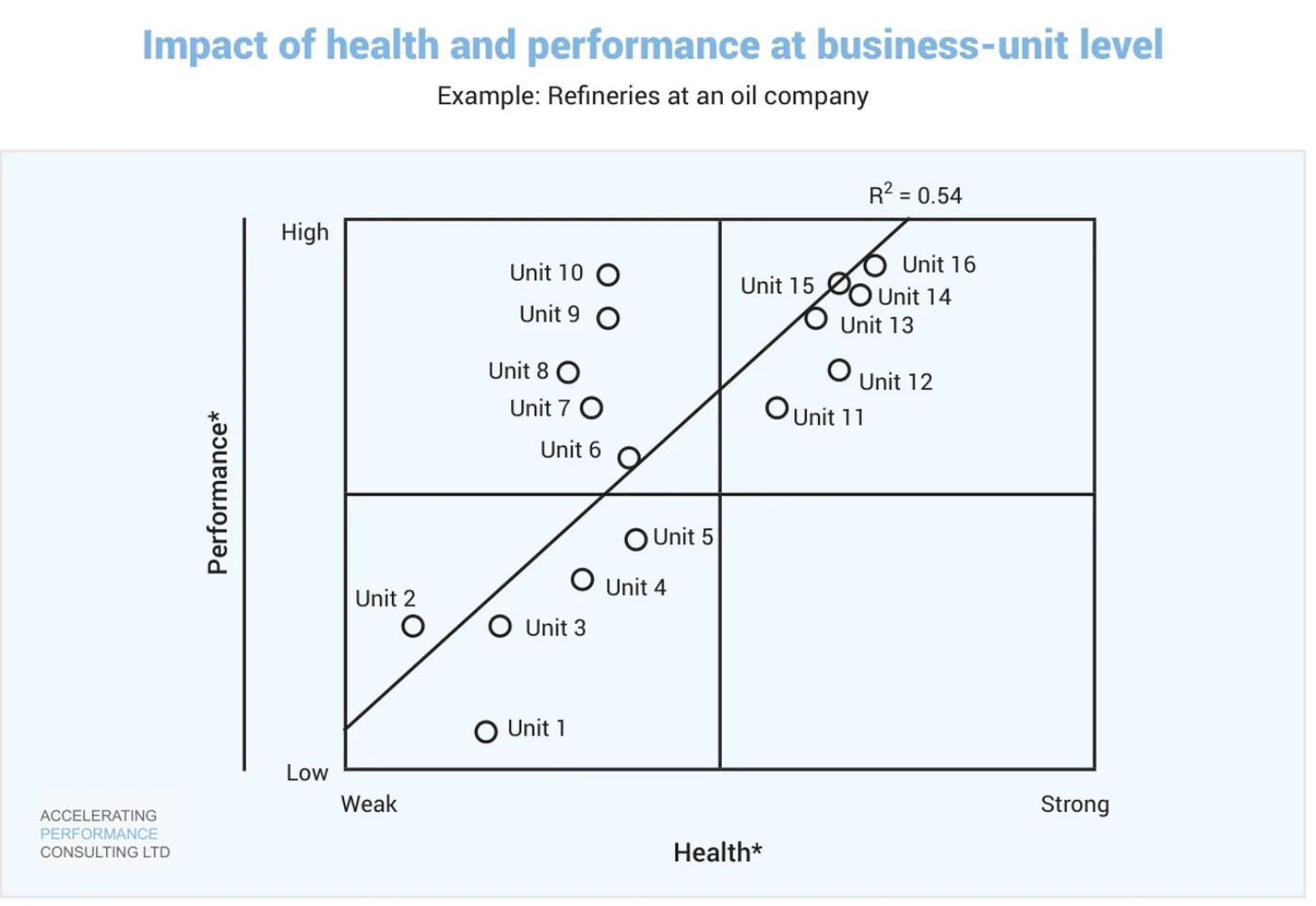
The idea of health driving performance can be easily grasped via the chart below. These refineries were in the same company, producing an undifferentiated product through a standard process. So, we were comparing apples with apples. As you can see, the higher the health (the soft stuff), the higher the performance (the hard stuff). The same analysis holds true across every industry we’ve looked at. That includes healthcare, which has some institutions in the bottom left quadrant with both poor organisational health, and poor performance outcomes, measured through mortality, morbidity, hospital-acquired infections and patient experience.
On retiring from McKinsey in 2013, I’d expected that Beyond Performance would be my last major publication. I was wrong. Plans changed and I became Senior Partner of a boutique consulting firm focused on organisational health, working alongside Sharon Toye, my business and life partner.
Sharon and I were struck by how much the conversation had changed. Clients were demanding to know much more about the ‘how?’ Almost everyone in business now bought the idea that shared values/culture were important. The days of ‘grab them by the hair and their hearts and minds will follow’ had thankfully come to an end. So, In Search of Excellence had done its job.
Leaders could also see that health today drives performance tomorrow, rather like an athlete who focuses on their training, conditioning and health to deliver outstanding performance. In that sense, Beyond Performance had achieved its purpose. But now the question was ‘How, in practice, do I improve my organisation’s health, as quickly as possible?’ The emphasis on speed in this question is important. Let’s take two extremes. In one situation you have three months to turn a business around, or it becomes insolvent. What would you do? Well, you wouldn’t focus on health. You would cut costs to the bone, squeeze suppliers, dump unprofitable products, and kill all non-essential projects. Your focus on health would be pretty much zero. Now let’s imagine the opposite. You have twenty years to build a world-beating organisation. You would hire the best talent, build a distinctive culture, invest heavily in the brand, and become a leader in ESG. In other words, most of your focus would be on health.
Leaders could also see that health today drives performance tomorrow.
The longer the time horizon the stronger your focus on health. That makes sense. But the world changes quickly and nobody has a twenty-year window. Our clients were demanding to know how to achieve distinctive capabilities quickly. This question led us to write our co-authored book, Accelerating Performance, published in 2017.[4] Its focus is on how organisations can reduce the time taken to create value, by building momentum and executing more quickly than their rivals. We call this their corporate metabolic rate.
Our research findings
1. Organic revenue growth is the best predictor of future enterprise value. We looked at 24 different financial metrics (EBITDA growth, ROCE, Gross Margins, cash conversion, share buybacks etc) and calculated their impact on the value of the company.[5] We did this for all the Forbes 500 companies and carried out follow-up interviews in 252 of those companies. Organic revenue growth was the standout winner. If you’re growing your sales, margins will follow, cash will be produced, profits will be delivered, and the stock market will reward you with a higher valuation.
2. So, what drives organic revenue growth? The standard business school answer is to pick an attractive market segment or a nice profit pool to fish in. Where you fish is more important than how you fish. Well, it turns out that isn’t quite correct. Looking at 36 different industries from aerospace through to retail, we found that the average enterprise value of companies in those segments varied by 19% from the most attractive industry to the least attractive. The business schools were at least partially correct. However, the difference in company enterprise value between the top decile and the bottom decile within (not between) those industries was 34%. Sure, ideally you would have both, a great pool to fish in and an outstanding fishing capability. But it’s inescapable that the value of a company is more determined by its performance relative to its peers than the industry it sits in.
Studying these super accelerators up close and personal was a privilege.
3. This led us to find what we called the ‘super accelerators’. These were the standout companies that were able to accelerate organic growth much better than their competitors. We had a few rules that kept us honest. The companies had to be profitable, not just growing, they had to operate in open markets and get no more than 20% of their revenue from state sources. We allowed for some inorganic activity as long as it drove subsequent organic growth.
Studying these super accelerators up close and personal was a privilege. We met with their CEOs and Chairs and often with a much wider sample of leaders in the business. Note, being a super accelerator in one year doesn’t guarantee it for the next year. Sometimes companies fall off their perch. And sometimes a new star comes along. In 2017 NVIDIA didn’t make the cut. Look at them now, the world’s most valuable company.
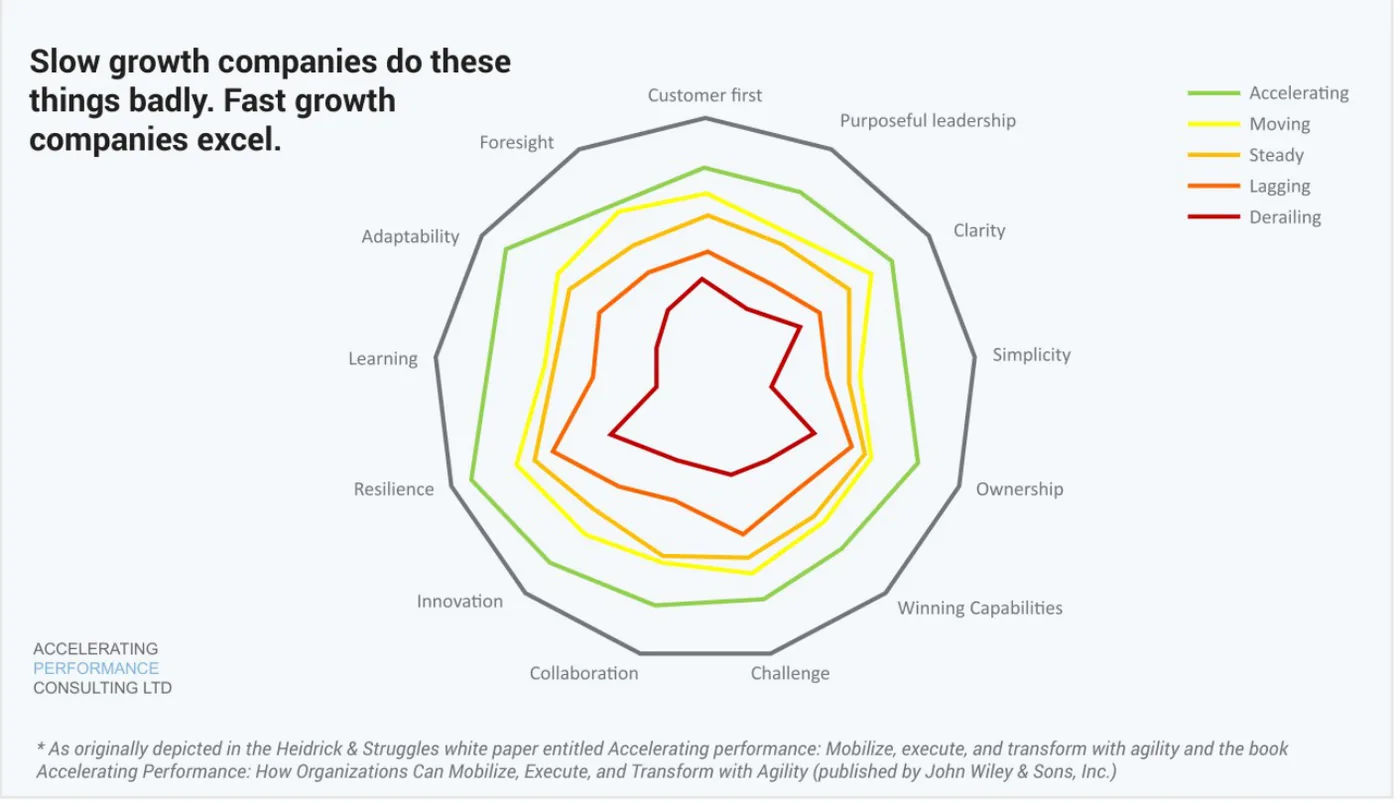
4. We found these exemplars were distinctively better than their competitors at mobilising, execution, transformation and agility: META. In one sense META is a close cousin of organisational health, But the differentiator was speed. Companies don’t have 20, 10 or even 5 years to build health. They must respond to the market right now. Super accelerators move with pace. Take a look at the chart below. It paints a stark picture. Accelerating companies (fast organic growth) vary from derailing companies (slow organic growth) in their ability to be great at 13 things. We wish it was 10, or 7, but no matter how we cut the data, it’s 13.
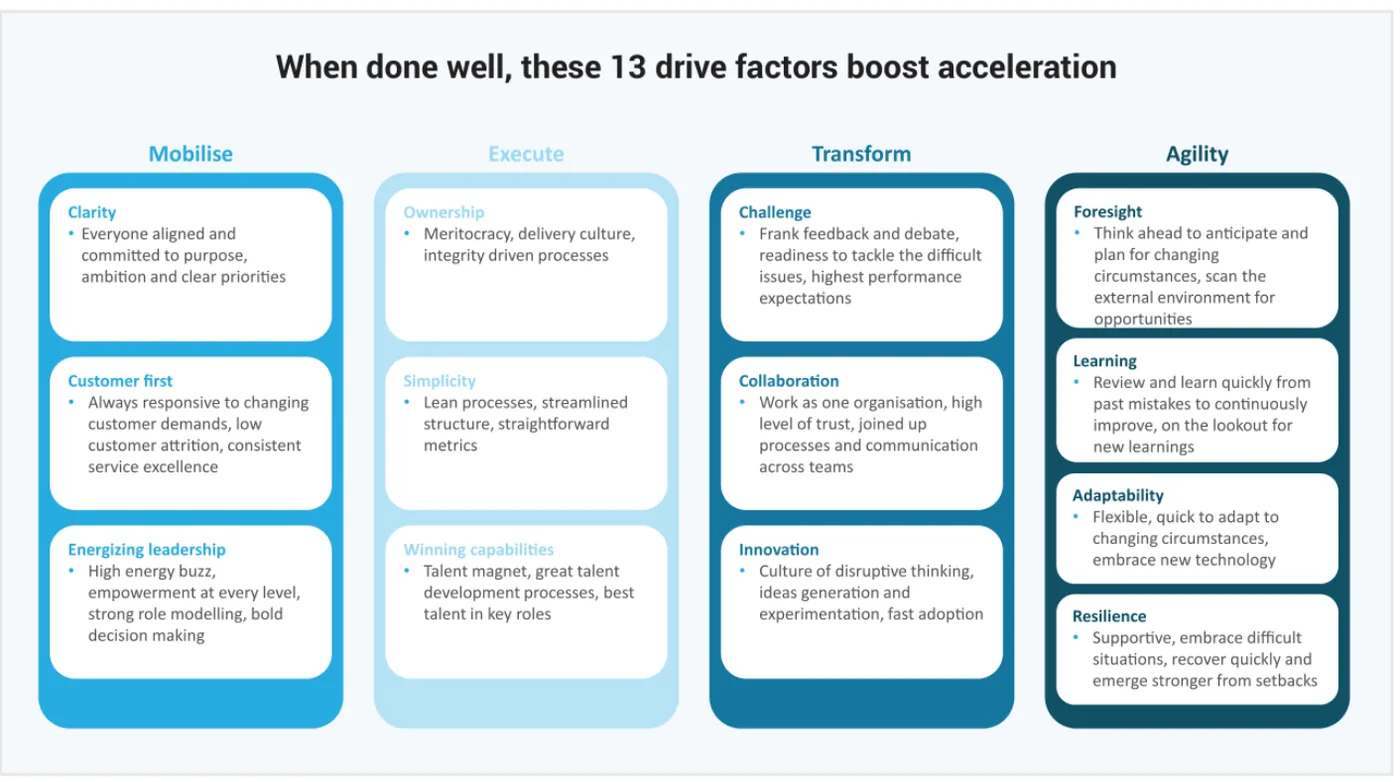
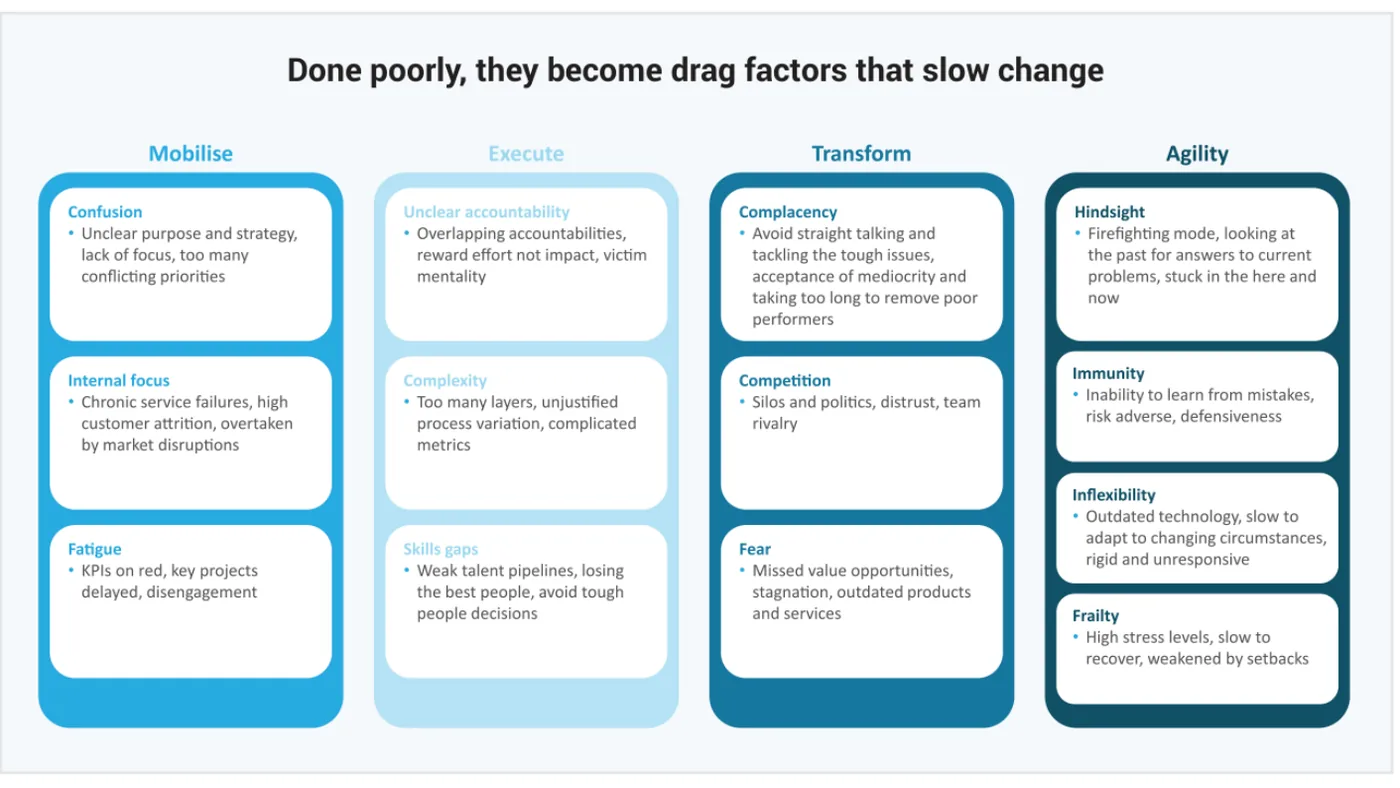
5. The obvious next question was ‘how?’ How did the winners differentiate from the laggards? The figures below summarise the difference. The winners have the drive factors in place, the laggards are weighed down by the drag factors.
* As originally depicted in the Heidrick & Struggles white paper entitled Accelerating performance: Mobilize, execute, and transform with agility and the book Accelerating Performance: How Organizations Can Mobilize, Execute, and Transform with Agility (published by John Wiley & Sons, Inc.)[6]
Since the publication of Accelerating Performance, the need for speed has only grown. The AI revolution is upon us. If you think the internet changed things, hang on to your hat. What’s coming down the pike powered by Gen AI Assistants smarter than any human that has ever lived is going to be truly revolutionary. And they’re 24/7/365. So, when that computational power is combined with robust and user-friendly robotics, we enter a new age.
We now work with a small group of like-minded obsessives whose purpose is to help organisations shorten the ‘time to value’. Private Equity (PE) is a natural sector for this kind of focus. Think about a company that has been bought for X and the usual intention is to float or sell for 4X in four or five years’ time. There’s little appetite for delay. Organisational politics, skill gaps, bureaucracy, and sloppy processes all need to be addressed, and quickly.
But it’s not just the PE world that values speed. Consider insurance companies. They predict the likelihood of an event happening, put a price on it and pay claims. That’s a huge algorithm. Insurance companies have a couple of years to start using AI to their advantage or they can expect to be steamrolled by it.
And the public sector in many countries needs urgent reform. Most of the NHS metrics in the UK have gone the wrong way over the last 15 years; mortality, morbidity, hospital-acquired infections, cancer survival rates. These are the vital signs of the NHS as a body and they don’t look good. Urgency is required to save this particular patient.
These are the problems of ‘human systems’, or what we call organisations when working out how to improve them. It’s a double-edged sword. On the one hand, the ability of our species to collaborate is amazing. We’ve gone from families, to tribes, to villages, to cities, to countries and to groups of countries, (although our ability to forge a true United Nations is still unachieved).
Without this collaboration ability, we would be lost. Who amongst us could build a car on our own, much less a plane? Or manufacture paper, produce clean water, or generate electricity?
On the other hand, while we have the technology of the gods, we also have the draw of the tribe. We look to create enemies, even if they are just a different group in the same organisation. We are driven by ego. The in-group feels stronger if they create an out-group. We take personal credit for anything good that happens but expend tremendous energy finding someone to blame when bad things happen to us. These are the fundamental weaknesses of our species.
But organisations must live in this space. The space between fabulous collaboration capability and ego-driven destruction. How can you do that successfully?
Taking on board this desire for greater clarity and focus on the ‘how’, we’ve spent the last few years observing that six factors seem to outweigh the others. These half-dozen topics are the difference between accelerating and not. Their relative importance differs by company but think about your own organisation and decide how you’re doing in each of them.
The leader sets the pace
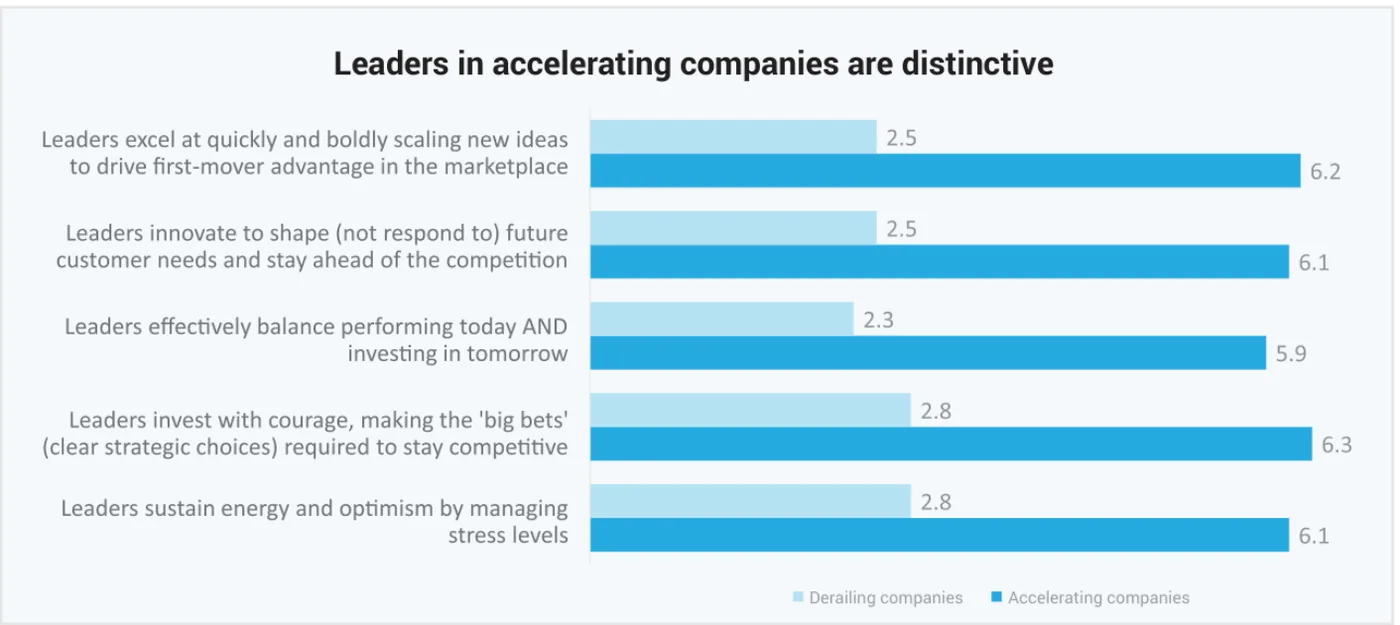
It’s obvious that good leadership matters. But the extent of the impact of leaders has always been tricky to calibrate. The route we’ve taken is to examine certain leadership behaviours and measure the extent to which they show up in fast-growth companies versus slow-growth companies. The chart (see Figure 5 below) is stark. To be honest, starker than we expected. We’d thought that so much research has been done and so much writing on leadership sweated over that surely all leaders must ‘get it’. Sure, there would be differences based on talent and experience, but those differences would be marginal. How wrong we were!
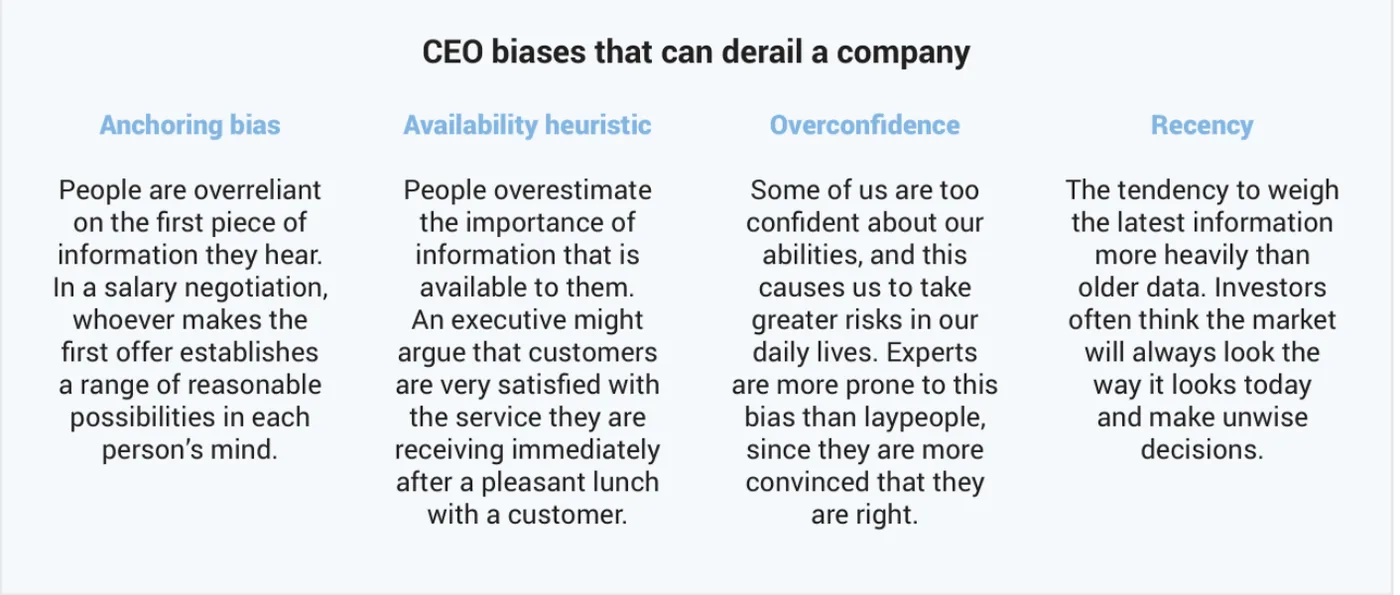
In our most recent research, we dug deeper and investigated the hidden drivers of poor leadership behaviour. No one actively wants to be a poor leader, so what traps some individuals and causes them to be, frankly, pretty lousy?
We found four mental models or biases that were much more present in the poor leaders and almost entirely absent from the outstanding leaders.
This research helped us pin down the roadblocks to acceleration in companies, but it didn’t quite satisfy us. Knowing the problem doesn’t automatically give you the solution. So, we interviewed some of the outstanding leaders from outstanding companies. About 75% of these folks were CEOs but we had a few COOs and CFOs as well. We found them to be remarkably reflective and a delight to talk to. From our discussions, we produced the model below and although none of the leaders articulated their approach exactly in this way, we’re pretty confident they would recognise themselves.
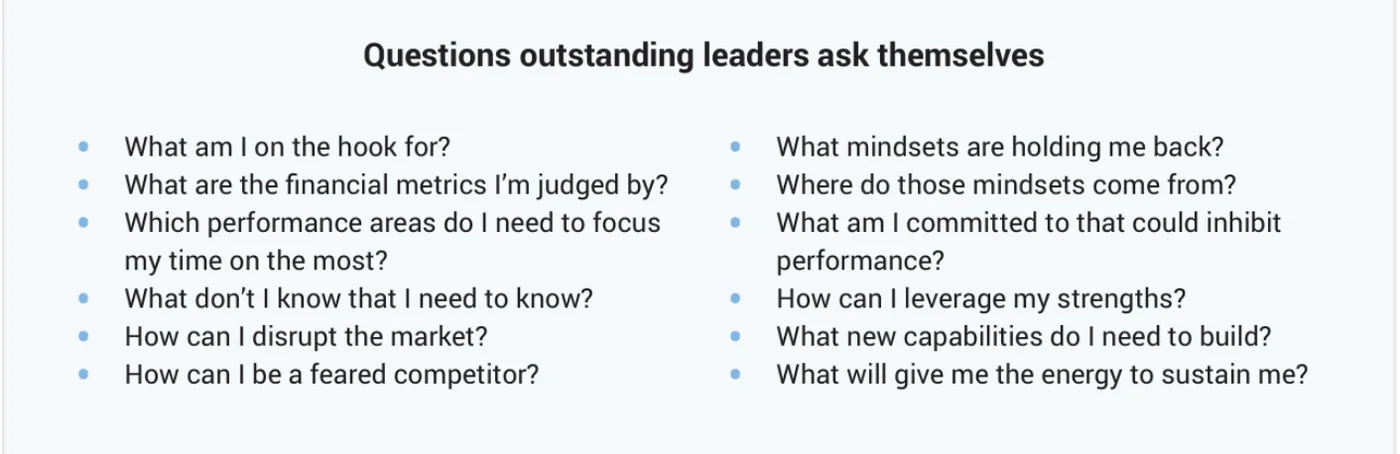
These leaders start with the market, the numbers, the competitors, the regulators and all the external stuff. They’re obsessed with winning. This means they seem to have remarkably little interest in or patience for organisational politics or anything not directly concerned with revenue up, cost down, cash in and risk out. But don’t make the easy assumption they only focus on numbers. They’re deeply interested in what drives the numbers. They work on themselves. They’re aware of their own blind spots and limiting mindsets so actively work on improving themselves.
Let’s take a look at teams
If leaders hold some of the cards on accelerating an organisation, groups of leaders, we’ll call them teams, amplify the effect.
Some bad news. The closer a team is to the top of an organisation the more influence it has but the worse it is likely to be. That’s a profoundly depressing thought. Surely people who have made it to the top of an organisation have the skills to work well in a team? Well, the data doesn’t lie.
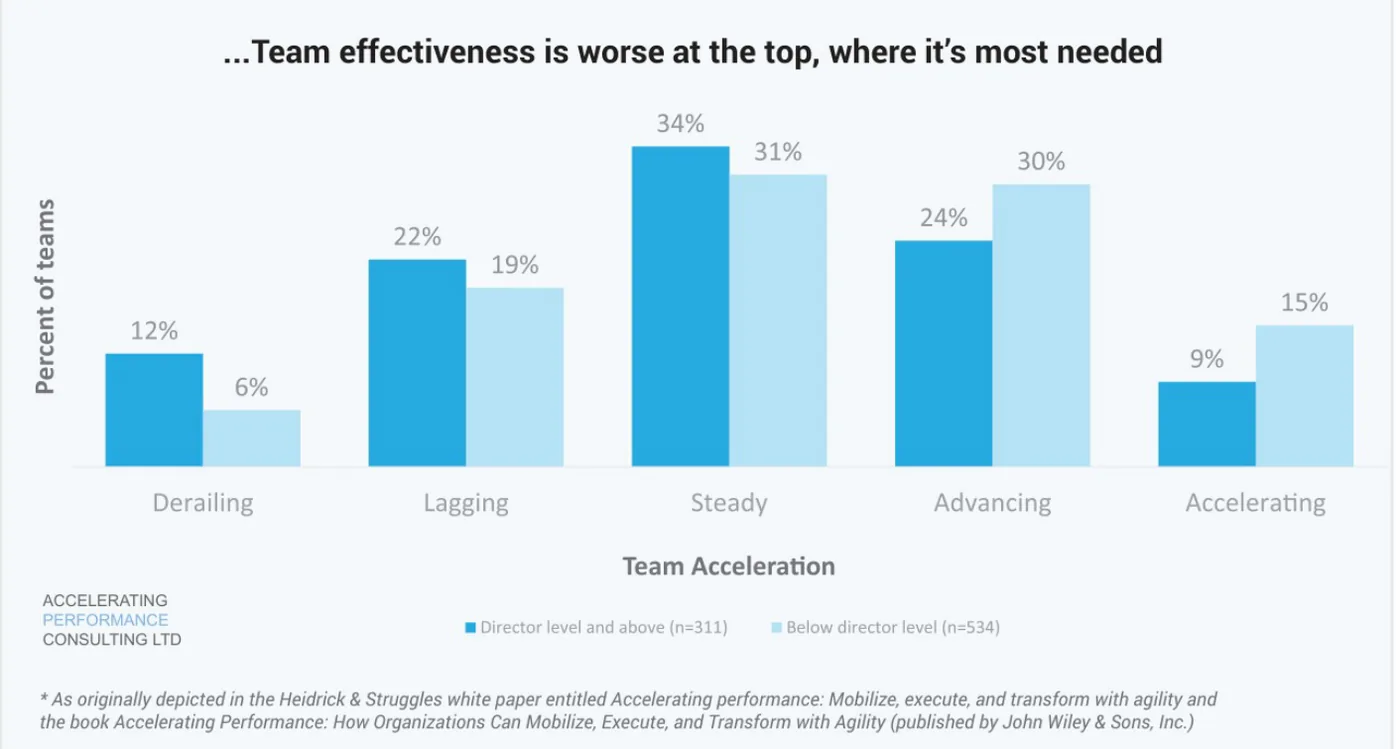
We’ve pondered this for hours and cut and recut the data to see if we were missing some gold dust hidden beneath the coal. But there’s no getting away from it. Senior teams aren’t great. Why? Well, some of the reasons may be excusable. There’s a lot of pressure at the top and that can create tension. The personal responsibility to deliver commercial numbers can create anxiety. If it’s a global company the senior team won’t physically meet very often. But it seems to us that these reasons, although real, can all be overcome. And many of them are true for mid-level teams.
So, what drives dysfunctionality at the top? It often comes down to competing agendas. The CFO wants cost reduction. The HR leader doesn’t disagree but not at the expense of the learning and development budget. The COO wants a strong focus on simplifying the product range, but the CMO worries about losing customer segments. It’s a triumph of the sub-team over the corporate team. The priority is given to representing the leader’s patch rather than optimising for the organisation as a whole.
What to do about it? Well, it comes back to the CEO. Team development is a body contact sport. Team members won’t reduce their allegiance to their functional team unless the attractions of the corporate team outweigh them. It’s a competition for loyalty. CEOs (or the less talented ones) chronically underestimate this. They assume because they are focused on what’s right for the company as a whole the rest of their team will be. Hogwash!
We use the eight questions below to assess a team.
• How is your team doing?
• Is your team aligned and inspired around a common purpose and clear priorities?
• Does your team have a common understanding of the expectations of stakeholders?
• Is your team focused on customers and consumers?
• Does your team have the right composition and fit-for-purpose structure, with team members moving fluidly in and out of roles?
• Does your team have clear accountabilities with collective and individual delivery commitments?
• Does your team deliver through clear decision-making processes and robust execution rhythms?
• Does your team operate with the trust and candour necessary for high care and robust challenge?
• Can your team transform with agility, both the organisation you lead and how you lead it?
We’ve noticed a big uptick in the number of extended leadership teams that are being formed. Say the top team or Exco is 10 people, the extended team, sometimes called the Opco, is the 10 plus perhaps 20 others. We view this as a positive development. It’s one more move away from traditional top-down hierarchical structures. But it’s not without its challenges. What exactly is the role of the extended team? Saying they are culture carriers is fine but lacks precision. What decisions are moved from the Exco to the Opco? Is the Opco a sounding board for the Exco? Or just a communications channel? These problems of ambiguity of role can be solved, but it takes careful thought.
Mobilising the middle
Here’s a true story from a manufacturing company that was a division of a parent company and was bought by a new owner company. The process of acquisition took about nine months. When it was done folks were exhausted but excited. Instead of being buried under the weight of their previous owners, they were now backed by a much more successful global company with super high ambitions and an obsession with acceleration. The acquiring company followed the playbook they had successfully used dozens of times before. Agree the strategy, change out weak leaders, sell off or close down dubious product lines, form a new board, and incentivise the hell out of the top team. A year later progress was insipid, the CEO was replaced, and the new owners were deeply concerned.
We were asked to try and find out where the fault lines were. It turned out to be much simpler than we imagined.
We asked 110 middle managers to do a diary analysis and allocate their time into 24 buckets of activities and to compare that time allocation before and after the acquisition. There was a 3% difference. Middle managers were pretty much doing what they had always done. The excitement, sense of urgency, radicalism and ambition had simply not reached middle management. Figure 9 is a heavily sanitised chart that summarised the work.
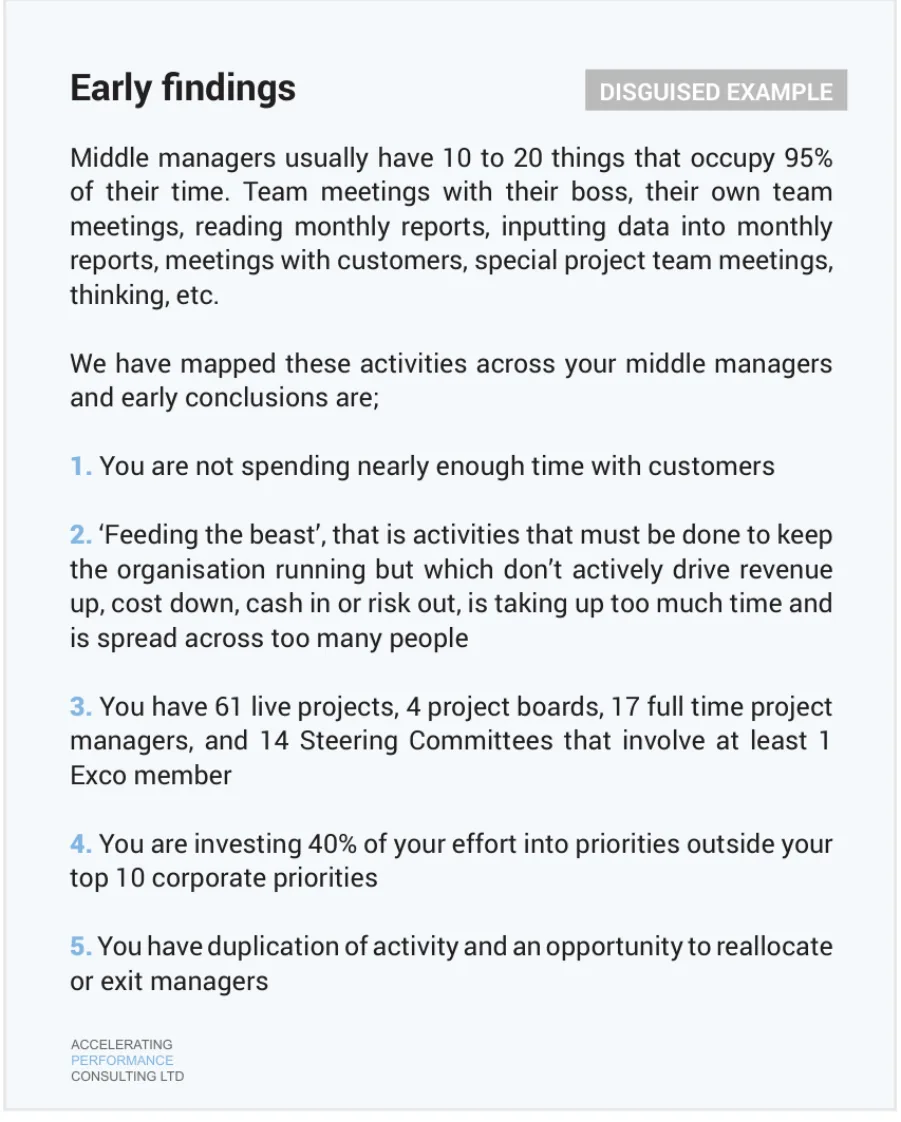
What must be true if middle managers are to shift their behaviours?
1. Stop as many initiatives as you start. Otherwise, the old ones drag on and the new ones starve to death.
2. Connect managers with purpose and strategy. Not all the strategy can be shared with middle managers. Certainly, the acquisition and divestment elements cannot. In the absence of detail, a strong sense as to ‘who we are and why we exist’ can act as a motivating force.
3. Reduce layers and widen spans. Managers make work for each other. Not deliberately, and certainly not maliciously. But the more managers you have the slower you’ll move. How quickly have you seen a meeting of 15 people reach a decision?
4. Make your line managers responsible for change. The moment you move the responsibility for transformation from a line leader to a specialist change manager, you reduce the chances of success by 50%.
Training
We’re using deliberately reductionist wording for the title of this section. We could call it continuing personal development, vertical development or a host of other funky, new-wave titles. But at the end of the day, it’s about giving people the skills and supporting mindsets to deploy those skills for maximum impact, and we call that training. When it comes to moving the business forward with pace, we’ve found five topics to be the most critical:
• Accountability. How do we exercise accountability in the business? Do we try to hold others accountable, or do we help those we lead learn to hold themselves accountable?
• Enterprise leadership. How do we work horizontally to avoid silos and make a market impact quickly?
• Influencing with impact. How do leaders use the full range of influencing strategies rather than rely on the typically narrow set that has got them to where they are?
• Stakeholder navigation. In organisations how do we speed up impact through engaging key stakeholders successfully?
• Leader as coach. How do leaders amplify their impact by coaching their followers to be better each day?
We find this a frustrating topic. We know training works, we know it’s comparatively inexpensive, and yet companies are doing less of it than ever. Research by the analyst, Josh Bersin, shows companies with great leadership development practices are 3x more likely to exceed financial targets, 12x more likely to engage and retain employees, and 5x more likely to innovate effectively. The case for training is clear, but overwhelmingly it still isn’t happening. Less than 25% of companies say their leadership model is either “up to date” or “highly relevant”. Fewer than 20% of companies are actively investing in developing leaders at all levels. Only 17% of companies are growing their leadership development budgets, with 40% of companies spending less than $500 per employee on leadership development. Some businesses may well spend more than $500 a year on coffee. Are we really willing to invest less in training our leaders than in purchasing their caffeine?
Harvard Business Review reported that 70% of employees say they don’t have mastery of the skills needed to do their jobs.[7] And yet they aren’t receiving the training they need to change this. With Zoom, Teams and other similar software, this has become even easier and there’s even less excuse for not having a vibrant leadership development approach. Get on with it!
Process trumps organisation
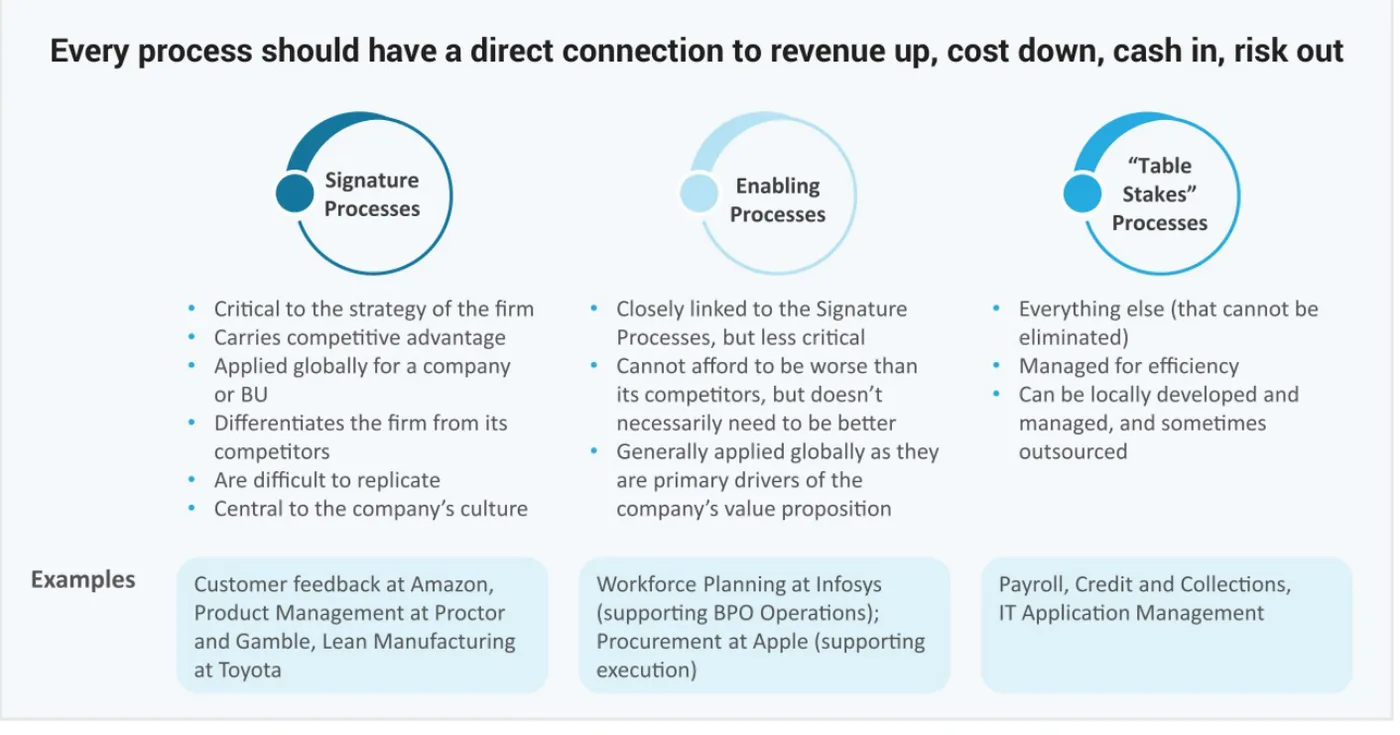
Remember the days of process reengineering? It was an over-hyped obsession for a while. But it wasn’t all bad. Processes do indeed drive the day-to-day work of a business. And the more cumbersome your processes the slower your business. But big businesses have literally thousands of processes. How do you decide where to focus? We use the organising device in the chart below:
Here’s a super simple example:
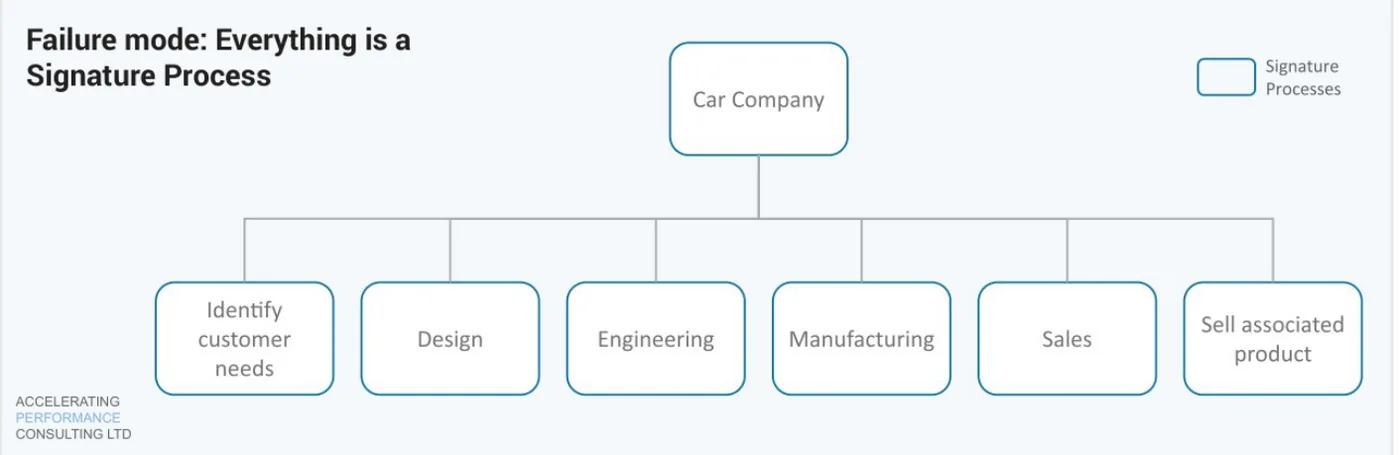
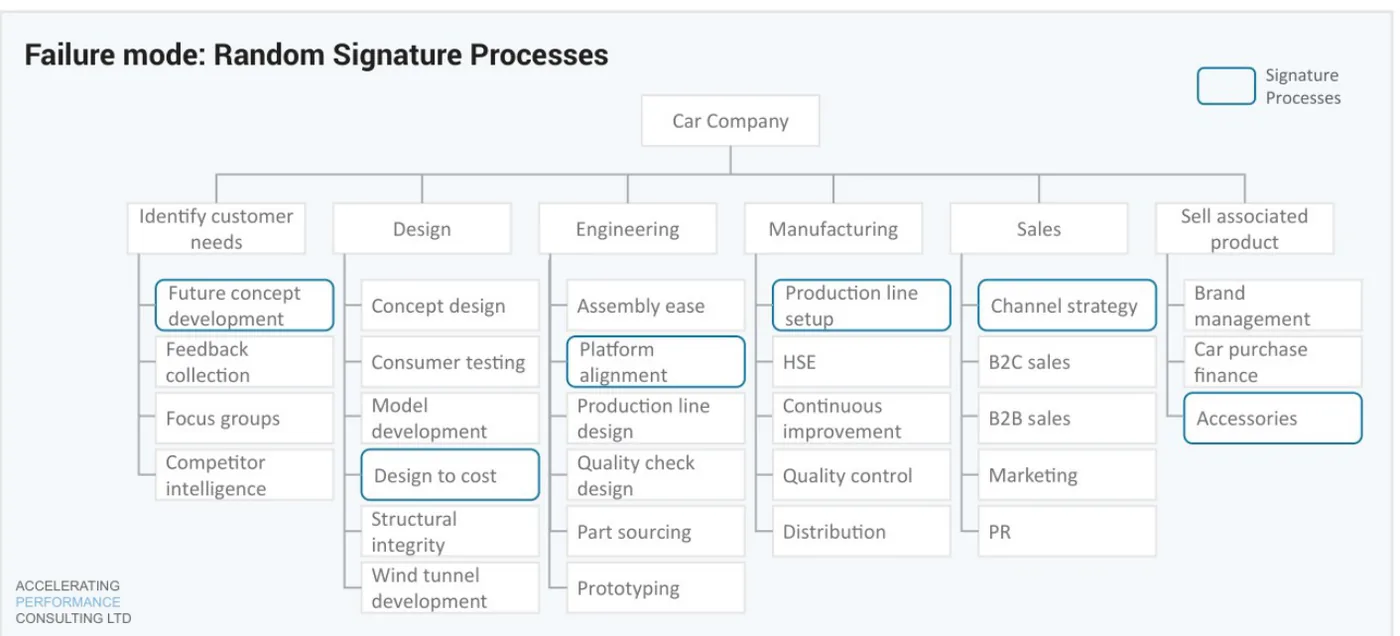
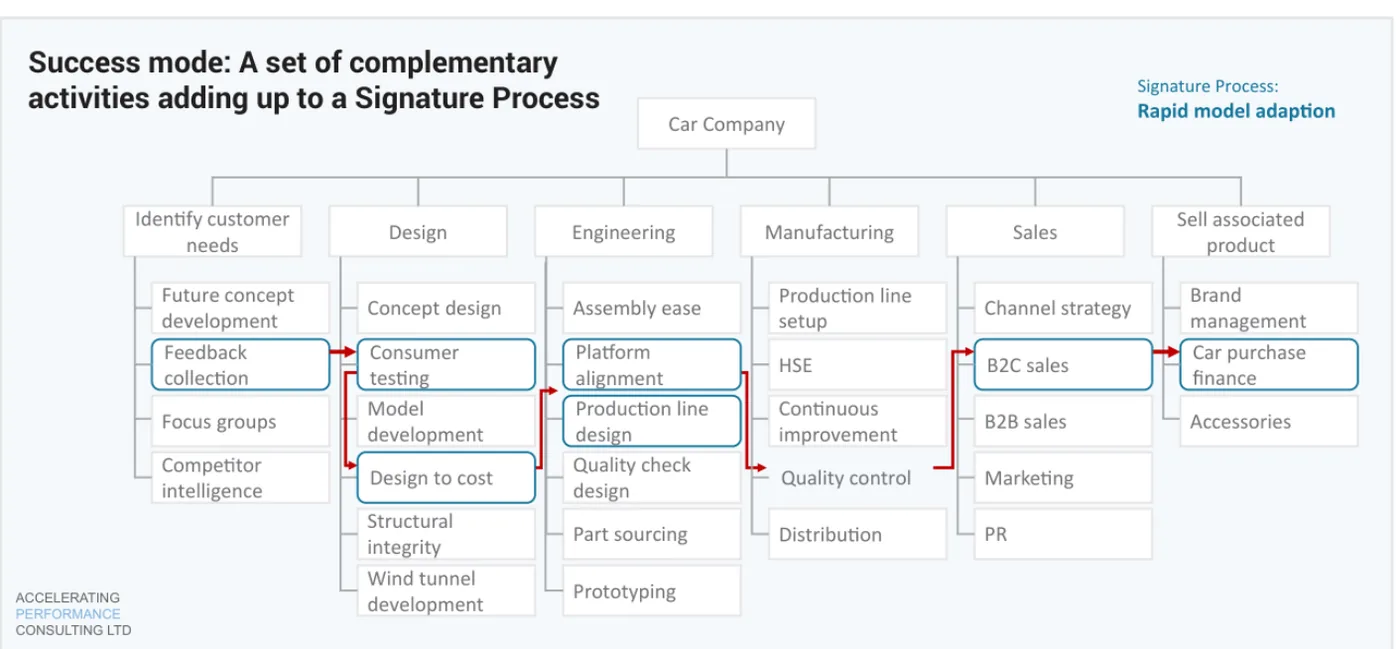
A signature process is something that’s critical for the success of your business. Obviously, paying your staff is not optional, but payroll is not a signature process. It doesn’t differentiate you. But if you’re a car manufacturer, the rate at which you can get customers to shift from an old model to a new model is existential. The charts are super simplistic and miss many nuances, but we are sure you get the idea.
So, what are the handful of signature processes in your organisation? Can you, hand on heart, claim they are;
• Documented?
• Have a member of your top team on the hook for them?
• Are digitised as much as possible?
• Are constantly improving?
• Have a dashboard so you have insight into their performance?
Simplicity wins
Here’s the problem, Leonardo da Vinci said, “Simplicity is the ultimate sophistication” and Albert Einstein said, “Everything should be made as simple as possible, but not simpler”. They’re both right. Companies often need complexity to win. Why does almost every car manufacturer have many models and thousands of opportunities to configure the vehicle to the customers’ requirements? Because that’s what the customer wants, and they will go elsewhere if they don’t get it. Why does Sephora have 45,000 products? Because tastes are fickle, and the cost of a marginal product is next to nothing.
These are examples of good complexity.
But if an insurance company has 50 systems that don’t talk to each other and the net impact is that a pricing change takes a month, that’s bad complexity.
One of our clients nicely characterised their complexity problem in the chart below:
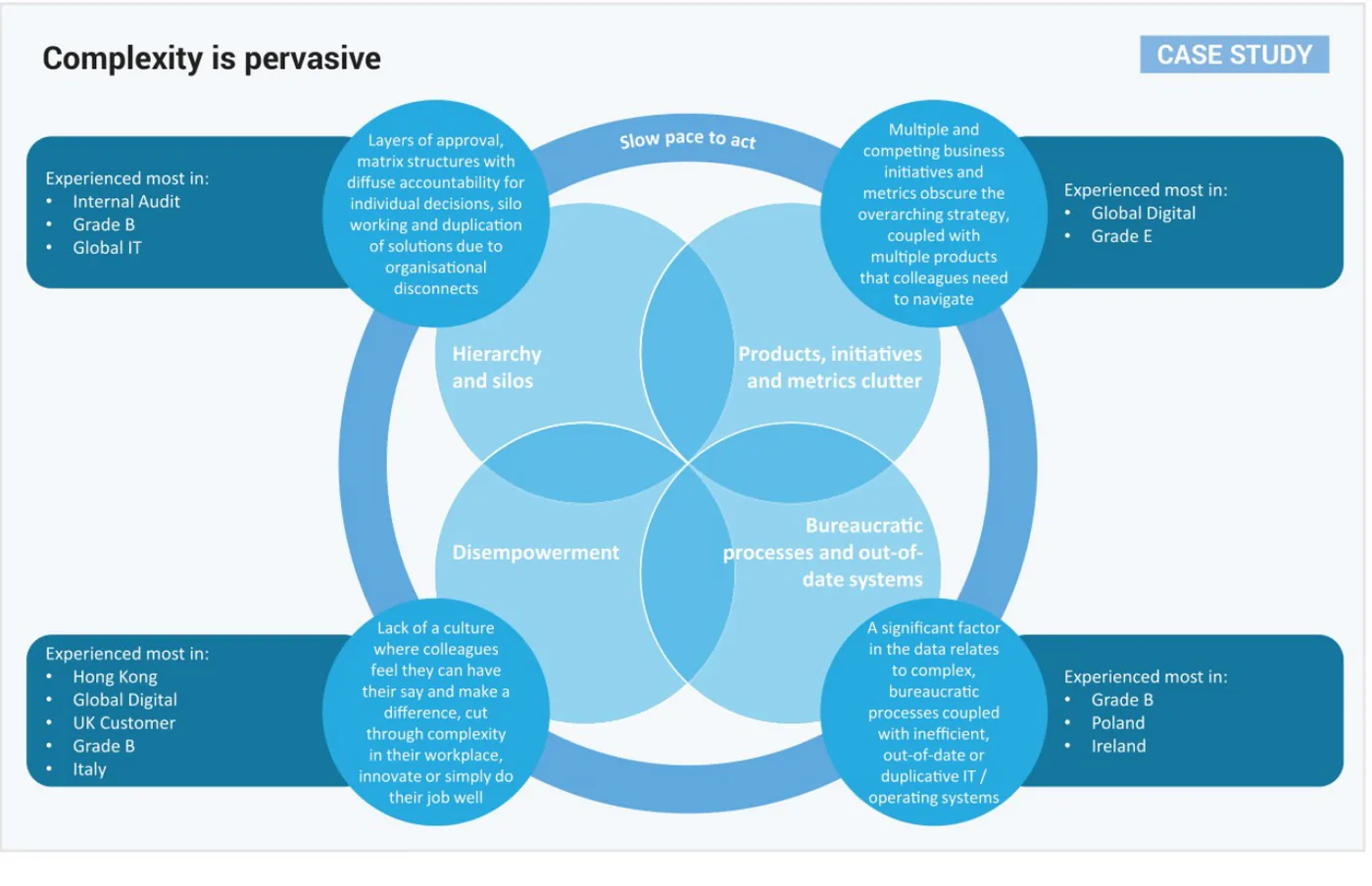
The implication of this malaise was particularly impactful on the highest-performing staff:
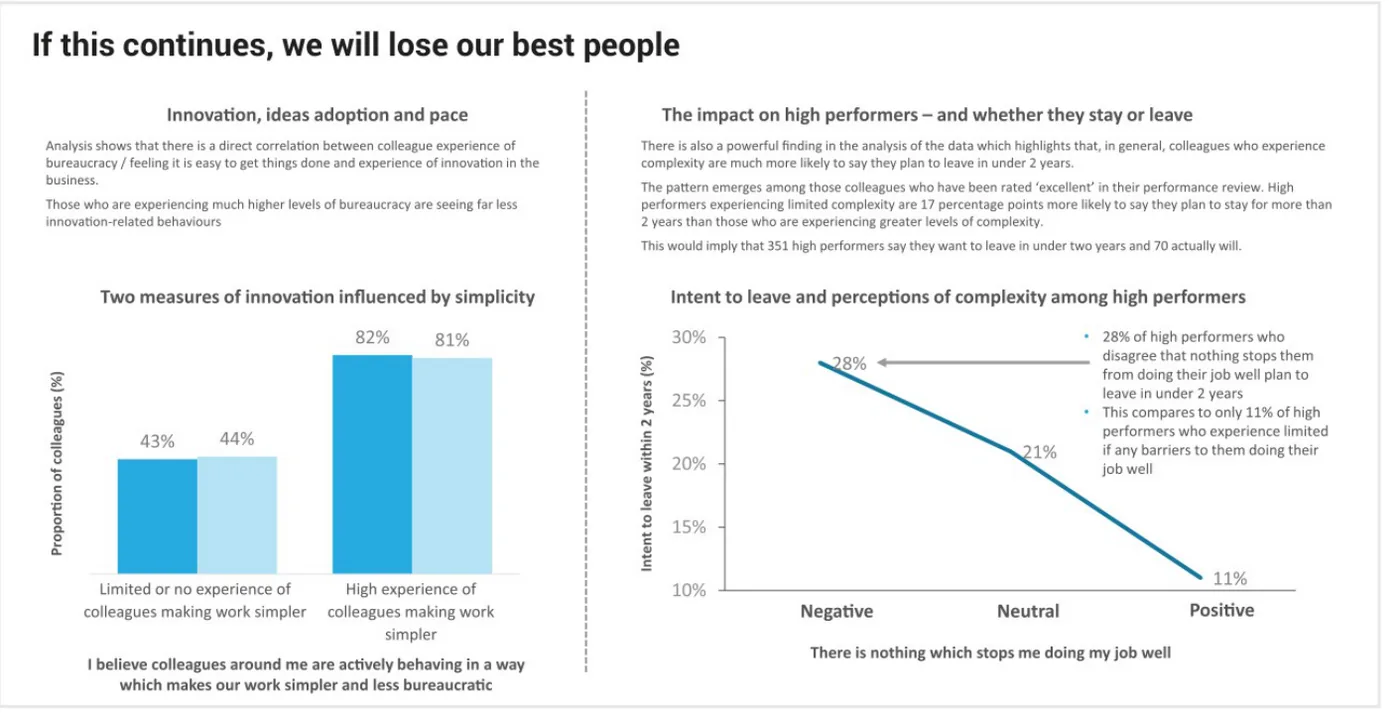
Before we talk about solutions, consider this example. Our daughter is an expert cook. She spends part of her time volunteering in a homeless shelter and cooking meals for 50 people. If she and Colin were given the same materials and the instruction of ‘cook a nutritious three-course meal for 50 people in the next hour’ she would find it simple, and Colin would find it complex. Complexity is the residual between the sophistication of the task and the skills of the individual. That’s why we’re so frustrated by the points above about the lack of training. We can reduce complexity by giving people skills.
One of the problems with complexity is that having the problem precludes the ability to deal with it. Managers are just too busy to simplify. But it must be done. The best strategy in the world is useless if managers have to constantly battle with organisational complexity to get it implemented. It’s a topic that does not have a simple answer (ironically) but we have found the following logic flow helpful in our work;
1. Drain the swamp. Start with the easy stuff. Do you really have to sign off on all travel expenses? Do you need all the ‘pre-meetings’ for the Exco? Does procurement really need three signatures?
2. Focus on where you make money. We’re currently working with a bank with 122,000 staff. 55,000 of those staff sit in various ‘control’ functions; Compliance, Legal, Finance, HR, Procurement, Property, and Technology. We’re not dismissing these activities. Technology, in particular, can be the driver of massive improvement. But there’s something odd going on in many organisations. The total weight of initiatives tends to be skewed towards these overhead functions and away from the revenue-generating functions. That can’t be right. Think hard before you kick off any initiative that doesn’t have direct customer impact.
3. Prioritise. This is where senior leaders need to step up. People want to do a good job but often create unnecessary complexity. We did an experiment a few years ago where we had the top 22 leaders from a company in a room and we asked them to list the top five priorities they were working on. When we added them up and took out the overlaps there were 81 priorities. All driven by a genuine desire to improve. But all also creating complexity. The top team has to be the rate-regulating factor. It has to make the tough calls.
4. Reengineer. Here’s a story from a startup. They had 500 staff of which 370 were in a call centre. The top team made the business segment choice they would only serve customers who downloaded their app and they built one of the best apps in the market. This enabled customers to self-serve through the app. And for more demanding customer enquiries. they used a standard chatbot powered by Chat GPTv4 to act as a customer-friendly avatar. The 370 call centre staff dropped to 14. That’s simplification. Harnessing the power of technology to completely reimagine the business.
5. Create a modular structure. Too many layers, too narrow spans, and too much distance from a P&L will create complexity. Break your business down into mini-businesses. The closer a manager is to a customer the less likely they are to invent useless complexity.
6. Build a speak-up culture. Much of the complexity comes from a mindset of perfection. And that desire to create perfection is often driven by a fear of failure. Shift the mindset to ‘good enough’. Value speed over perfection. Encourage front-line workers to raise concerns about dumb tasks and excess complexity.
On a positive note, the chart below from one of our clients shows progress is possible.
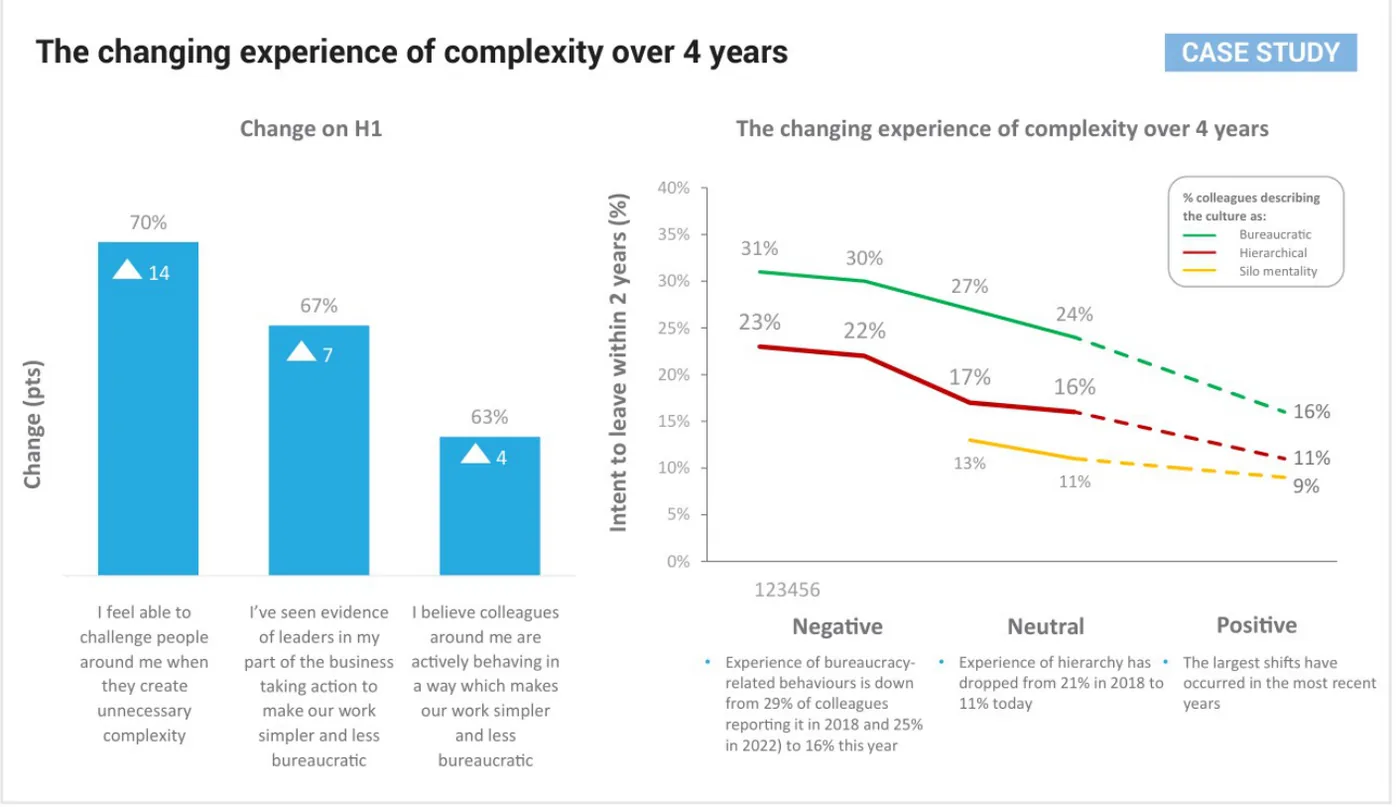
These are the six roadblocks that slow companies down. Let’s take a quick look at the implications of these issues and see how accelerating companies manage their improvement efforts.
1.They don’t talk about resistance to change. People do not resist change, they resist loss. Instead, they design for behavioural buy-in from the start.
2. They don’t have a cumbersome communication plan. Instead, they depend on real-time, reactive communications from empowered leaders.
3. They don’t go for the one-size-fits-all approach. That was excusable in the days before data science. But now we can shift from the blunderbuss to sniper fire. The accelerators use custom-made, agile, change approaches.
4. They realise to generate empowerment and commitment they have to provide space. Top-down decision-making is great in a crisis. But for growth, we need empowered teams.
5. They put their leaders centre stage. Specialist change resources hurt more than help. It’s the role of a leader to drive change.
6. They integrate run and change. Change projects are dead, long live continuous change.
We’ve focused on how some companies beat others. You might argue that one bank outperforming another bank by a few per cent doesn’t really matter. Some shareholders lose and some win. So what? But take a wider view. We need our organisations to be the engine of growth. Between 2007 and 2023 UK productivity grew by 0.9% pa.[8] That’s dreadful - less than half compared to the previous 15 years. And we have 4.3 million children living in poverty in the UK, even though this is the Silicon Age when we’re on the brink of AI developments we can hardly imagine.[9]
The all too human factors we’ve set out are dragging our progress down. We must do better.
Sources and further reading
1. Peters, T. J., and Waterman, R. H., Jr. (1982). In Search of Excellence: Lessons from America’s Best-Run Companies. Harper & Row. The 7-S discussion refers to this work.
2. Keller, S., and Price, C. (2011). Beyond Performance: How Great Organizations Build Ultimate Competitive Advantage. Wiley. Organisational health and performance research discussed in the article. Source
3. McKinsey & Company (2024). Organizational Health Is (Still) The Key To Long-Term Performance. 12 February. Organisational health research cited in the article. Source
4. Price, C., and Toye, S. (2017). Accelerating Performance: How Organizations Can Mobilize, Execute, and Transform with Agility. Wiley. Background to the acceleration framework, organisational research and exhibits. Source
5. Authors’ research and client examples. The article describes acceleration research, leadership interviews and anonymised organisational diagnostics. Client exhibits retain the qualifications and attributions in the supplied article. The underlying client datasets are not published with it.
6. Heidrick & Struggles (2016). Accelerating Performance: How to Mobilize, Execute, and Transform with Agility. White paper; original source credited in the article’s team-effectiveness exhibit. Source
7. Glaveski, S. (2019). Where Companies Go Wrong With Learning And Development. Harvard Business Review, 2 October. Source
8. Office for National Statistics. Labour productivity statistics. Source identified in the article for the discussion of UK productivity. Source
9. Department for Work and Pensions (2024). Tackling Child Poverty: Developing Our Strategy. Background to the 4.3 million child-poverty figure discussed in the article. Source