Executive summary
Unnecessary complexity consumes margin, traps cash and makes capable people spend too much of their working lives helping the organisation cope with itself. The aim is to preserve the differences customers value and regulators require while reducing the effort needed to deliver them.
AI changes what is possible. It can interpret customer requests, connect fragmented information, carry out bounded tasks and reduce the cost of modernising old systems. It can also multiply reports, exceptions and approvals. Leaders must decide what should disappear before deciding what a machine should do.
The seven actions in this paper connect simplification to commercial results: align the top team; establish shared information; improve the processes that distinguish the business; clarify authority; protect useful variety; change leadership behaviour; and turn released capacity into value. Start with a customer journey whose cost or delay matters. Measure the whole result, including quality, rework and risk, and retire the arrangements it replaces. Simplicity lasts when leaders stop recreating the work they have asked everyone else to remove.
In this paper
- The commercial cost of good intentions
- Some complexity deserves investment
- Which complexity earns its keep?
- How we studied complexity
- What we found
- Committed people can still struggle to act
- Simplicity creates the capacity to accelerate
- Follow the effect into profit and cash
- Complexity is reinforced by ordinary behaviour
- Seven actions to reduce complexity
- Align the top team and settle the competing priorities
- Follow the work and account for the time
- A signature process crosses departmental boundaries
- Does the diary match the strategy?
- Establish a common language for data and reporting
- Build the business around its signature processes
- Remove unnecessary layers and review them again
- Preserve the complexity customers and regulators need
- Change the behaviour that keeps recreating the problem
- Turn released capacity into value and prevent the work from returning
- Start where the business feels the cost
- Sources and further reading
The commercial cost of good intentions
A customer asks for something slightly different. Sales agrees. Operations needs a new specification. Finance creates a new code. Technology builds a workaround. Someone asks whether the exception has been approved, so a meeting goes into the diary. A modest commercial opportunity has acquired a small administrative family.
Each person has done something reasonable. The customer may even be delighted. But nobody has added up the cost of delivering the promise or considered what happens when the next hundred customers ask for something slightly different too.
This is how a business can become harder to run while everyone is trying to improve it. Complexity accumulates through individually sensible decisions whose collective consequences remain invisible. Eventually the company needs more effort to achieve the same result. Customers wait. Capable people become expert at navigating their own organisation. The leadership team wonders why a good strategy takes so long to deliver.
AI makes this problem more urgent and more tractable. Generative AI can interpret and produce language and code; agentic AI can use tools to carry out sequences of work within permissions set by people. Both can remove searching, re-entering and chasing. Both can also help us manufacture bureaucracy at a speed our predecessors could only have dreamed of. A pointless report written in thirty seconds remains a pointless report. It has simply acquired an excellent typist.
For shareholders, that is a commercial problem with a clock attached. Time spent reconciling systems, reopening decisions and managing exceptions is time unavailable for growing the business. The cost appears in overheads, in margin lost on supposedly attractive orders, and in cash waiting behind unresolved invoices. Some of the damage never reaches a separate line in the accounts. It appears as an opportunity that somebody else captures.
Yet the instruction to simplify can be equally dangerous. Remove the wrong products and customers leave. Standardise the wrong activity and local markets become harder to serve. Strip out a control without understanding its purpose and a tidier process creates a larger risk.
Companies often need complexity to win. The leadership task is to distinguish the complexity that earns its place from the complexity that consumes value, and to build an organisation capable of telling the difference repeatedly. That requires commercial judgement, changes to how work flows, and a hard look at the behaviour of the people at the top.[1]
Our research with both corporates and private equity (PE) portfolio companies brought us back to an uncomfortable conclusion: a company can spend heavily on simplification while its leadership team continues to manufacture complexity. Mixed messages at the top become conflicting work everywhere else. That is where the remedies have to begin.
Some complexity deserves investment
Good complexity gives customers a valuable choice, helps the business meet a real obligation, or creates an advantage worth more than its full cost. A specialist manufacturer may need different configurations for different applications. A business operating across jurisdictions may need tailored responses to regulators. A service company may need several ways for customers to obtain help because their circumstances and capabilities differ.
The benefit does not always arrive as a price premium. It may be permission to operate, stronger retention, access to a market or the ability to recover when a supplier fails. A second source of supply can look inefficient until the first source disappears. There are forms of complexity we should willingly pay for.
Bad complexity makes these things harder without a sufficient return. It includes systems that cannot exchange reliable information, approvals that repeat the same judgement, and structures in which several people can delay a decision but nobody can finish it. Its defining characteristic is the burden it creates relative to the value it contributes.
The distinction depends on context. A detailed review of a novel, high-risk contract may be essential. The same review applied to every routine renewal may be wasteful. A small product line may support a strategically important customer relationship. Another may survive because nobody wants the conversation about closing it. Counting products or signatures will reveal possible problems. It will not settle them.
Nor does internal convenience establish customer value. A company can simplify its own operation by making customers re-enter information, accept an unsuitable service package or deal with several departments. The work has moved. It has not disappeared. The right boundary for assessing simplicity includes the customer, the supplier and the people who must carry out the work.
A useful test is to ask what would be lost if a particular difference disappeared. Who would notice? Would they pay to preserve it? Does it protect against a material risk? Could the same benefit be delivered through a shared process? These questions bring the debate out of personal preference and into economics.
A bicycle manufacturer illustrates the point. Offering only one bicycle makes production easier but leaves different customer needs unmet. Adding useful models can create value; adding variants whose full cost exceeds their benefit cannot. The ambition is to preserve useful variety while reducing the internal effort needed to provide it. A business can become more sophisticated in what it offers and simpler in how it operates. That is where the most interesting opportunities lie. AI can lower the effort required to deliver useful variety, but it cannot decide whether that variety is worth preserving. Cheaper coordination changes the arithmetic; it does not excuse us from doing it.
Preserve the differences that create value.
Which complexity earns its keep?
Assess the value of the difference and the effort needed to deliver it.
| Value created or protected | Low internal cost and friction | High internal cost and friction |
|---|---|---|
| High value | Preserve and scale Preserve valuable differences and extend them without adding unnecessary internal effort. | Simplify delivery Retain valuable tailored offers while removing manual handovers and disconnected systems. |
| Low value | Standardise and contain Keep minor internal variations simple and prevent them from multiplying. | Remove Duplicate reporting, repeated approvals and unnecessary reconciliation. |
Value includes customer benefit, regulatory obligations and protection against material risks.
Preserve the differences that matter.
Reduce the effort required to deliver them.
How we studied complexity
During 2025 and the first half of 2026, 48 private equity portfolio companies across 11 countries participated in our complexity study. We used surveys, interviews and direct process assessments to examine how complexity was experienced and how it related to financial performance.[2]
We heard from top teams, middle managers and frontline colleagues. The Simplicity Questionnaire examined priorities, meetings, reporting, decisions, technology and leadership behaviour. Respondents estimated unnecessary work and described the obstacles they encountered.
We also measured elapsed time and management effort in customer order to fulfilment, new product development, budgeting and bonus allocation, giving the first two processes twice the weight of the others. Waiting and active effort were measured separately.
The combined Complexity Quotient used a 100-point scale, with higher scores indicating greater complexity. The sample mean was set at 50 and scores ranged from 12 to 81. These were comparative index scores, not percentages of time wasted.
We then examined the relationship between the Complexity Quotient and a blended financial performance score combining earnings before interest, taxes, depreciation and amortisation (EBITDA) with free cash flow.
For six companies, three with low complexity and three with high complexity, we added four same-industry comparators each, mainly listed companies. We then explored how the organisations worked with senior management, including their CEOs.
What we found
The correlation coefficient was −0.63. Companies with higher complexity scores tended to have weaker combined financial performance. That is a substantial association within this sample, although the coefficient applies to the blended measure, not separately to either component.[2]
This is an association in a small, participating sample, not proof that cutting complexity will produce a particular financial return. Sector, scale, business mix and management quality can influence both measures. Financial difficulty may itself lead companies to add controls.
In five of the six industry comparisons, lower-complexity companies outperformed; the sixth comparison was inconclusive.
The industry comparisons strengthen the case for investigating how the companies work, while leaving causation unresolved. They guide a diagnosis; they do not provide a savings forecast.
The next question was the one most useful to leaders: why do some companies manage to keep complexity low when others in the same industry do not? The themes from those interviews form the practical foundation of this article. Our recommendations draw those themes together with our earlier work on organisational performance.
Committed people can still struggle to act
A separate diagnostic at a large global insurer showed how commitment could coexist with difficulty getting things done. Colleagues understood the direction but encountered competing initiatives, outdated systems, hierarchy and blurred authority.
The obstacles differed across functions, countries and management levels. A company-wide average would have concealed where work actually stalled. Removing a layer would achieve little if its reporting demands and unresolved decisions remained.
An insurer may need sophisticated products and different responses to regulators. It rarely needs repeated data entry, competing definitions and duplicated approval. Preserve the differences customers and regulators need, then simplify how they are delivered.
Simple language belongs in this response. An ambiguous request creates interpretation, clarification and rework. State the outcome, name the decision-maker and make the trade-offs explicit. Shared definitions should extend beyond the data to the way people describe priorities, responsibilities and success.
The lesson is to make commitment easier to convert into action. Diagnose the obstacles where people encounter them, improve the conditions in which they work, and judge simplification by whether customers are served better and decisions move faster.
Simplicity creates the capacity to accelerate
Our work on accelerating performance asks how organisations mobilise people around a clear direction, execute reliably and transform themselves with agility. We use the shorthand META for those connected capabilities. Simplicity supports each of them.[1]
Competing priorities obstruct mobilisation. Slow handovers and repeated entry of information weaken execution. A crowded programme calendar leaves little capacity to transform. Escalating routine decisions through several layers makes adaptation harder. Removing those burdens creates room for the organisation to act on its strategy.
That is why simplicity belongs inside the value creation plan. The aim is to increase the organisation’s capacity to deliver and renew its customer proposition. A company that becomes tidier but loses its ability to innovate has made the wrong trade-off.
Private equity makes the tension visible. Acquisitions bring capabilities alongside incompatible systems and different ways of working. Preserving everything postpones integration; standardising everything can damage what made the acquisition attractive. The right choices depend on the business being built.
AI makes it possible to tackle some of the coordination burden without sacrificing the capabilities acquired. It can help match records, translate between systems and identify repeated exceptions. But business leaders still have to agree the meaning of the information and the authority to act on it. A machine should not be left to negotiate a merger that the executives have politely declined to finish.
Follow the effect into profit and cash
The association matters because there are identifiable routes through which unnecessary complexity can weaken profit and cash. Every exception to a standard offer may require extra engineering, scheduling or support. If those costs are scattered across functions, an order can look attractive to sales while consuming the margin elsewhere. The business needs to understand the full cost of delivering its promises.
Cash exposes another part of the problem. A delivery can be complete while billing waits for a missing reference or a disputed service record. A fragmented product range can require more inventory and smaller production runs. Neither issue is resolved simply because the management accounts show acceptable EBITDA.
Inventory released from the balance sheet generates cash without creating an equivalent recurring improvement in operating profit. A technology replacement may improve operations while requiring substantial investment. A business needs both perspectives to judge whether simplification is paying.
There is also an opportunity cost. Time spent reconciling information or securing repetitive approvals is unavailable for serving customers, developing a product or improving quality. But hours released are capacity, not automatically savings. They become financial value when the business serves additional demand, avoids hiring, reduces overtime or actually removes expenditure.
The same discipline applies to AI. Count the time needed to review, correct and maintain its work, as well as the time it saves. A quicker draft that needs an afternoon of repair is an expensive way of arriving at lunchtime.
That distinction matters to a private equity owner. A buyer will distinguish a shorter meeting calendar from a durable change in earnings. The improvement has to survive scrutiny, and it has to survive the departure of the people who first drove it.
Time spent reconciling information or securing repetitive approvals is unavailable for serving customers.
Complexity is reinforced by ordinary behaviour
The structures and systems we can see are the accumulated consequences of decisions. Change the organisation chart without changing the behaviour behind it and the burden can quickly return. A different set of boxes acquires a familiar collection of meetings, exceptions and defensive approvals.
Complexity often arises from the presence of motivation rather than its absence. People rarely arrive at work intending to make life harder for everyone else. They want to improve things, progress in their careers and avoid mistakes. Those reasonable ambitions can produce unreasonable amounts of work. A specialist adds detail because they see another qualification. A new manager redesigns a process to put their stamp on the job. A team reinvents something another division already does well because adopting somebody else’s answer offers less recognition.
Mistrust generates additional checks. Avoidance turns a difficult conversation about performance into a new procedure for everyone. Perfectionism demands greater precision than the decision needs. Each response can feel safer to its author while increasing the burden on the organisation. And because the cost is distributed among other people, its creator may never see the total.
There is a further paradox. People who readily identify themselves as victims of complexity can be reluctant to examine their own contribution. The head office is blamed for the reporting burden; the head office blames unreliable information from the business. Both can be right about the symptom and evasive about the remedy.
We should include ourselves in this examination. Advisers are quite capable of recommending simplicity in a presentation with an appendix the size of a modest parish. The useful question is what each of us will stop asking other people to do.
This is why a programme devoted only to removing existing clutter will struggle. Unless the organisation changes what it rewards and tolerates, the next generation of managers will rebuild it. The following seven remedies address the decisions that create the burden as well as the work that results from it.
Seven actions to reduce complexity
Preserve the differences that create value and remove the work that slows performance.
| Leadership action | What leaders do | Test of progress |
|---|---|---|
| 1 Align the top team | Agree priorities, trade-offs and what will stop. Resolve conflicts before passing work down. | Fewer conflicting requests and decisions that stay made. |
| 2 Establish common data and reporting | Agree shared definitions, connect the data and report from one consistent view. | Less reconciliation and fewer disputes about whose numbers are right. |
| 3 Optimise signature processes | Design distinctive processes around customer outcomes. Standardise supporting work and own the whole journey. | Shorter end-to-end time, with quality and control maintained. |
| 4 Remove unnecessary layers | Eliminate redundant approvals, delegate clear authority and review layers again as the business grows. | Fewer approval steps, clear ownership and effective management. |
| 5 Preserve valuable complexity | Retain choices customers value and differences regulators require. Test their full cost and benefit. | Customer choice and compliance preserved at a justified cost. |
| 6 Change leadership behaviour | Stop low-value demands, reward simplification and seek direct feedback on the work leaders create. | Less duplicated work and rework, with greater decision ownership. |
| 7 Realise value and prevent recurrence | Put released capacity to use, track the benefit and retire old routines so the work does not return. | Lasting improvements in growth, cost, cash or service. |
Source: Authors’ synthesis of the research and earlier work described in this article.
1 Align the top team and settle the competing priorities
Mixed messages and competing priorities from the top team were the strongest recurring theme in our follow-up interviews. Employees cannot resolve strategic contradictions that their leaders have left unresolved.
One diagnostic interview captured the commercial consequence: “We sell anything to anyone to lift revenue”. Imagine sales being told to accept every promising opportunity while operations is told to reduce variation and finance to release inventory. Each instruction has merit. Without an agreed commercial choice, every difficult order becomes a negotiation among functions. Meetings multiply because the top team has delegated its disagreement to the rest of the organisation.
Alignment requires agreement about the choices as well as the ambition. Which customers will we prioritise? Where will we accept the cost of customisation? What must wait? What will we stop? The chief executive should insist that the answers survive contact with the first commercially awkward exception.
An aligned presentation is insufficient if executives subsequently give their teams different instructions. Decisions need to remain settled unless new information provides a reason to reopen them.
An executive team can agree the wording of a strategy while disagreeing about almost every decision it implies. The slide is aligned; the business is not. Test agreement against an actual customer exception, investment choice or project that must stop.
Employees cannot resolve strategic contradictions that their leaders have left unresolved.
Bring the major demands on the business into one view, including requests from the sponsor. Identify which scarce people each initiative requires. Several apparently separate programmes may depend on the same operational experts. A full diary then becomes a constraint on the entire value creation plan.
Then compare those priorities with how managers actually spend their time. Ask the next layer of managers to list recurring activities, estimate the hours consumed across everyone involved, and link each activity to a customer outcome, a strategic priority or a necessary operating obligation. Work outside a named priority is not automatically waste: payroll and regulatory controls still have to function. The question is whether the activity earns its cost.
Managers closer to the work must help make these choices. The top team can see the large programmes; it may miss the repeated handovers, local reports and small interruptions that collectively absorb a working week. Compare teams and locations while allowing for differences in workload, service requirements and risk.
Ask each executive to identify work they sponsor that should stop, shrink or wait. Pausing a project while leaving its meetings and reporting intact releases little capacity. Closing it requires choices about unfinished obligations and the people involved. Some good ideas will have to wait because more valuable ones need the same resources.
Owners must apply the same discipline. A board, deal team and operating partner can each make a reasonable request and collectively overwhelm management. Agree a common set of priorities and a route for changing them. A long diligence list is not an instruction to start everything at once.
The test is whether people below the executive committee can describe the same priorities and the same trade-offs. If every executive protects their own projects, the organisation will understand exactly how serious the commitment to simplicity is.
Follow the work and account for the time
A signature process crosses departmental boundaries
Rapid product adaptation illustrates how a signature process works. It begins with a customer need and ends with a delivered offer and feedback from use. The blue activities sit in different functions but must operate as one connected sequence. The grey activities remain important responsibilities of those functions; they sit outside this particular journey.
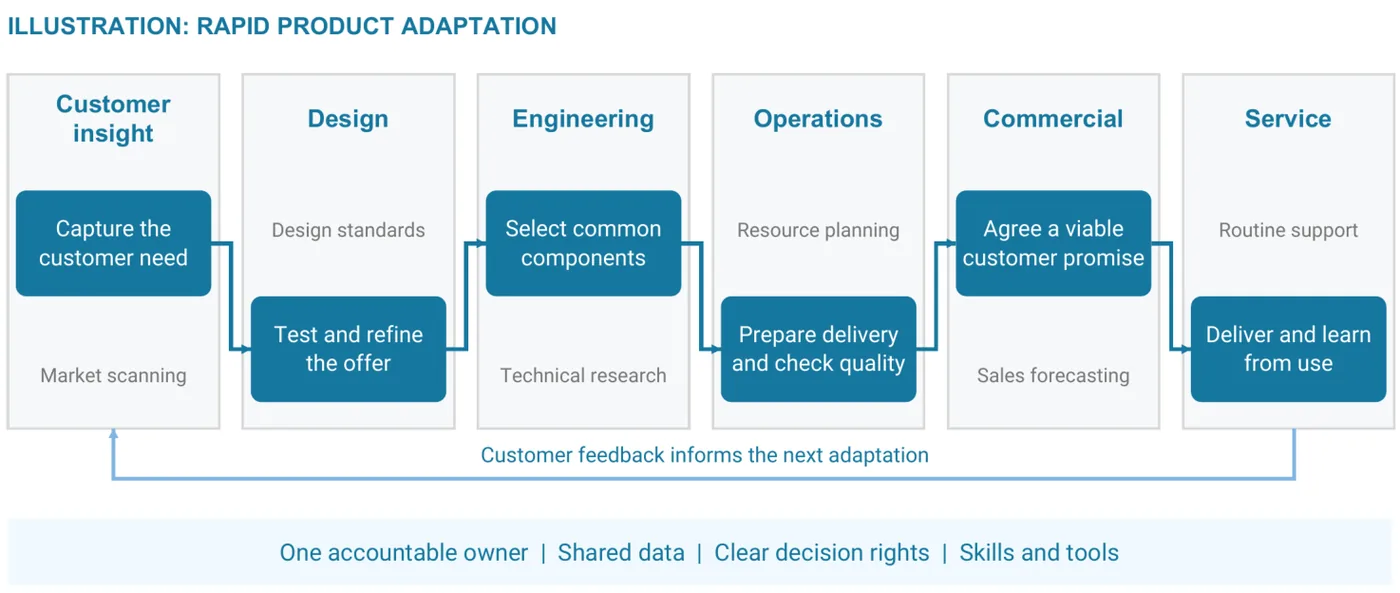
Use this view to find where work waits, information is re-entered or a decision is sent back. Each handover needs a clear output, an owner and a rule for resolving exceptions. The bar beneath the chart shows what makes the sequence work: shared information, clear authority and the skills and tools to act. Give one executive responsibility for the whole journey and judge it by customer outcomes, elapsed time, effort and risk. A faster department achieves little if the next handover still stalls.
Does the diary match the strategy?
List recurring activities, total the hours across everyone involved, and connect each activity to a priority or necessary obligation. Then make an explicit choice.
| Work actually done | Evidence to collect | Decision to make |
|---|---|---|
| Advances a priority | Customer or strategic outcome; total hours; bottlenecks. | Protect the work. Reallocate time towards the strongest opportunities. |
| Meets a necessary obligation | Requirement; service standard; effort and risk. | Simplify delivery while retaining effective controls and service. |
| Duplicates existing work | Who uses the output; the decision it changes; other versions. | Combine or stop it, and retire the associated reports and meetings. |
| Has no clear purpose | Named owner; expected benefit; reason it continues. | Challenge its continuation. Agree what stops and who will check. |
Use one record per activity: owner, outcome or obligation, people involved, total weekly hours, decision and review date. Recheck where the released time goes.
2 Establish a common language for data and reporting
The second theme was the importance of a common understanding of the business’s information. A company cannot move quickly if the first half of every meeting is spent debating whose numbers are correct. More reporting will not resolve a disagreement about what the numbers mean.
A common data ontology sounds technical. Its practical meaning is straightforward: agree what a customer, an order, a product, revenue and a completed job mean, and how those things relate. Then establish a common data layer through which systems can share that information. If two acquired businesses use different customer identifiers, a group dashboard alone will not make them consistent.
This work needs business ownership. Finance should own the definitions that determine financial reporting; commercial and operational leaders must agree the definitions that describe demand and delivery. Technology makes the information accessible and reliable. It cannot resolve a commercial disagreement disguised as a data problem.
AI can help identify duplicate records, inconsistent labels and conflicting policy versions. Ask it to show the evidence for a proposed match and send uncertain cases to a named owner. Settling what counts as revenue or a completed order is a business decision, even when the disagreement arrives wearing a technical vocabulary.
Common definitions do not mean that every local requirement disappears. A shared record can support different regulatory views, currencies and legitimate management questions. The discipline is to make the differences explicit and traceable, rather than forcing people to reconcile several unexplained versions of reality.
Information infrastructure earns its value when it makes the work easier to understand and carry out. The test is whether colleagues can use the information to make a better decision, with less time spent reconciling competing accounts.
Build recurring reporting from that common foundation. Agree which decisions each measure supports, who owns it and when it needs attention. Reuse the same core for management, the board and the sponsor wherever possible. Preserve statutory and contractual requirements while challenging formats that survive because somebody prefers them.
For every new dashboard, identify the spreadsheet or manual reconciliation it allows the business to retire. A new layer of reporting laid over inconsistent information can make the problem more attractive to look at without making it smaller.
Extend that rule to AI-generated reporting. Each new agent or automated pack should name the decision it supports and the old work it replaces. Otherwise we will have one machine writing a paper, another summarising it, and a roomful of people meeting to confirm that both have been industrious.
Track the time spent reconciling data, the recurrence of disputed figures and the speed of action once a problem appears. A single source of truth is a management discipline supported by technology. It is not the name of a software purchase.
3 Build the business around its signature processes
The third theme was to think about processes before structures. Customers experience the passage of work through the company. They rarely care which executive owns the department where it stops. A process can be efficient within every function and slow overall because the delays sit between them.
Distinguish three kinds of process. Signature processes create a distinctive advantage, such as rapid product adaptation or an exceptional response to equipment failure. Enabling processes support that advantage: workforce planning, for example, may underpin reliable field service. Routine operating processes, such as payroll, must meet their obligations reliably and efficiently. They do not all need a bespoke design. Which processes deserve distinctive investment depends on how the business intends to compete.
Invest attention accordingly. As the signature-process chart shows, connect the activities that produce the customer outcome across reporting lines, and give one executive responsibility for the whole journey. A signature process is rarely an entire department. Nor is it a random selection of fashionable projects. Its strength comes from complementary activities working together. Use a sound common approach for supporting work unless a commercial or regulatory requirement justifies variation. There is little strategic glory in having the most original expenses process in the industry.
Process discipline can increase freedom to act. When people know the required information, the decision rules and who owns an exception, they can use their judgement without negotiating every handover. The process must bring together data, systems, tools and skills. A new workflow cannot compensate for information that arrives late or a team that has never been prepared to use it.
Our four process assessments offer a useful starting point. Customer order to fulfilment and new product development expose the work of delivering and renewing the customer proposition. Budgeting and bonus allocation expose how the organisation allocates resources and rewards people. All four can reveal the consequences of unsettled priorities, inconsistent data and repeated approval.
Danfoss, the Danish engineering group, provides a practical example. Customer orders arrived in emails and attachments outside its established direct system connections. Staff had to interpret them and move between systems. Its Go Autonomous solution uses AI to interpret requests and initiate actions in the system managing business transactions. Google Cloud’s customer account reports processing time reduced by 50%, up to 80% of transactional decision-making and communication automated, and a single working interface replacing navigation across as many as five systems. Complex cases such as pricing discrepancies can still need human judgement.[3]
The useful variety remained: customers could order in different ways. The internal burden of translating those requests into action fell. The achievement was a connected journey, not merely a clever reply to an email. Apply the same test to your own AI programme: which handover, queue or repeated entry has actually disappeared?
Clarify decision rights along the journey. Standard transactions should follow agreed rules; exceptions should reach someone with the authority and competence to resolve them. Technology should support that design. Automating an unnecessary approval preserves the wrong work, albeit at greater speed.
Measure elapsed time and management effort separately, alongside quality, customer outcomes and risk. Invest where simplification makes the business more competitive, and retire the old systems and routines once their replacements work. Otherwise the transition becomes a permanent extra layer.
Amazon illustrates a different source of complexity: yesterday’s technology. In August 2024 it reported using Amazon Q Developer to help upgrade tens of thousands of production applications to a newer version of Java, the programming language. It estimated more than 4,500 developer-years of manual upgrade work avoided and, separately, $260 million in annual infrastructure savings from performance improvements that allowed computing hosts to be removed.[4]
These are company estimates, based respectively on migration effort and computing capacity no longer required. The distinction matters. One benefit is work avoided; the other is lower operating cost. For a business with an untidy inheritance of systems, AI may make modernisation affordable enough to undertake. The financial benefit still depends on testing the replacement and switching the old system off. A retirement party at which the retiree continues doing the same job is a peculiar form of progress.
4 Remove unnecessary layers and review them again
The fourth theme was the burden created by management layers. Each additional level adds an interface at which information may be interpreted, a decision reviewed or work returned for revision. It can also create another set of preferences for everyone below to satisfy.
A layer can earn its place through expertise, coaching, control or the coordination of genuinely different activities. It should not survive simply because it has always existed. Ask what judgement that level adds, what decision it owns and what would become harder if it disappeared. Relaying information up and instructions down is an increasingly weak justification for a management role.
Interview material described blurred accountability as “Multiple people with hands on same steering wheel”. That is a useful warning: reducing layers must also clarify who decides. Look beyond the formal organisation chart. A project office, regional forum or matrix relationship can add an effective approval layer without appearing as one. Removing a reporting level while retaining its committees and informal vetoes may change the picture without changing how work gets done.
A practical test is to follow a recurring decision from the customer-facing team to its conclusion. At each stop, identify whether someone contributes indispensable judgement or merely seeks comfort from the next level. Then place authority where the relevant knowledge and accountability can meet.
Senior managers also need to stop drawing decisions upwards simply because they can answer them. Repeated intervention teaches capable colleagues to wait. Agree the limits within which a team can decide, support sound judgement and reserve escalation for exceptions that genuinely require it.
An AI agent needs equally clear boundaries. Specify what it may read, recommend and execute, which decisions require a person, and who can stop it. Give employees a usable route to challenge its output. Replacing a managerial queue with an algorithm nobody feels able to question is a change of gatekeeper, not an increase in agency.
This requires redesigning work, not simply removing people. If an executive inherits too many direct reports, coaching and judgement can deteriorate. If a control role disappears without its obligations being reassigned, risk increases. Eliminate unnecessary reviews and clarify responsibility as part of the change, so that the retained managers can actually perform their jobs.
Skill matters here. We can reduce experienced complexity by giving people the competence and confidence to handle demanding work.[1]
Sharon’s goddaughter appeared on The Great British Bake Off. In one episode, she was asked to make 12 perfect cookies in 30 minutes. She won that episode. Her skills were so well developed that she experienced little complexity. Give the same task to either of us and we would find it complex beyond belief.
Complexity, in this sense, is the residual between the difficulty of the task and the skills of the person or team undertaking it. The task can stay the same while skill makes it simpler.
Delegating decisions to people who have neither the information nor the preparation to make them is unfair. Build competence and give feedback, particularly where managers have spent years being rewarded for asking permission.
In AI-enabled work, that includes recognising a plausible but unsupported answer, understanding the process beyond one’s own desk and knowing when to escalate. People also need enough safety to admit uncertainty and suggest an improvement. If the first person to question the new system is treated as an obstacle to progress, the organisation has just disabled one of its best controls.
Then revisit the design. A layer removed today can return tomorrow under another title. Growth and acquisitions may create legitimate new coordination needs, but they should prompt a fresh choice rather than an automatic expansion of hierarchy.
The test of progress is whether decisions travel through fewer unnecessary stops, responsibility becomes clearer and managers have time to help their teams. A lower headcount with the same approval burden is an incomplete simplification.
5 Preserve the complexity customers and regulators need
Begin with the business’s promise to customers. Where does choice matter? Which differences justify a premium, protect retention or enable market access? Which obligations genuinely vary? The chief executive should ask the commercial and operations leaders to answer together, with finance testing the economics. A product review conducted entirely within one function will tend to preserve that function’s preferred answer.
Consider a hypothetical PE-owned industrial components company. It has grown through acquisitions and now offers many similar configurations. Some satisfy distinctive operating conditions at major customers. Others reflect historic design decisions that nobody has revisited. A blanket reduction in the number of products would treat these differences as equivalent.
Our proposed approach would examine families of products and the customers they support. It would include engineering time, small production runs, inventory, quality requirements and service obligations. It would also ask whether apparently marginal products support a profitable package. The objective would be to preserve valuable configurations while using common components wherever customers do not benefit from a difference.
In this example, management could retain a demanding specialist range, migrate customers from redundant variants and charge appropriately for exceptions. Results would need to be assessed through customer retention, contribution after service costs, inventory and delivery reliability.
The same logic applies to regulation. A business operating in several jurisdictions may need different controls or evidence in each. The useful question is which requirements genuinely differ and which internal activities have merely evolved separately. Common information can support tailored responses without forcing every jurisdiction into an identical process.
There will be disagreements. A commercial leader may see future potential where finance sees a costly tail. Make the assumptions explicit and give uncertain exceptions an owner and a review date. Some will prove their value. Others should expire. Permanent exceptions should require more than someone’s continuing enthusiasm.
The test of progress is not a shorter catalogue. It is a clearer explanation of why each meaningful difference exists and evidence that the company can deliver it economically. If the simplification programme cannot describe what must be protected, it is not ready to start cutting.
Unilever offers a concrete example of reducing variety. In its 2025 reporting, Personal Care said it had cut separately managed product variants by more than 20% since 2022; Beauty & Wellbeing reported a reduction of over 30% since early 2024. Its wider productivity programme delivered approximately €670 million in cumulative savings by the end of 2025. Those savings cover the broader programme, not product pruning alone.[5]
For leaders, the useful question is which variants attract customers, justify a premium or meet a real local requirement, and which bring a small entourage of forecasts, packaging, stock and exceptions without paying for it. AI can help cluster similar specifications and find shared components. Commercial and operational colleagues must make the choice together, with a sensible migration route for affected customers. A thinner catalogue is only an achievement if the business is stronger.
6 Change the behaviour that keeps recreating the problem
Our interviews and questionnaire attempted to make the behavioural task concrete: clarity, courage, experimentation, empowerment, collaboration and focus. They also explored whether leaders value fewer priorities, resist equating busyness with contribution, and recognise pointless perfectionism. These habits matter because a leader’s influence extends far beyond the work they personally assign. People infer preferences from what attracts attention, what gets challenged and what leads to promotion. Simplicity will remain fragile if the organisation’s daily signals reward complication.
Start with direct feedback. Ask colleagues for specific occasions when your behaviour created avoidable work. Did you reopen an agreed decision? Add an urgent request without changing existing priorities? Seek more precision than the decision required? Make a passing observation that others interpreted as an instruction?
This is more revealing than asking whether people regard you as an empowering leader. General questions invite agreeable answers. A recent example exposes a choice you can change. The senior team should discuss its own contribution before launching a campaign aimed at everyone else.
GE Aerospace’s 2025 shareholder letter describes a revealing moment at Terre Haute, Indiana. Employees wanted an electronic tape dispenser to replace a laborious manual step. Their leader, Gerald Beuvelet, initially asked for extensive justification, then recognised the discouragement he had created and authorised the purchase. The team named the dispenser “The Gerald”. Through a wider series of improvements, the turbine centre frame line’s on-time delivery rose from 20% in 2023 to 96% by the time of the letter.[6]
The company does not credit the improvement to one tape dispenser. The point is that the person holding the authority changed his mind and trusted the people doing the work. A business that can make jet engines ought to be able to buy a tape dispenser without launching a second engineering programme. Ask where comparable obstacles sit in your organisation, including the ones you have defended.
There is a human difficulty here. Some leaders experience detailed involvement as care. Others see rapid intervention as proof of competence. Giving up either can feel like becoming less useful. The transition requires a different conception of the job: creating the conditions in which other people can exercise sound judgement.
People do not experience the removal of work as an uncomplicated gift. A report may carry someone’s status; an approval may be how a manager demonstrates care; a routine may support a livelihood. Explain the purpose, involve the people who know the exceptions and be honest about consequences for roles. Give them time and help to learn. Their knowledge is part of the solution, not inconvenient luggage to be left at the platform.
That includes distinguishing where precision is essential from where refinement has stopped adding value. Safety-critical work needs exacting standards. A reversible commercial experiment may not need another month of analysis. Leaders should agree those distinctions in advance, so that teams do not have to guess how much certainty will satisfy them.
Recognise the person who eliminates a recurring problem, not only the person who heroically manages it each week. Make stopping low-value work a legitimate contribution to performance. When a colleague challenges a request, respond to the reasoning. A ritual invitation to challenge, followed by visible irritation when someone does, is a remarkably efficient way to teach silence.
Skills must support the change. Managers may need help making decisions with incomplete information, resolving conflict across functions or using new systems. Frontline teams need time to learn a revised process. Cutting that investment to accelerate implementation can leave the old workaround as the only method people trust.
Recognise the person who eliminates a recurring problem, not only the person who heroically manages it each week.
The evidence of progress should come from the people affected. Are decisions staying made? Can teams explain their priorities? Have specific recurring frustrations disappeared? Feedback should focus on changes in work, with enough candour to reveal where senior behaviour still contradicts the stated intent.
Include the human cost in that review. Ask whether repeated obstruction is leaving people exhausted, preventing useful ideas from being tried or making capable colleagues consider leaving. Examine these signals alongside workload and management quality. Removing frustrating work can matter to the people doing it as well as to the economics of the business.
Leaders do not have to become perfect simplifiers. They do need to become corrigible ones. A chief executive who can say “I created that work, and we should stop it” gives the organisation something more useful than another slogan.
7 Turn released capacity into value and prevent the work from returning
Simplification needs an economic owner. The operations leader may remove a bottleneck, but finance and the commercial team must help determine what happens to the capacity released. Otherwise the organisation can feel better without delivering a measurable improvement.
For each material change, establish the starting position, the intended operational benefit and the route into financial performance. Distinguish recurring cost reductions from avoided future costs. Separate cash released from inventory or receivables from improvements in ongoing cash generation. Include implementation expenditure and the temporary burden of running old and new arrangements together.
A simple worked example shows the distinction. Suppose, purely for illustration, that a business with £100 million in annual credit sales collects payment five days earlier, with sales and other conditions unchanged. On a 365-day basis, this represents approximately £1.37 million less cash tied up in receivables. It is a potential one-off working-capital release, not £1.37 million of additional annual EBITDA. The business must sustain the improvement to keep the cash from becoming trapped again.
Likewise, ten hours a week released across a team may be valuable without supporting a reduction in headcount. Management should decide whether those hours will reduce overtime, absorb growth or improve service. Compare effort on similar deliverables after allowing for volume, service requirements and risk. A difference in staffing is a prompt to investigate, not proof of waste. Describe the benefit honestly and track it against its intended use.
Do not mistake speed at one point for speed through the system. Suppose a quotation takes two hours to prepare and then waits four days for authority to offer a non-standard price. Halving preparation time releases capacity; changing the approval may matter far more to the customer. Measure active work and waiting separately, and follow the effect all the way to the result.
Avoid setting a single target for reducing complexity across the company. A product count, system count or number of approvals is a useful diagnostic, but a poor universal definition of success. Use a small set of measures relevant to the selected problem, and pair them with checks on customer outcomes and control effectiveness. Faster work that creates more errors will eventually become slower work.
Then make subtraction part of normal management. Give temporary controls a review date. Include integration and system retirement in acquisition plans. Ask what a new initiative replaces and who has capacity to deliver it. Review exceptions because they are exceptions, rather than allowing them to become an invisible second operating model.
Maintain a small register of AI agents: purpose, owner, access, decision limits and the work each replaces. Review them when policies or processes change. Otherwise an abolished committee may enjoy a vigorous afterlife as six digital officials, each faithfully enforcing a different version of its former wishes.
The board should periodically examine whether benefits have held, whether demand has changed and whether complexity is accumulating elsewhere. The discipline should fit existing management routines wherever possible. A permanent committee devoted to simplifying other committees would be an unfortunate monument to the programme.
Then make subtraction part of normal management.
Success is visible when the business can do more valuable work without a corresponding rise in the effort needed to coordinate itself. That is a capability worth carrying into the next acquisition and the next stage of growth.
Start where the business feels the cost
These seven choices do not require seven programmes. They can be brought together around one commercially significant problem. Choose a customer journey that is too slow, a product family whose economics are unclear or a recurring decision that repeatedly reaches the top. Give one executive responsibility for the outcome and bring the relevant people together around the actual work.
In the first month, establish what customers and regulators need, where work waits, and which measures will reveal improvement. Listen to the people who manage the exceptions every day. They will usually know which parts of the formal process have ceased to describe reality.
Use AI to help examine process records, classify recurring exceptions and find where cases wait or return for correction. Limit access to the information legitimately needed, then test its suggestions with the people doing the work. A system log records events; it does not always explain why a colleague took the only workable route available.
Use the next period to test a simpler design on a contained part of the business. Remove unnecessary work, clarify authority and build the skills needed to operate differently. Keep the test small enough to learn from, but meaningful enough to expose the difficult interfaces. A pilot that avoids every organisational boundary proves very little about the ability to scale.
Include awkward cases in the trial: missing information, conflicting prices, cancellations and customers who need personal assistance. Agree what can proceed automatically, what must pause and who owns an exception. If errors, customer effort or unresolved cases exceed the agreed limits, narrow the scope and repair the design. A pilot should teach us something, not spend its life protecting the announcement that launched it.
Before expanding, check both the operational result and its financial interpretation. Has the delay actually fallen? Are customers receiving what matters to them? Have errors or risks moved elsewhere? Has the released capacity been used? Then retire the old arrangements and make the new approach part of ordinary management.
The deeper change is in what leaders consider their responsibility. Many executives are good at asking the organisation to do more. Fewer are equally deliberate about deciding what it can stop. Yet every additional demand consumes a portion of the attention needed to deliver the strategy.
Simplicity requires intellectual effort. It removes places to hide. Fewer priorities expose the choices. Clearer authority exposes who decides. Better information exposes performance. A more coherent process exposes the handovers for which nobody previously accepted responsibility.
The aim is an organisation sophisticated enough to serve its customers and disciplined enough to avoid burdening itself unnecessarily. Preserve the differences that create value. Invest in the capabilities that make them manageable. Remove the work that no longer earns its place. AI can help us do all three. It cannot supply the courage to stop asking for things. That remains a leadership task, inconveniently resistant to automation.
Sources and further reading
1. Price, C., and Toye, S. Accelerating Performance. Wiley, 2017; and Speed Wins, APC. Background to the performance and signature-process framework.
2. Price, C., and Toye, S. Organisational complexity study, 2025 to first half of 2026. Unpublished survey, interviews and process assessments of 48 PE portfolio companies in 11 countries. The insurer diagnostic is a separate client study.
3. Google Cloud. Danfoss and Go Autonomous: Reimagining order management at scale. Customer-reported results; accessed November 2026. Customer case
4. Cholkar, A. A. Amazon Q Developer just reached a $260 million dollar milestone. AWS, 1 August 2024. Company estimates and calculation method. Account and method
5. Unilever. Annual Report and Accounts 2025 and Full Year 2025 Results, published 2026. Product-variant reductions and wider productivity savings. Annual reporting Results
6. GE Aerospace. 2025 Annual Report, CEO letter, published 2026. Terre Haute improvement programme and the tape-dispenser account. Letter