Executive summary
Organisational health is the collective capacity to deliver worthwhile results, adapt to changing conditions and renew the capabilities on which future success depends. It includes the quality of people’s working lives, but reaches well beyond morale. A business can be cheerful, profitable and dangerously unprepared. Health shows up in how it makes decisions, serves customers, learns and behaves when its assumptions stop being true.
Health today drives performance tomorrow. The working arrangements that help people make sound decisions, coordinate and learn are part of the machinery of value creation. Their practical expression must now change. AI alters who can know, decide and act. War, geopolitical fragmentation, cyber threats and concentrated supply chains expose dependencies beyond the organisation’s boundaries. A healthy organisation must combine trust and purpose with productive paranoia: enough vigilance to detect danger, enough preparation to withstand it, and enough confidence to keep moving.
Drawing on our work in organisational performance, leadership and teams, alongside operating experience and newer research, this paper argues for a more demanding approach. Align owners and leaders around a credible mandate. Improve whole customer journeys. Make authority, information, incentives and skills work together. Build human and AI agency with explicit limits and effective intervention. Preserve learning, social connection and the capacity to recover when efficiency programmes remove familiar work or reserve capacity.
Begin with a consequential performance problem and a consequential vulnerability. Follow both through the real organisation, test the causes and make a few mutually reinforcing changes. Measure customer and economic outcomes alongside capability, resilience and learning. The aim is an organisation that becomes more capable through its work, and stays sufficiently alert to notice when that work needs to change. Building health is hard but achievable; sustaining it requires continuing attention as success, leadership changes and new pressures test the habits that created it.
In this paper
- Good results can conceal a weakening organisation
- The empirical case links health to hard outcomes
- Keep the foundations and change the demands
- Productive paranoia is part of health
- Health starts with the mandate and the facts
- Follow the work before diagnosing the people
- Make the changes reinforce one another
- The customer experiences the joins
- AI changes the architecture of health
- Build the next generation of judgement
- Renewal needs resources while the business is winning
- Building health is hard and keeping it is harder
- Improve health through work that already matters
- Measure the capability as well as the result
- A manifesto for healthy organisations now
- What success should leave behind
- Sources and further reading
Good results can conceal a weakening organisation
A company can report a record quarter while becoming less capable of repeating it. Experienced people have gone. Customers are waiting longer for awkward problems to be resolved. The next generation of managers is getting plenty of practice explaining the numbers and rather less improving the work. The results presentation will, of course, describe the performance as sustainable.
Now give that company AI. Its reports arrive faster, its customer responses sound more accomplished and its decisions travel further before anyone notices a mistake. Add a disrupted shipping route, a cyber incident or a change in access to a critical market. What looked like efficiency may turn out to have been the removal of everything that allowed the organisation to cope.
This is why organisational health needs a fresh examination. We define it as the collective capacity to deliver worthwhile results, adapt to changing conditions and renew the capabilities on which future success depends. A healthy organisation maintains the people, trust, resources and relationships needed to do those things under pressure. It can act with confidence while questioning the assumptions on which that confidence rests.
In Beyond Performance, the book Colin wrote with Scott Keller, the central distinction was between current results and the organisational capabilities that make good results repeatable. Alignment means agreeing what matters and directing effort towards it. Execution means turning that intent into reliable delivery. Renewal means learning and changing before the old approach stops working. The research examined whether organisations that strengthened these capabilities subsequently performed better. That question remains central to this paper. [1]
The argument was forged in the aftermath of the financial crisis, which had supplied a rather expensive lesson in the difference between reported success and institutional strength. But we should resist treating a useful framework as a finished constitution. AI is changing the distribution of expertise and authority. Geopolitical conflict can change the conditions of trade and investment, not simply the forecast. An efficient organisation built around yesterday’s assumptions can become fragile remarkably quickly.
We arrive at this argument through different, overlapping routes. Colin’s perspective has changed since writing Beyond Performance as a McKinsey adviser. Work in private equity and start-ups, including one on a multibillion scale, has brought the discipline of living with decisions as well as recommending them. Sharon has spent more than 25 years working with leaders and their teams, as an organisational psychologist, a coach to Chairs and chief executives and a practising psychotherapist. She co-founded Co Company, the leadership and team consultancy later acquired by Heidrick & Struggles, and went on to build Heidrick’s global team practice. She has also led culture and transformation inside a European bank, so she knows what a change programme looks like from the client’s chair. Her work brings the question into the room: can people challenge one another, confront difficult choices and follow through? In our study of 408 senior teams, the ability to surface and productively address disagreement was the capability most strongly associated with outperforming competitors. A sound operating model still needs people who can make it work together.
Neither perspective is sufficient on its own. Commercial demands can become wishful thinking if they ignore how people behave; leadership development can become an agreeable diversion if it never changes the work. Our shared concern is the connection between them. We explored it together in Accelerating Performance, and it runs through this paper: does improving the way people lead and work together help the organisation serve customers, grow, release cash and manage risk? Health has to survive contact with both the balance sheet and the Monday morning meeting.
Between us, we have worked with more than twenty private equity portfolio companies. Sharon’s client work includes Unilever, QBE, Volvo, Nokia, Nationwide, BT, L’Oréal, Npower, IMI and RS Components, and spans board reviews, leadership and executive team development, and one-to-one work with Chairs and chief executives. Colin’s includes Cisco, Wellcome, Apple, British Aerospace, the English NHS and JPMorgan. We have both worked with Aviva, UBS and Thomson Reuters’ financial and risk business, subsequently known as Refinitiv and now part of LSEG. Colin’s work also includes Bain Capital, which kindly contributed a chapter to our book Accelerating Performance. He is Chair of itim, a software company listed in London. Across these different settings, we ask the same question: can people do better work together, and does that improvement reach customers and the economics of the enterprise?
Experience in private banking, insurance and private equity has made the argument more practical. Incompatible owner expectations, different versions of the facts, overhead that crowds out useful work and the behaviour of the most senior leader are not peripheral to health. They determine what the organisation can actually do. They belong inside the definition, not in a separate conversation about the “hard” business. [3]
The task now is to build institutions that can perform, sense, respond and renew together. That takes more than a reassuring survey score. It also takes more than a permanently anxious chief executive. The organisation must be alert enough to see trouble and healthy enough to do something useful about it.
The empirical case links health to hard outcomes
The empirical case has three parts: comparisons between organisations doing similar work; studies that follow performance after changes in working practices; and evidence about the mechanisms involved. Together they make a stronger argument than a survey showing that people in successful companies feel pleased about it. The question is whether healthier ways of organising help produce the success.
Start with two unusually tangible comparisons. Figure 1 brings together the refinery and hospital relationships used in our health research presentations. Each dot represents a unit in the source slide. The horizontal axis runs from weaker to stronger organisational health; the vertical axis from lower to higher performance. In both settings the fitted line rises: healthier units tend to perform better. [4]
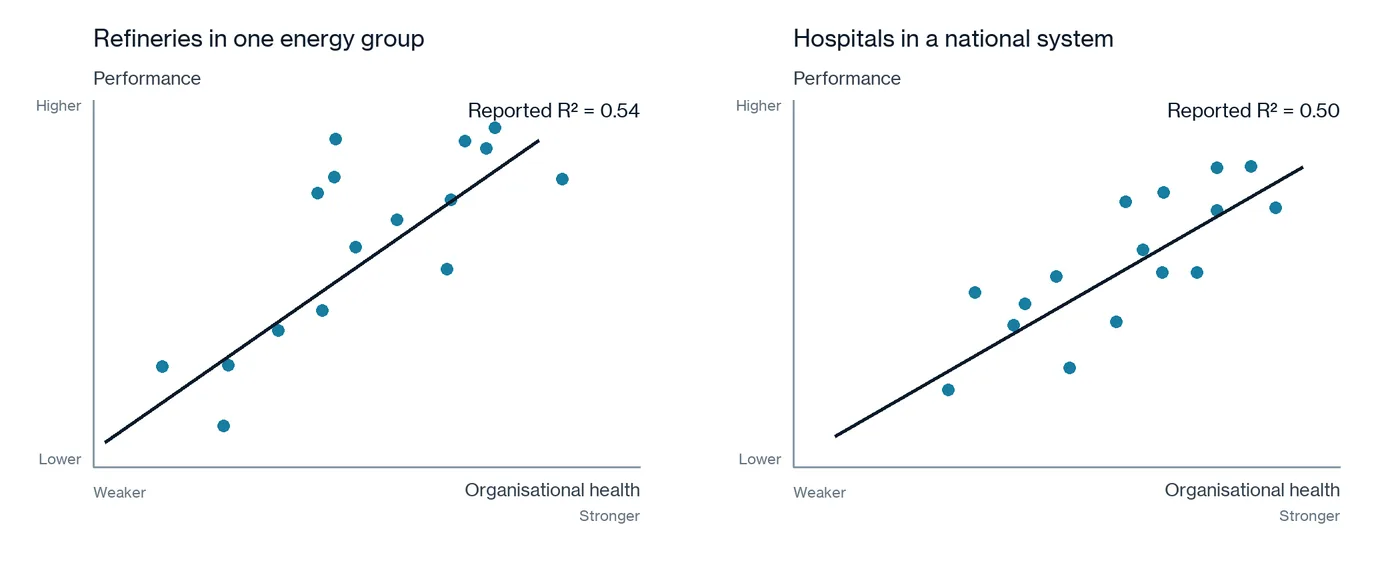
The refinery analysis covers sixteen production facilities in one energy group. The published study measured organisational effectiveness across nine outcomes, including direction, accountability and capabilities, and compared financial performance with an industry benchmark in dollars per unit produced. Its fitted relationship associated a ten-point improvement in the organisational score with a $0.28 reduction in the performance gap per unit. The reported R² was 0.54. This connects the way the organisation works to an operating measure a finance director can recognise. [5]
The hospital slide reports R² of 0.50. Put simply, the fitted relationships account for roughly half the observed variation in the performance measures used. That does not mean a 50% improvement in performance, nor does it establish causation. The hospital slide does not specify its performance metric or underlying dataset, so it should not be read as a mortality chart. Its role here is to show the reported pattern across a second setting; the stronger test comes from studies with defined outcomes and comparisons over time. [4]
A separate study of sixty-one acute hospitals in England provides a more specific clinical link. Researchers examined appraisal, training and teamworking alongside patient mortality, and found strong associations between better people-management practices and lower mortality. The size of individual analyses varied with available data, and the design was observational. These were nevertheless patient outcomes, not ratings of how agreeable the staff restaurant had become. [6]
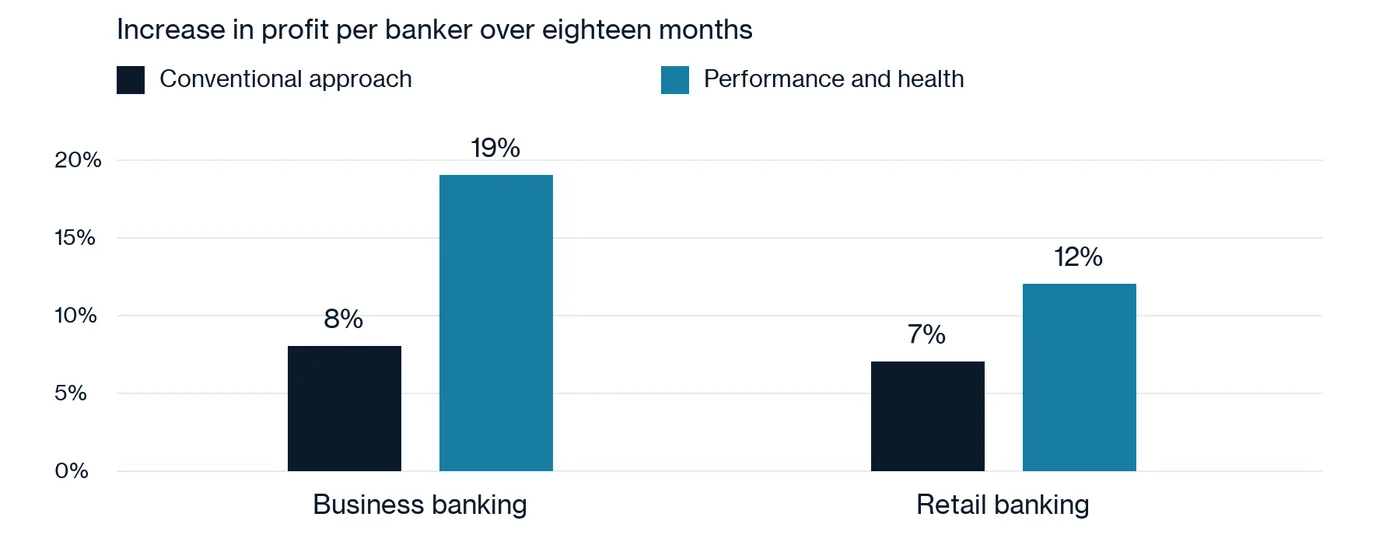
The next question is whether improving health is followed by better results. At a large financial institution, research reported in Beyond Performance compared groups matched on profitability, customer economics and staff characteristics. Over eighteen months, business bankers in a programme combining performance and health improvement increased profit per banker by 19%, against 8% under the conventional approach. In retail banking the improvements were 12% and 7%. These were matched organisational comparisons rather than randomised trials. Their strength is that working practices changed and subsequent results were followed. Figure 2 shows the difference. [1]
Comparable improvement programmes in mining, retail and telecommunications tested changes where people actually worked, with customers, deadlines and imperfect information. The recurring lesson was that a higher target became more productive when people also acquired the capability and conditions to achieve it. In a mine that might mean better coordination between shifts; in a retailer, more useful coaching and greater responsibility for solving customer problems. The target matters, but it cannot do the work. [1]
A longitudinal McKinsey analysis followed companies working on organisational health and reported an 18% increase in earnings before interest, taxes, depreciation and amortisation, against 7% for its S&P 500 comparison. The benchmark cannot isolate every other influence on earnings, but it adds evidence over time to the matched intervention studies. Health is being connected to what the enterprise subsequently produces, not simply to how it feels today. [7]
More recent evidence changes the practice as well as reinforcing the interest. McKinsey’s 2023 revalidation, published in 2024, involved nearly 9,000 employees and expanded its diagnostic from 37 to 43 management practices. It found that effective decision making required several practices working together, including data, decisiveness and empowerment. The enduring capabilities remained; the behaviour needed to produce them evolved. [8]
A US Veterans Health Administration study offers a further test over time. It followed 182,409 sampled surgical procedures across 108 facilities. Annual surgical mortality fell by 18% in the 74 facilities introducing a medical team-training programme, compared with 7% in the 34 not yet trained. The retrospective comparison associated the programme with improvement; its practical interest lies in what changed in the work. [9]
What was done is as instructive as the result. Preparation preceded the training, operating-room professions participated together, and quarterly coaching continued for a year. Briefings, debriefings and checklists changed daily work. The programme gave people repeated opportunities to coordinate and speak up. Buying the workshop and leaving the working arrangements untouched would have purchased only a small part of the intervention. [9]
Taken together, these findings support a business proposition: investment in organisational health can improve subsequent performance when it changes the conditions of delivery. Earlier warnings make correction cheaper. Better handovers reduce rework and lost customers. Clear authority shortens the wait between knowing and doing. Coaching develops the next capable colleague. Recovery arrangements limit the damage when a dependency fails. That is how health today can become performance tomorrow.
Keep the foundations and change the demands
Health, culture, engagement and wellbeing are related, but they are not interchangeable. Culture is the shared expectations and habits that shape behaviour. Engagement concerns people’s connection to their work and organisation. Wellbeing concerns their experience and condition. Health asks whether the organisation can bring people and resources together to achieve its purpose over time. Enthusiastic people can still be trapped in a badly designed system.
A strong culture is not automatically a healthy culture. People can agree intensely about the wrong thing. An organisation that rewards loyalty above evidence may look wonderfully aligned until circumstances change. Equally, a relentlessly challenging environment can exhaust people if nothing ever settles into a decision. Healthy organisations need both independent thought and the ability to commit.
Alignment, execution and renewal remain useful foundations. Their meaning must now extend beyond stable internal arrangements. Alignment must survive distributed decisions by people and AI agents. Execution must survive interrupted supply, conflicting rules and new forms of error. Renewal must occur while the business is still delivering, not after a committee has agreed that the previous model is deceased. Table 1 sets out the practical shift.
| Enduring need | What now has to be designed | Evidence in ordinary work |
|---|---|---|
| Alignment | Shared intent and explicit limits for distributed human and AI decisions. | People can explain the purpose, trade-offs and conditions for escalation. |
| Execution | Reliable delivery across functions, partners and digital dependencies. | The customer gets a resolved outcome; exceptions have an owner. |
| Renewal | Continuous learning as technology, markets and threats change. | Assumptions are revised; skills and resources move to new needs. |
| Resilience | Selective reserves, alternative routes and rehearsed recovery. | The service remains usable when a critical dependency fails. |
Table 1. The foundations of health endure; their practical expression must change. Developed from Beyond Performance and the argument in this paper. [1]
The boundary matters. A company may have excellent internal teamwork and still depend on a supplier, cloud platform, shipping route or financing arrangement it barely understands. Health now needs to be examined across the network that produces the outcome. The organisation chart is a useful administrative document. It is a poor map of everything that can stop a customer being served.
Nor should a health programme attempt to make the organisation exceptional at every management practice. All require adequate trust, competence, accountability and safety. Beyond those foundations, choose the few ways of working that will make the greatest difference to customers and the strategy. Copying admired practices from several successful companies can produce an organisation with excellent ingredients and a distinctly peculiar taste. For an insurer, a distinctive strength might be resolving a difficult claim without asking a distressed customer to explain the same incident to five departments. That requires shared information, clear authority and reliable coordination with repairers, as well as considerate people on the telephone. Start with the experience the customer should have, then work backwards to the capabilities and relationships that make it possible. Choose an owner for the whole outcome and measures that reveal whether the promise survives an awkward case. AI may help retrieve information or coordinate the next step, but faster responses are of limited comfort if nobody can settle the claim. Health becomes commercially distinctive when these arrangements work together often enough for customers to trust them.
Productive paranoia is part of health
A healthy organisation is not one that feels safe from the world. It is one in which people feel safe enough to discuss the world as it is. That distinction reconciles psychological safety with productive paranoia. Be demanding about the evidence and curious about the threat; do not make the person bringing bad news the most endangered person in the room.
Jim Collins and Morten Hansen used “productive paranoia” in Great by Choice to describe preparation for abrupt change: reserves, margins of safety and disciplined action before conditions turn against the organisation. The useful word is productive. Worry earns its place by improving a decision, a contingency or a capability. Anxiety circulated through the leadership team is still anxiety, however impressive the distribution list. [10]
War and geopolitical conflict make this more than a colourful phrase. They can affect people’s safety, market access, energy, payments, suppliers and the ability to move information across borders. The ECB and European Systemic Risk Board’s January 2026 report examined how geoeconomic fragmentation can transmit shocks through financial and non-financial channels. The organisational implication is to examine connected exposures rather than file “geopolitics” as one remote item on a risk register. [11]
Maersk’s response to attacks affecting Red Sea shipping shows what a changed assumption looks like in practice. In January 2024, it diverted vessels around the Cape of Good Hope, accepting longer journeys to protect crews, vessels and cargo and provide a more predictable service. The route that had supported the operating plan could no longer be treated as a dependable given. The response required different scheduling, capacity and customer communication, not greater enthusiasm for the original timetable. [12]
For another company, the question is which apparently separate activities share the same point of failure. Two technology suppliers may rely on the same cloud provider. Alternative manufacturers may buy the same critical component. Several customers may depend on one public budget. AI agents assigned different tasks may use the same model and reproduce the same blind spot. A portfolio can look diversified from the boardroom while standing on one rather narrow leg.
Leaders should name the handful of assumptions that could invalidate their strategy or interrupt an essential service. For each, agree the warning signals, who watches them, the threshold for action and the response already authorised. Then trace one recent development, perhaps a change in a market, a geopolitical threat or a competitor’s use of AI, through the organisation. When did someone first notice it? When did its significance become clear? When was a decision made, and when did action follow? Failure to notice, failure to understand and failure to act require different remedies. More intelligence will not cure a decision that nobody owns. Some organisations have excellent early-warning systems. The warning arrives early; the decision remains indefinitely postponed. Find where the response stalled and repair that part of the work. Rehearse the difficult version too: a key person is unavailable, the data are incomplete and the preferred supplier cannot help. A plan that works only when its author is in the room is closer to a personal talent than an organisational capability.
Preparation also means choosing what reserve to protect. Cash, spare capacity, a second source, cross-trained colleagues and a workable manual route all have costs. Some are worth paying. A saving that removes the only person who can recover a critical system deserves a fuller description than “efficiency”. Equally, resilience is not an excuse to keep every legacy activity. Protect the specific capacity that allows the organisation to absorb a shock and recover.
There is a discipline to stopping as well as starting vigilance. Review a small set of consequential signals at an agreed cadence. Separate a reversible experiment from a commitment that could threaten survival. Close risks whose conditions have changed. Decide who may act, rather than requiring another round of approval at precisely the moment speed matters. The purpose is to preserve room for confident action, investment and imagination. Permanent emergency is a poor operating model and an exhausting personality.
A healthy organisation is one in which people feel safe enough to discuss the world as it is.
Health starts with the mandate and the facts
Owners and managers can use the same strategy presentation while making quite different commitments. A management team may be building a five-year business while its investor expects cash back in two and cannot fund the intervening development. The resulting cancellations, sudden cost reductions and changes of emphasis will eventually be diagnosed as a culture problem. The culture is receiving some very mixed instructions. [3]
The Chair, owners and executive team need agreement on the value being created, the horizon, the investment and the risks they will accept. That agreement should include the conditions that would cause them to reconsider. In a public service, the equivalent involves political intent, funding, statutory duties and operational capacity. Commitment cannot compensate indefinitely for promises that the system has no means to honour.
Productive paranoia belongs in that agreement. How much disruption can the organisation finance? Which capabilities must survive a downturn? What would justify withdrawing from a market or pausing an AI deployment? Settling these questions in advance makes it less likely that a difficult quarter will lead to indiscriminate cuts and a new collection of unfunded priorities.
People also need a common factual base. Sales may have fallen because an unprofitable segment was deliberately abandoned. Complaints may have risen because a technology investment was cancelled. Two functions can disagree vigorously while each is using internally correct data from different periods and definitions. Before commissioning a workshop on collaboration, it is sometimes worth checking whether everybody is discussing the same month. [3]
AI makes this issue more urgent. It can assemble information from disconnected systems, but it can also produce a remarkably fluent reconciliation of figures that should never have been combined. Preserve definitions, dates, provenance and the ability to question an output. Shared facts should support competing interpretations, not establish one officially sanctioned opinion.
The mandate must then survive translation into budgets, roles and daily choices. If cooperation matters, examine where budget ownership makes cooperation costly. If renewal matters, identify the time and money actually available for it. If customer trust matters, test the exceptions leaders permit when a target is at risk. People are excellent readers of those decisions, even when they have mislaid the values booklet.
Follow the work before diagnosing the people
In a retail-bank improvement programme, sales staff spent too little time with customers despite instructions and incentives to do otherwise. Paperwork appeared to be the obstacle. Closer investigation showed that some of it was self-imposed: staff were more comfortable with the forms than with customer conversations. Removing forms alone would have released time without necessarily changing how it was used. [13]
The response extended from frontline behaviour to the executive committee. Senior meetings became working sessions in which decisions were tested for customer impact. Customer measures entered capital management, strategic planning and risk discussions. The published account reported customer loyalty increasing by a third over three years, attrition falling by more than half and the cross-selling ratio rising by a fifth. The point is the connected change: customer focus became part of how the bank was run. [13]
This is a recurring feature of successful health work. A label such as “lack of accountability” often conceals several different problems. People may not know the outcome expected of them. They may lack authority, resources or skill. They may expect punishment for a reasonable mistake. Or they may be avoiding a commitment they are perfectly capable of meeting. Those situations require different interventions.
Start with a piece of work that matters: a claim that repeatedly returns, a product launch that slips or a customer whose problem crosses three functions. Follow successful and unsuccessful cases. Compare what the process says with what people actually do. Ask what they are trying to achieve, what they believe will happen if they act differently, and where they must improvise. Use operating records, interviews, observation and customer accounts together.
Connect the business outcome to the practices, behaviour and assumptions producing it. A delayed claim might reflect an approval rule, a skill gap, unreliable information or a sensible fear of being blamed. Each explanation suggests a different remedy. Test the explanation before choosing the intervention. A workshop is a treatment format; it is not a diagnosis.
Look for strengths as carefully as weaknesses. In a retailer examined in the research reported in Beyond Performance, stronger salespeople approached the same work differently. They treated more visitors as potential buyers and sought coaching to improve their technique; weaker performers were more likely to regard coaching as punishment. The useful question was how to spread the more productive habits through everyday supervision and practice. Comparing teams facing similar conditions helps reveal what people can change, rather than declaring the entire workforce insufficiently motivated. [1]
Ask what people fear losing. Expertise, status, security, friendships and the satisfaction of doing a worthwhile job are real stakes, particularly when AI enters the work. People often resist the loss attached to change rather than change itself. Give them space to understand what is happening, influence the design and practise the new work. Do not promise that every consequence will be pleasant. Trust can survive a difficult truth more readily than an implausibly cheerful forecast.
Make the changes reinforce one another
Health improves when the arrangements around the work become coherent. Give someone authority but withhold the relevant information and the permission is of limited use. Encourage experimentation but penalise every failed trial and the rational response is to stop experimenting. Reward individual utilisation while asking for cross-functional help and colleagues will discover that generosity has become a chargeable offence.
The practical answer is complementarity: changes that strengthen each other. People need a reason to change that they understand and can believe in. The processes, authority and incentives around them must support the new behaviour. They need the skills to act, leaders who demonstrate the change and space to understand, practise and engage. Better training cannot compensate for a decision process that forbids the use of it. Nor can a persuasive speech survive the chief executive’s first conspicuous exemption. [14]
Leaders and organisations have familiar preferences. Some reach first for structure and targets; others for communication or training. The neglected conditions are often where the intervention fails. Design the changes as a coherent set, make sure they cover the real obstacles and check that the organisation has the capacity to carry them through. These are tests of a plan, not an invitation to add another programme.
For a customer-service improvement, that might mean explaining the customer outcome, changing decision limits and incentives, practising difficult cases and having managers visibly back sound decisions. It also means removing enough competing work for people to learn. A delegation announcement accompanied by the old approvals, old targets and old blame is unlikely to set anybody free.
Leaders must be part of the intervention. If they demand candour but humiliate the first person to offer it, the organisation has learned quickly and accurately. If they describe a mistake they made, explain what changed their mind and support someone who surfaced a risk early, they make a different lesson available. Role modelling is particularly powerful when it costs something: forgoing an attractive sale, delaying a launch or challenging a successful colleague’s conduct.
The leadership team should examine its own habits before asking everyone else to change. Who speaks first? Which subjects are treated as settled? Does the meeting end with a decision and an owner, or an invitation to circulate a revised paper? We have all encountered an organisation in which the document becomes steadily better while the decision remains completely stationary.
Health also involves power. Some people benefit from opaque budgets, informal vetoes or being the only person who knows how something works. Their objections may contain legitimate concerns, but those concerns should be examined rather than allowed to settle the matter by rank. Identify who loses discretion or status, provide a fair route into the new arrangements and make clear which changes are no longer optional. Endless consultation can become a comfortable residence for an unacknowledged veto.
The same discipline applies to capable but damaging leaders. Offer clear expectations, feedback and support; examine whether the job and incentives are part of the problem. Then act where behaviour remains unacceptable. Repeatedly exempting a high performer tells everyone what the organisation really values. The costs are often paid by colleagues who are less conspicuous and less well protected.
The customer experiences the joins
The English NHS offers a sobering example of why commitment inside individual organisations is insufficient. Many staff are profoundly dedicated to their purpose. Yet patients depend on a connected pathway through primary care, hospitals, community services and social care. Budgets, information and decision rights do not necessarily travel as easily as the patient needs them to.
In a report Colin prepared for the NHS on its future architecture, he included a deliberately direct personal assessment of the reforms associated with the Health and Social Care Act 2012. His criticism was that market mechanisms and fragmentation had been expected to coordinate a deeply interdependent public service. The following passage captures the force of the argument: [15]
“They relied on Adam Smith’s invisible hand to drive behaviour in a complex system. And they relied on the theory of creative destruction to drive innovation. We certainly got destruction, but very little creation.”
The report argued that years of energy had been consumed implementing structural reforms and then reversing them, diverting attention from patients, safety and everyday delivery. Its conclusion was blunt: “You get what you design for.” The architectural criticism matters, but design alone does not explain every NHS difficulty. Funding, workforce pressures, population needs and the pandemic also matter. [15]
The practical lesson travels well beyond healthcare. Do not make each institution responsible for its own result while leaving the relationships between institutions nobody’s business. Put authority over resources where responsibility for outcomes sits. Retain national standards and useful shared infrastructure while allowing people close to the work to adapt delivery. Fewer boxes on an organisation chart are not progress if the remaining boxes have acquired more reasons to write to one another.
Lord Darzi’s September 2024 investigation reported that up to 13% of hospital beds could be freed if patients could transfer to appropriate care settings. A person ready to leave hospital may still be unable to obtain the support needed elsewhere. The bed cannot serve the next patient; pressure accumulates across the system. Asking everyone to work harder cannot create the missing care arrangement. [16]
This is a problem of capacity, investment and coordination as well as culture. Social care has a purpose far wider than releasing hospital beds. Improvement requires the whole person’s needs to be considered across institutional boundaries, with shared information, workable handovers and a way to resolve conflicting priorities. An institution can meet its own target while making the overall journey worse.
Commercial organisations reproduce this pattern on a smaller scale. Sales promises something delivery cannot provide. Service identifies a recurring defect but product development has no capacity to address it. Finance improves working capital by moving pressure to a supplier whose failure would interrupt production. Each function can present a defensible local result. The customer receives the combined consequence.
Assign responsibility for that combined consequence. Give the people involved a common outcome and a way to make trade-offs. Examine cases at the boundaries, not just average performance within departments. A contact centre that shortens calls by passing unresolved work elsewhere has improved a measure and lengthened a customer’s afternoon.
This is where teams and networks become the building blocks of health. A team needs a shared purpose, clear commitments and dependable ways to challenge and help one another. It also needs useful relationships with the teams around it. A top team that functions beautifully in its own meetings but hears little from middle managers is well rehearsed rather than well informed. The people translating strategy into work must also be able to change the strategy when experience demands it.
The answer is not to abolish specialisation. Finance, clinical practice, engineering and risk need depth of expertise and the independence to challenge. Silos become destructive when the parts can meet their targets while the whole fails. Healthy organisations connect those specialisms through shared outcomes, clear decisions and commitments people can rely on. Genuine challenge also needs relationship repair: a team must be able to disagree vigorously today and work together usefully tomorrow.
AI changes the architecture of health
AI can make expertise more widely available, reduce coordination costs and help people act without waiting for a specialist. It can also concentrate dependence on a small number of models and providers, obscure how decisions are made and spread an error across thousands of cases. Health determines whether the capability becomes useful agency or merely faster activity.
Consider two recent studies. A staggered rollout to 5,172 customer-support agents, published in the Quarterly Journal of Economics in 2025, found that AI assistance increased issues resolved per hour by 15% on average. Less experienced and lower-skilled workers gained most; the most experienced workers saw smaller speed gains and some quality deterioration. The practical implication is to design support around the work and the person, rather than assume one tool produces one uniform benefit. [17]
A 2026 field experiment with 791 Procter & Gamble professionals found that individuals using AI matched the performance of two-person teams without it on product-innovation challenges. AI also helped bridge technical and commercial perspectives. This was a bounded task, not a test of replacing a continuing team’s responsibilities. It nevertheless shows that access to complementary expertise can be redesigned. [18]
These gains should not be converted into a general rule that adding AI always improves judgement. A 2024 meta-analysis found that human–AI combinations, on average, performed worse than the better of humans or AI alone, with important differences between decision and content-creation tasks. The combination has to be designed and tested. A human in the loop can be a safeguard, a bottleneck or a person clicking “approve” while late for another meeting. [19]
Colin’s experience as COO of an insurance technology start-up illustrates the operating choices involved. After a merger with a traditional broker, the combined business had a call centre of 300 people. The team chose to accept customers who would download its app, enable self-service policy changes and adopt newer data-science and AI pricing tools. In insurance these changes are called mid-term adjustments: moving house, for example, or asking what it will cost for a daughter to borrow the car for a trip to Glastonbury. The latter is a pricing question with a certain amount of parental sentiment attached.
Those decisions were not free of pain. Some customers did not want an app. Building the self-service journeys was expensive, and pricing for adjustments was not yet perfect. Together, the changes enabled the call-centre headcount to fall from 300 to 14, with people retained to support vulnerable customers. The result came from the combined redesign of service, processes and technology, rather than AI alone. [20]
The lesson for health is more demanding than the cost result. Customer choice, service design, pricing capability, human support and accountability had to be considered together. The same result would not establish health if customers could not get help, errors multiplied or nobody retained the expertise to challenge the system. A smaller organisation must still be able to learn, handle difficult cases and recover when automation fails.
When agents can act, specify the intent they serve, the actions they may take, the resources they may commit and the conditions that require escalation. Give someone the authority, competence and time to stop or alter the process. Accountability should match the decisions people can actually influence. Holding a colleague responsible for an automated decision they were not permitted to change is an efficient way to ensure that they work around the system.
Human agency needs four connected conditions: understanding, means, voice, and enough confidence and safety to take a responsible risk. Voice includes an improvement idea as well as a warning. AI can strengthen all four, by explaining context, making knowledge available and revealing patterns across cases. It can weaken them through opaque scoring, surveillance or removing discretion while retaining blame. [21]
Use AI to help examine the organisation itself. Customer complaints, repeated exceptions, delays and rework can reveal where the formal design no longer fits the work. Give people a way to inspect and challenge the interpretation. Do not turn a useful diagnostic into secret individual ranking; people will adapt to the measurement, and the resulting data may become less candid just as the dashboard becomes more polished.
Productive paranoia must include technological dependence. Test failure of the model, the data feed and the provider. Ask whether several agents could amplify the same wrong assumption. Preserve an alternative route for essential work, and verify that it can carry the expected load. A manual fallback staffed by people whose jobs have disappeared is an interesting literary device, but not a recovery plan.
Build the next generation of judgement
As AI takes over familiar tasks, leadership needs more than intellect and fluent answers. Wisdom is the judgement to choose worthwhile ends, weigh competing goods, recognise the limits of the evidence and make difficult trade-offs. Doubt can be productive when it exposes an assumption or opens an alternative. Leaders must be sufficiently secure to say that they do not yet know, and sufficiently responsible to decide when a decision is needed.
The route to expertise also needs redesign. Junior people traditionally learned through simpler cases before taking responsibility for difficult ones. If AI absorbs the simple work, a company can improve today’s throughput while quietly closing tomorrow’s apprenticeship. Create supervised cases, simulations, explanation and progressively wider responsibility. Test what people can judge without assistance as well as what they can produce with it.
Development works best when there is somewhere for it to go. In an English local-authority social-services organisation, managers used action-learning groups to work on live problems, question one another’s assumptions and try solutions. Those groups evolved into regular management meetings dealing with implementation. The learning acquired a home in ordinary work, rather than depending on the good intentions with which participants left a course. [22]
Make jobs developmental. Give people a meaningful piece of an outcome, access to feedback and some discretion over how to improve it. As AI changes the work, distinguish removing management layers from improving management. Begin with the customer’s needs, the decisions required and the expertise needed to make them well. Remove duplicate approvals and roles that merely pass information along, but establish who will coach colleagues, resolve competing priorities and handle the difficult exceptions. Removing a box from the organisation chart does not necessarily remove the work. Sometimes it merely makes the work homeless. A wider span of control may be sensible where teams are experienced and the work is stable; it may overwhelm a manager supporting novices through unfamiliar decisions. Protect time for supervision and learning, and test whether the redesigned team can cope when something goes wrong. Headcount alone cannot tell you whether management has improved.
Four questions are a useful starting point. Do you know who your leadership population is? Do they know? Do you know what you expect of them? Do they know? Include the supervisors, specialists and informal leaders whose judgement shapes other people’s working day. Their contribution includes maintaining standards, developing others, connecting work and making it possible to speak.
Social connection belongs in the design too. Work provides companionship, identity, confidence and the satisfaction of being useful. AI may make a task more individual while making human contact more important elsewhere. Design purposeful opportunities to discuss difficult cases, help a colleague and learn together. A weekly call with forty muted squares is not automatically a community.
Finally, give people a believable account of how the gains will be used. Some changes will reduce roles; others will release capacity for growth or better service. Be plain about what is decided and what is not. If helping improve the work appears to make someone’s livelihood less secure, hesitation should not astonish us. Honest transition arrangements and credible development are part of implementation, not a communications appendix.
Renewal needs resources while the business is winning
Success supplies excellent reasons to postpone renewal. Existing products pay the bills. Familiar colleagues know how things are done. A new proposal must justify itself against a current operation whose hidden costs have become part of the furniture. The future is invited to compete, but the present owns the judging panel.
Talent, capital and ideas need to move towards opportunity. A healthy organisation can redirect them without a prolonged territorial dispute. It can question a successful practice before the market makes the answer unavoidable. That ability to organise is itself a source of value: the same assets can achieve very different results depending on how readily people can combine and redeploy them. [23]
LEGO offers an external example of performance alongside renewal. Its Leadership Playground gives colleagues a common language of bravery, curiosity and focus and uses participation and team conversations to bring that language into work. The useful tension is between creative freedom and the discipline required to make choices and deliver. [24]
In 2025, LEGO’s revenue rose 12% to DKK83.5 billion and operating profit rose 18% to DKK22 billion, while investment in property, plant, equipment and intangible assets reached DKK9.2 billion. These company-reported results do not isolate the effect of its leadership practices. They show a business investing in future capacity while performing strongly today. [25]
For another organisation, the lesson is to examine how focus, capability, investment and participation fit together. A box of bricks at the next away day would be a more straightforward purchase, but would leave most of the organisational work outstanding.
Renewal also needs selective subtraction. Remove reports nobody uses, duplicate approvals and projects that no longer merit the word priority. Protect maintenance, coaching and experimentation because they preserve future capacity. Useful slack has a purpose; unnecessary work has a history. They should not be treated as interchangeable merely because neither produces this week’s revenue.
Combine small experiments with deliberate commitments. Test uncertain ideas where learning is cheap and reversible. Invest properly when the evidence supports a direction. Keep alternatives alive where disruption could be severe, but avoid spreading resources so thinly that nothing becomes useful. Productive paranoia should protect the ability to take a good risk, not turn every proposal into an application for permission to stand still.
Not every tension requires a permanent compromise. Before accepting that safety must make service slow, or that local authority must weaken consistency, ask whether the work can be redesigned so the objectives reinforce one another. Clear boundaries can give frontline people both greater freedom and greater assurance. AI can make routine service inexpensive enough to preserve expert attention for difficult cases. Test the economics and consequences; some trade-offs remain real. The opportunity is to change a constraining arrangement, not simply become more cheerful about living with it.
Building health is hard and keeping it is harder
Building organisational health is difficult, but very possible. We have seen organisations recover trust, improve their economics and become places where capable people can do better work. The harder achievement is to keep them that way. Health resembles fitness: three months of good work can be undone by a week in Vegas. The corporate equivalent usually has fewer sequins and a more respectable expenses policy.
A rushed acquisition, a senior appointment that exempts someone from the rules, or a quarter in which leaders reward results irrespective of how they were achieved can undo painstaking progress. People learn from these exceptions quickly. If the business claims that collaboration matters but promotes its most accomplished territorial warlord, no further communication campaign is necessary. The message has arrived.
Nor does health stand still while the organisation congratulates itself. A sound allocation of authority can become a bottleneck as the business grows. AI can remove work through which junior colleagues once learnt judgement. A supplier that appeared dependable can become inaccessible through conflict or a change in trade restrictions. Sustaining health requires continuing adaptation, not faithful repetition of the programme that first improved it.
Make that discipline part of the ordinary management cycle. Test major appointments, acquisitions, incentives and technology changes against the capabilities they may strengthen or damage. Watch whether bad news still travels, whether exceptions acquire owners and whether people can recover from mistakes. Ask new leaders what they intend to preserve as well as what they intend to change. When standards slip, repair the cause while it is still small enough to discuss without commissioning an inquiry.
This is where productive paranoia earns its keep. Leaders remain alert to deterioration without making colleagues feel permanently under suspicion. They protect the habits that make performance repeatable, then change those habits when conditions demand it. Health is not a trophy earned at the end of a transformation. It is a capability renewed through the choices made after the advisers have gone home.
Improve health through work that already matters
A separate health programme has to compete with the business every morning. The most useful starting point is a performance challenge people already recognise, paired with a vulnerability they cannot afford to ignore. For example, improve the resolution of complex claims while testing the ability to continue serving customers if the automated route fails. The same work can build capability, confidence and resilience.
Our Any Behaviour Change model, or ABC, offers a useful way to plan the human side of that redesign. It connects purpose, the operating model, skills and role modelling, with space at the centre: room to understand, practise, address the fear of loss and choose to engage. These are interdependent conditions, not stages to complete in sequence. Table 2 applies them to one outcome, so the model earns its place by helping a team make decisions. [26]
| ABC condition | What to change in an insurance claims service | Evidence that it is working |
|---|---|---|
| Connect with purpose | Agree the aim: resolve claims fairly and promptly, including for customers who need human help. | Colleagues can explain the customer outcome and the trade-offs. |
| Align the operating model | Give a named owner responsibility for the whole claim. Set human and AI decision limits; align measures and escalation. | Fewer repeat contacts, unresolved handovers and avoidable approvals. |
| Build skills | Practise difficult cases, AI challenge and customer judgement. Develop or reposition people where the work changes. | People demonstrate competence on real and unfamiliar cases. |
| Role-model | Leaders welcome a justified challenge, correct their own assumptions and back properly authorised decisions. | Raising a concern changes a decision without punishing the messenger. |
| Provide space | Remove competing work. Give people time to learn, discuss losses and test improvements within clear limits. | People can use the new method in an ordinary working week. |
Table 2. Use ABC to connect the changes needed for one outcome. This is a worked planning example, not a separate transformation programme. [26]
Review the rows together. Training people to exercise judgement while penalising every exception will not work. Asking for concerns while rewarding only faster closures will not work either. Role modelling makes the commitments credible; without it, the other conditions struggle to hold. Space is not an extra meeting. It may require removing one. The plan should make the desired behaviour possible, worthwhile and safe enough to try.
Choose the scale of intervention to fit the diagnosis. A dangerous failure in safety, trust or accountability needs immediate repair. A sound model with local friction may need a focused workflow change. Growth may require additional leadership and coordination capacity. A changed strategy, geopolitical exposure or AI-enabled business model may require a connected redesign. A pilot cannot settle an incompatible ownership mandate, and a slow approval does not always require a constitutional convention.
For an initial ninety-day cycle, begin by agreeing the customer or public outcome, the commercial consequence and the vulnerability to be tested. Establish a baseline. Follow representative cases, including failures, and compare what senior leaders believe with what happens near the work. Name the few constraints that explain most of the difficulty. Specify what the team will stop doing to create capacity for improvement.
Then design the changes as a set. Move the relevant authority, improve access to information, practise the required skills, adjust an incentive and change the leadership behaviour that would otherwise undo the work. Agree the limits of any AI deployment and the evidence that would cause you to pause it. Put an operational leader in charge, with the authority to resolve conflicts across functions.
Test under ordinary conditions. Include difficult customers, incomplete information, absence and system failure. Ask whether a second team can reproduce the method without the original sponsor standing behind it. A pilot protected from normal life can demonstrate possibility; it has not yet demonstrated organisational capability. Give people a safe route to report flaws and show what changed because they did.
A large retailer that had suffered three loss-making quarters used a small programme team, executive sponsors and initiative teams accountable for specific improvements. It brought people with detailed knowledge of operations into the work, gave them responsibility for delivery and made the executive team remove obstacles. Within six months it reported a 12% cost reduction alongside improvements in organisational health. The temporary support structure could then be dismantled, leaving responsibility with the business. The point is ownership: transformation should strengthen line management, not establish a permanent dependency on the programme office. [1]
By the end of the first cycle, distinguish what has been implemented, what people can now do, what customers experience and what value has actually been realised. Extend what works, change what does not and decide which connected changes need to move together. Ninety days is a useful period for learning and establishing credibility. It is not an expiry date for the work of becoming healthy.
A good adviser can help make the diagnosis more searching, challenge familiar explanations and help leaders design changes they can carry through. But the executives must own the decisions, and the people doing the work must help improve it. In our experience, the lasting contribution is the organisation’s increased ability to solve its next problem. That is a rather better legacy than a shelf of reports nobody can find.
Measure the capability as well as the result
Health deserves the same rigour as financial performance, but not the pretence that one score explains everything. Pair an outcome with evidence of the capability expected to produce it. Examine the experience of customers and employees alongside operating data. Break down averages where they conceal a weak team, a fragile dependency or a group whose concerns never reach the centre.
Table 3 shows how this can work. The measures should expose a decision, not merely decorate a dashboard. Establish who acts when they diverge, and examine the cost of the control as well as the risk it manages.
| Outcome that matters | Capability to examine | Warning that the result is misleading |
|---|---|---|
| Customers get a resolved outcome | Decision authority, first-time resolution and effective handovers. | Faster contacts accompanied by repeat calls or complaints. |
| AI creates useful value | Quality, escalation, intervention and full cost of the workflow. | High adoption but more correction, hidden overrides or no realised gain. |
| The business can withstand disruption | Tested recovery, critical skills, liquidity and alternative supply. | An attractive cost reduction that creates a single point of failure. |
| The next generation can lead | Demonstrated judgement, coaching, succession and live responsibility. | More training attendance but fewer people ready for difficult work. |
| The organisation learns | Assumptions revised, recurring errors reduced and improvements reused. | A long list of lessons recorded, with the same failures recurring. |
Table 3. Pair performance measures with evidence that the underlying capability is strengthening.
A higher survey score, a completed workshop and a lower cost per resolved case are different kinds of evidence. Follow the chain rather than substituting whichever number arrives first. Where feasible, introduce changes in stages or use comparable teams, record other influences and examine outcomes over time. Make room for contrary evidence: a junior colleague’s account may reveal a problem before the average moves.
Interpret silence carefully. More reported concerns may mean that people feel safer to speak. Fewer complaints may mean that customers have given up. An AI system with no overrides may be excellent, or its operators may have learned that disagreement is unwelcome. Ask what happened to the last warning and the last useful improvement idea. The answer is often more revealing than the policy.
Financial discipline matters too. Time saved can be used to serve more customers, improve quality or reduce paid cost. It can also vanish into additional reporting. Count integration, supervision, correction and transition costs; do not count the same hour as both a headcount saving and capacity for growth. The promise of AI does not include the ability to spend Tuesday twice.
The board should examine health through consequential choices: which capabilities are strengthening, where results are being borrowed from the future, and which dependencies could interrupt the purpose. Review leading indicators alongside financial outcomes, and test a sample of decisions and recovery arrangements. Health is a question about the durability of earnings and service, not an optional people discussion after the important business.
A manifesto for healthy organisations now
The commitments below bring together the foundations that endure and the demands that have changed. They belong in ordinary governance and management. Choose the commitments that expose the largest gap between what the organisation says and what it currently makes possible, and give the resulting work owners, resources and evidence of progress.
1. Agree a purpose that survives a difficult choice. Align owners, the board and executives on the value being created, the horizon and the resources required. Make the trade-offs explicit. Purpose becomes useful when it changes an investment, a customer decision or an exception to a target. It should work on a wet Tuesday as well as at the annual conference.
2. Be productively paranoid. Identify assumptions and dependencies that could put the organisation at serious risk. Build selective reserves and options, agree warning signals and rehearse responses. Protect those who bring unwelcome evidence. The purpose is to make confident action possible, not to distribute the chief executive’s anxiety more efficiently.
3. Take responsibility for the whole outcome. Follow the customer’s or citizen’s journey across functions, partners and technologies. Give unresolved problems an owner and create a way to settle conflicting priorities. The handover is part of the work. It is not the point at which responsibility is quietly posted to somebody else.
4. Make leadership behaviour the first intervention. Examine what senior people must change in their decisions, meetings and treatment of colleagues. Support leaders at every level and act on persistent damaging conduct. Without credible role modelling, the rest struggles to survive. People notice who receives an exemption from the values.
5. Make the working arrangements coherent. Connect authority, information, incentives, skills and capacity. Repair essential foundations, then build distinctive strengths that fit the strategy. Avoid importing isolated practices because an admired company uses them. Complementarity matters more than the length of the improvement plan.
6. Design human and AI agency together. Give people understanding, means, voice and the confidence and safety to act. Set explicit limits for automated decisions, align accountability and retain effective intervention. Test the whole service, including unusual cases and failure. A faster process that nobody can question is a fragile achievement.
7. Protect the ability to learn. Build expertise through real work, feedback and progressively wider responsibility. Replace the learning opportunities that automation removes. Make room for doubt and improvement ideas, and demonstrate how they affect decisions. Knowledge should remain available when the expert changes role or the technology changes provider.
8. Fund renewal and preserve useful resilience. Stop unnecessary activity while protecting maintenance, coaching, experimentation and essential recovery capacity. Decide deliberately which risks to accept. Keep the business able to invest and act when circumstances change. An organisation with no slack may simply have moved its reserve capacity into its employees’ evenings.
9. Turn healthier work into realised value. Connect changes to customer outcomes, quality, revenue, cost, cash and risk, or to public value. Establish the mechanism and test it. Follow released time through to its use and count benefits once. A culture score is evidence about the organisation; it is not a substitute for doing something useful.
10. Keep redesigning. Build improvement into budgets, induction, development, succession and operating reviews. Revisit assumptions as AI, markets and geopolitics change. Preserve the principles that matter without preserving every arrangement that once expressed them. Health must outlast the programme, the adviser and the current leadership team.
What success should leave behind
The most satisfying result of helping an organisation improve its health is not that it adopts our language. It is that people can do worthwhile work more effectively, confront a difficult fact sooner and solve the next problem with greater confidence. A customer notices less friction. A manager develops someone capable of succeeding them. A team changes its method before the same failure happens again.
Health today has to encompass intelligent machines, more exposed dependencies and a world whose political and economic assumptions can change abruptly. It must support ambition and preparation, trust and challenge, efficiency and the capacity to recover. The foundations matter because they help people act; their practical expression must evolve as the work changes.
A strong quarter still deserves celebration. Then ask what it leaves behind. Are people more capable? Is the organisation better informed, less brittle and able to act on what it learns? The future will provide an answer whether or not the board asks the question. A healthy organisation prefers to hear it early enough to do something about it.
Sources and further reading
1. Keller, Scott and Colin Price (2011). Beyond Performance: How Great Organizations Build Ultimate Competitive Advantage. Wiley. Chapters 2, 4, 5 and 7.
2. Thomson Reuters (2018). Financial & Risk transaction announcement, 28 August; LSEG, Refinitiv corporate history. The Financial & Risk business became Refinitiv, subsequently acquired by LSEG. Read source
3. Price, Colin (2024). What I’ve learned about organisation health from having a couple of “real jobs” (and why I’m returning to consulting). LinkedIn, 30 April. Read source
4. Price, Colin (2014). Organisational health and performance. Research presentation, UBS HR Conference, 16 May.
5. Leslie, Keith, Mark A. Loch and William Schaninger (2006). Managing your organization by the evidence. McKinsey Quarterly, 3, 64–75, especially the refinery exhibit on p. 71. Read source
6. West, Michael A. and colleagues (2002). The link between the management of employees and patient mortality in acute hospitals. International Journal of Human Resource Management, 13(8), 1299–1310. Read source
7. Gagnon, Chris, Elizabeth John and Rob Theunissen (2017). Organizational health: A fast track to performance improvement. McKinsey & Company, 7 September. Read source
8. De Smet, Aaron, Arne Gast, Drew Goldstein and Richard Steele (2024). Healthy organizations keep winning, but the rules are changing fast. McKinsey & Company, 2 August. Read source
9. Neily, Julia and colleagues (2010). Association between implementation of a medical team training program and surgical mortality. JAMA, 304(15), 1693–1700. Read source
10. Collins, Jim and Morten T. Hansen (2011). Great by Choice. HarperBusiness. See also Collins’s explanation of productive paranoia. Read source
11. European Central Bank and European Systemic Risk Board (2026). Financial stability risks from geoeconomic fragmentation. Joint report announced 22 January. Read source
12. Maersk (2024). Operations through the Red Sea and Gulf of Aden. Customer advisory, update of 5 January. Read source
13. Price, Colin, with colleagues (2013). Health check. FS Focus, May, pp. 10–11. Banking case connecting customer focus, internal processes and performance.
14. Lawson, Dame Emily and Colin Price (2003). The psychology of change management. McKinsey Quarterly, June. Read source
15. Price, Colin (2026). Regional Reform in the NHS: A CEO Operating Model for the Centre, Regions, ICBs and Providers. Report prepared for Sir Jim Mackey and Dr Penny Dash, August. Personal assessment and operating-model recommendations.
16. Darzi, Lord (2024). Independent Investigation of the National Health Service in England. Department of Health and Social Care, 12 September. Read source
17. Brynjolfsson, Erik, Danielle Li and Lindsey R. Raymond (2025). Generative AI at Work. Quarterly Journal of Economics, 140(2), 889–942. Read source
18. Dell’Acqua, Fabrizio and colleagues (2026). The Cybernetic Teammate: A Field Experiment on Generative AI and Teamwork. Organization Science, 37(4), 1217–1242. Read source
19. Vaccaro, Michelle, Abdullah Almaatouq and Thomas W. Malone (2024). When combinations of humans and AI are useful: A systematic review and meta-analysis. Nature Human Behaviour, 8, 2293–2303. Read source
20. Price, Colin (2026). Personal account of an insurance operating-model redesign.
21. Price, Colin and Sharon Toye (2026). Human Systems. Accelerating Performance Consulting.
22. McGurk, Patrick (2010). Outcomes of management and leadership development. Journal of Management Development, 29(5), 457–470. Read source
23. Price, Colin (2017). On the brink of understanding organisations. TEDxLSE talk. Read source
24. The LEGO Group. Leadership Playground. Account of the company’s approach to leadership throughout the organisation. Read source
25. The LEGO Group (2026). The LEGO Group delivers record results in 2025, driven by strong brand and innovative portfolio. Annual results announcement, 10 March. Read source
26. Price, Colin and Sharon Toye (2017). Accelerating Performance: How Organizations Can Mobilize, Execute, and Transform with Agility. Wiley. Chapter 11, Any Behavior Change model, Figure 11.1, p. 183.